
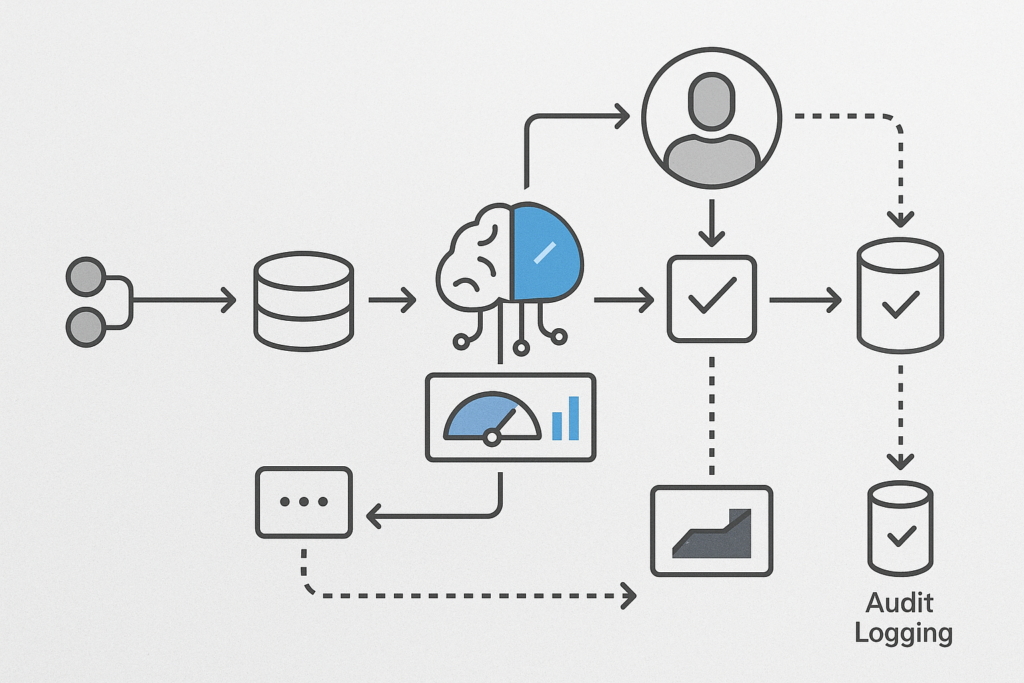
Thesis: The safest path to durable ROI is simple: treat AI as decision support by default and require evidence, controls, and reversibility before you let it decide.
If your roadmap says “automate decisions,” you’re asking the wrong first question. The right one is: which decisions deserve AI recommendations, and under what conditions (confidence, context, reversibility, and governance) should any of them be automated?
AI decision support means AI prepares options, drafts, and risk signals, while a human retains decision rights. That operating model creates value fast without handing irreversibility, liability, or brand risk to a probabilistic system. It also fits the technical reality: model uncertainty, retrieval drift, and tool-call side effects make full automation expensive to govern and harder to undo. Across regulations and guidance, from the NIST AI Risk Management Framework to the EU AI Act’s human oversight expectations to U.S. federal AI governance, human control, auditability, and measurable risk management are not optional; they are design constraints.
This article makes a practical argument: make “recommend, not decide” your default. Then graduate to supervised automation only when your workflow, evidence, and controls prove it’s safe and useful.
What “AI decision support” really means
Let’s define terms clearly so teams can act, not just agree in principle.
- AI decision support: The AI prepares a recommendation or draft with evidence and confidence signals. A human decides and is accountable for the outcome.
- Decision automation: The AI (or AI-driven workflow) acts without human approval by default, often with exceptions routed for review.
- Human-in-the-loop (HITL): A workflow that includes human review, correction, or approval. HITL is only meaningful if reviewers have context, time, and authority.
- Approval gate: A governed checkpoint where a human must approve before an action with material downside occurs.
- Irreversibility: The action’s blast radius if wrong. Payments sent, prices changed, customers declined, code merged, records deleted. The less reversible the action, the stronger the approval gate should be.
If your HITL step is a rubber stamp, you don’t have HITL. You have an illusion of oversight with the risks of automation.
Why this matters for the business
- Cost and speed: Decision support shortens cycle time immediately. Drafts and options reduce thinking and typing without exposing you to irreversible writes.
- Reliability and risk: When models misread context or retrieval degrades, supervised recommendations are cheap to correct. Fully automated writes are expensive to unwind.
- Governance and accountability: Regulators and risk teams care who saw what and why an action was taken. Recommendation-first workflows preserve that record.
- Customer experience: A good draft that a human approves can delight. A bad automated decision can create churn, complaints, and headlines.
- Capacity and change management: Decision support increases throughput without requiring organizational leaps to untested autonomy.
Technical reality: where production fails
Promising demos hide messy truths:
- Model uncertainty: Confidence is not accuracy. Without evidence traces and evaluation, “I’m 0.84 confident” can be meaningless.
- Retrieval and context risk: Out-of-date or mis-scoped context silently degrades outputs.
- Tool-call risk: Once an AI can update systems of record, your security model is only as strong as your guardrails and review paths.
- Observability gaps: If inputs, retrieval, tool calls, and outputs aren’t logged, you can’t evaluate, audit, or improve.
- Automation bias: Humans tend to over-trust automated advice unless the workflow actively counters it. That’s a design problem, not a training reminder.
That’s why decision support is the sane default. It delivers immediate value while your team builds the evaluation, review, and rollback capabilities that automation requires.
Common belief vs. production reality
| Common Belief | Production Reality | Better Question |
|---|---|---|
| “AI should automate decisions to pay off.” | Most early ROI comes from faster, higher-quality human decisions. | Which decisions get safer and faster with AI-generated drafts and evidence? |
| “A high model score means we can automate.” | Scores can drift; context and side effects matter. | What evidence shows stable quality under our data, tools, and edge cases? |
| “A reviewer step solves the risk.” | Reviewers rubber-stamp without time, evidence, or authority. | What does the reviewer see, decide, and escalate, and how is it logged? |
| “We’ll start full-auto and add review if needed.” | Reversing autonomy after harm is costly and political. | What must be proven before we remove the approval gate? |
The three operating modes you actually need
| Mode | What It Is | Typical Use | Risk Posture | Governance Must-Haves |
|---|---|---|---|---|
| Decision Support | AI drafts, classifies, or recommends. Human decides. | Customer replies, case categorization, sales notes, research summaries. | Low-to-moderate. | Evidence in view; confidence signals; retrieval sources; edit + accept/decline; input/output logs. |
| Supervised Automation (Recommend + Approve) | AI proposes an action. Human approves before write-back. | Refund routing, invoice match + pay, price adjustments under thresholds. | Moderate-to-high. | Approval gates; reversible writes; RBAC; eval sets; exception queues; audit trails. |
| Autonomous Decisioning (Exceptions-Only Review) | AI acts by default. Humans see exceptions or metrics. | Low-dollar, reversible changes with strong historical proof. | Narrow, well-bounded domains only. | Proven eval performance, drift monitoring, rollbacks, incident response, kill switch, strict least privilege. |
To graduate rightward, you need compelling evidence, not optimism.
A practical decision framework for “recommend vs decide”
Score each decision type across seven factors, then choose the operating mode accordingly.
1) Decision impact: Customer-facing? Financial? Safety? Reputational? 2) Reversibility: Can we undo the action quickly and cheaply? 3) Regulatory exposure: Does law or policy require meaningful human oversight? 4) Evidence quality: Do we have evaluation results on real data, edge cases, and failure modes? 5) Model confidence and calibration: Are signals reliable and aligned to task-level accuracy? 6) Observability: Can we inspect inputs, retrieval, tool calls, and outputs end to end? 7) Human capacity and authority: Do reviewers have time, context, and the right to say “no”?
A simple mapping:
- Any High in impact, Low in reversibility, or High regulatory exposure → Decision Support or Supervised Automation with strict gates.
- Medium across the board with strong evidence and rollbacks → Supervised Automation.
- Low impact, High reversibility, strong evidence with stable monitoring → Consider Autonomous, exceptions-only.
Designing human review that actually works
Human-in-the-loop only reduces risk when the loop is designed as a job, not as a speed bump.
- Present evidence, not vibes: Show retrieved sources, key fields, policy flags, and the proposed action in one view.
- Calibrate confidence: Use task-level, empirically calibrated thresholds that map to reviewer prompts (e.g., “Approve under $100 if confidence > 0.9, else escalate”).
- Time-boxed approval: Set SLA targets and auto-escalation paths when reviewers don’t decide.
- Authority and accountability: Name the decision owner in RACI terms. Approval without authority is theater.
- Exception routing: Route low-confidence, high-impact, or out-of-policy cases to senior review.
- Anti-automation-bias cues: Force a brief reason or quick checklist for approvals on high-impact actions. It slows rubber stamps and improves outcomes.
- Audit trail: Log what the reviewer saw, the decision, the rationale field, and the final action.
If you cannot describe the reviewer’s screen, you don’t have a real review step.
Examples: where AI should recommend, not decide (yet)
- Customer refunds and credits: Let the AI classify the issue, calculate a suggested amount under policy, and draft the reply. A human approves before money moves or an exception queue routes edge cases.
- Invoice matching and payment release: AI extracts fields and proposes a match to POs, flags discrepancies, and drafts the payment batch. Finance approves. Anything above thresholds or with mismatches escalates.
- Pricing adjustments: AI recommends discounts within predefined bands based on inventory, margin, and demand signals. Managers approve or adjust. Audit stores the rationale.
- Knowledge answers to customers or staff: AI drafts policy-grounded replies with citations. Agents or subject-matter experts approve before publishing.
- Access changes and sensitive system writes: AI proposes the change with reasoning and policy checks. Admins approve. Gates block full automation until audit confidence is earned.
In each case, the pattern is the same: draft, evidence, threshold, approve, log.
What must be measured before any autonomy
- Quality: Acceptance and correction rates by decision type; false-positive and false-negative rates for routing; calibration curves.
- Efficiency: Time-to-decision, review time by tier, exception queue aging.
- Risk: Rate of post-approval incidents; cost-to-correct; complaint or escalation rates; audit completeness.
- Drift and stability: Performance over time by segment, source, and policy change.
- Cost: Cost per successful outcome, including review time and cleanup when wrong.
- Coverage: Share of decisions still requiring human review, and why.
If your dashboards cannot show these, you are guessing.
Governance and standards: how this aligns
- NIST AI RMF emphasizes risk-based, measurable practices, including governance, mapping, measuring, and managing risks in context of the system’s purpose and impacts. Solid decision support aligns naturally: you can inspect, evaluate, and intervene at each step.
- EU AI Act’s human oversight requirement for high-risk systems expects effective, meaningful oversight designed into the system, not ambiguous afterthoughts. Keeping AI in recommend mode on high-impact steps is often the safest path while you prove oversight quality.
- U.S. federal OMB M-24-10 requires agency AI governance, inventories, and risk management for public-impacting uses. Again this favors auditable decision support patterns before autonomy.
- OWASP Top 10 for LLM Applications highlights prompt injection, data leakage, insecure tool use, and other risks that get worse when automated writes are allowed. Decision support confines the blast radius while you harden controls.
None of these frameworks say “never automate.” They say, in effect, earn autonomy with evidence and controls.
Typical failure modes and the fix
- Failure: Treating the model score as permission to act.
Fix: Calibrate scores to task-level accuracy, require evidence traces, gate high-impact actions.
- Failure: Rubber-stamp review.
Fix: Design review UI for evidence, authority, and short rationales. Measure the approval-to-incident relationship.
- Failure: Over-automating irreversible writes.
Fix: Start with drafts and supervised writes. Make rollbacks and kill switches first-class.
- Failure: Ignoring evaluation.
Fix: Build eval sets from real cases and edge cases. Monitor post-deploy drift. Tie automation thresholds to measured stability.
- Failure: No observability.
Fix: Log input, retrieval, tool calls, outputs, approvals, costs, and outcomes. Make them queryable.
- Failure: Assuming regulation is a paperwork exercise.
Fix: Translate policy into identity, permissions, approval gates, logging, and incident response. Treat governance as infrastructure.
A better mental model leaders can use
Think “ramp” not “switch.”
- Stage 1 – Recommend: AI drafts or recommends. Humans decide. You are buying speed and consistency with minimal downside.
- Stage 2 – Recommend + Approve: AI proposes an action. A qualified human approves. You reduce handling time for medium-risk work while preserving judgment.
- Stage 3 – Autonomy with Exceptions: AI acts on narrow, reversible tasks with proven stability. Humans review exceptions and metrics.
You move right only when evaluation, observability, reversibility, and governance give you proof. Not because the demo looked good.
What leaders should fund next
- Review design and approval gates for your top five decision types.
- Evaluation pipelines and calibration of confidence signals tied to real acceptance and correction data.
- Observability: end-to-end logging of inputs, retrieval events, tool calls, outputs, approvals, and outcomes.
- Risk tiering and decision rights (RACI) mapped to workflows, not just policies on slides.
- Incident response: rollback, pause, and investigation playbooks for AI-involved failures.
- Training for reviewers focused on evidence inspection and bias countermeasures, not just “be careful.”
The line worth defending
“Make AI recommend before it decides” isn’t anti-automation. It is pro-evidence. The fastest way to trustworthy automation is through great decision support, measurable oversight, and reversible steps. When your system can prove it works under your data, policies, drift, and failure modes, you will not have to argue for autonomy. The evidence will argue for you.
Key Takeaways
- Treat AI decision support as the default. Earn automation with evidence, controls, and reversibility.
- Human review only works when reviewers have context, time, and authority. Design the job, not a checkbox.
- Tie confidence thresholds to measured task accuracy and drift, not subjective vibes.
- Keep approval gates on high-impact or hard-to-reverse actions until stability is proven.
- Build evaluation sets from real cases and edge cases. Monitor post-deploy performance.
- Log everything that matters: inputs, retrieval, tool calls, outputs, approvals, outcomes.
- Align with NIST AI RMF, EU AI Act oversight, OMB M-24-10, and OWASP LLM guidance by making governance executable.
- Move from recommend to approve to automate only when metrics and controls justify it.
Practical Decision Framework
Use this quick rubric to choose an operating mode for each decision type.
| Factor | Low | Medium | High | Operating Mode Guidance |
|---|---|---|---|---|
| Decision impact | Minor, internal | Customer-facing but low stakes | Financial, safety, rights, brand | Any “High” → Decision Support or Supervised Automation with strict gates |
| Reversibility | Easy, cheap rollback | Some cost to undo | Hard or impossible to reverse | Low reversibility keeps approval gates in place |
| Regulatory exposure | None | Ambiguous | Explicit oversight or sector law | Favor recommendation or supervised approval |
| Evidence quality | Strong on real data | Partial | Weak or none | Weak evidence forbids autonomy |
| Confidence calibration | Well-calibrated | Partially calibrated | Uncalibrated | No calibrated signals → no autonomy |
| Observability | Full traceable logs | Partial logs | No reliable logs | No logs → recommendation-only |
| Human capacity and authority | Clear, staffed | Some gaps | Thin or symbolic | Thin capacity → defer automation |
Decision rule: choose the most conservative mode indicated by any High risk factor until the gap is closed.
FAQ
What is AI decision support?
AI decision support means AI drafts recommendations or actions with evidence, while a human retains decision rights and accountability. It accelerates work without exposing you to irreversible errors.
When should we allow AI to decide autonomously?
Only when actions are low-impact, highly reversible, and backed by strong, stable evaluation, calibrated confidence, comprehensive logging, and a proven incident response. Start narrow and expand by evidence.
How do we prevent “rubber-stamp” human review?
Design the review step: show sources and policy flags, require short rationales for high-impact approvals, and route low-confidence or out-of-policy cases to senior reviewers. Measure approval patterns against incidents.
What metrics tell us we’re ready to reduce human approval?
Sustained high acceptance with low correction rates, stable performance across segments, accurate calibration, minimal incident rates after approval, and short, safe rollback times.
How does this align with regulations and security standards?
It aligns well. NIST AI RMF encourages risk-based controls and monitoring. The EU AI Act requires meaningful human oversight for high-risk uses. U.S. OMB M-24-10 mandates agency governance and inventories. OWASP LLM guidance warns about risks that are amplified by unmanaged automation.
Do we need expensive tools to do this?
No. You need clear workflows, evaluation sets, logging, and authority. Tools can help, but governance is mostly design, ownership, and discipline.
Sources
- NIST AI Risk Management Framework (AI RMF 1.0): https://nvlpubs.nist.gov/nistpubs/ai/NIST.AI.100-1.pdf
- NIST AI RMF Overview: https://www.nist.gov/itl/ai-risk-management-framework
- EU Artificial Intelligence Act: Official Journal (EUR-Lex): https://eur-lex.europa.eu/eli/reg/2024/1689/oj/eng
- EU AI Act Explorer: Article 14 Human Oversight: https://ai-act-service-desk.ec.europa.eu/en/ai-act-explorer
- OMB Memorandum M-24-10 (March 28, 2024): https://www.whitehouse.gov/wp-content/uploads/2024/03/M-24-10-Advancing-Governance-Innovation-and-Risk-Management-for-Agency-Use-of-Artificial-Intelligence.pdf
- FTC, Joint Statement on AI (2023): https://www.ftc.gov/news-events/news/press-releases/2023/04/ftc-chair-khan-officials-doj-cfpb-eeoc-release-joint-statement-ai
- FTC Business Guidance on Generative AI Deception Risks (2023): https://www.ftc.gov/business-guidance/blog/2023/03/chatbots-deepfakes-voice-clones-ai-deception-sale
- OWASP Top 10 for Large Language Model Applications: https://owasp.org/www-project-top-10-for-large-language-model-applications/
- Automation Bias and Verification Complexity: Systematic Review (2020): https://pmc.ncbi.nlm.nih.gov/articles/PMC7651899/
- Automation-Induced Complacency Potential: Open Access Study (2018): https://pmc.ncbi.nlm.nih.gov/articles/PMC6389673/
Related articles from Kyle Beyke
- AI Governance Is Infrastructure, Not Paperwork: https://beykeworkflows.com/ai-governance-infrastructure-not-paperwork-business/
- Event-Driven AI Workflows: Reliable Guide: https://beykeworkflows.com/event-driven-ai-workflows-webhooks-queues-apis/
- The AI Pilot Trap: Why Strong Demos Still Fail: https://beykeworkflows.com/ai-pilot-trap-why-strong-demos-fail/
- AI Procurement Is Broken: Demand Real Evidence: https://beykeworkflows.com/ai-procurement-buy-evidence-not-demos/
- Model Context Protocol: The Critical Connector Shift: https://beykeworkflows.com/model-context-protocol-ai-connector-infrastructure/