
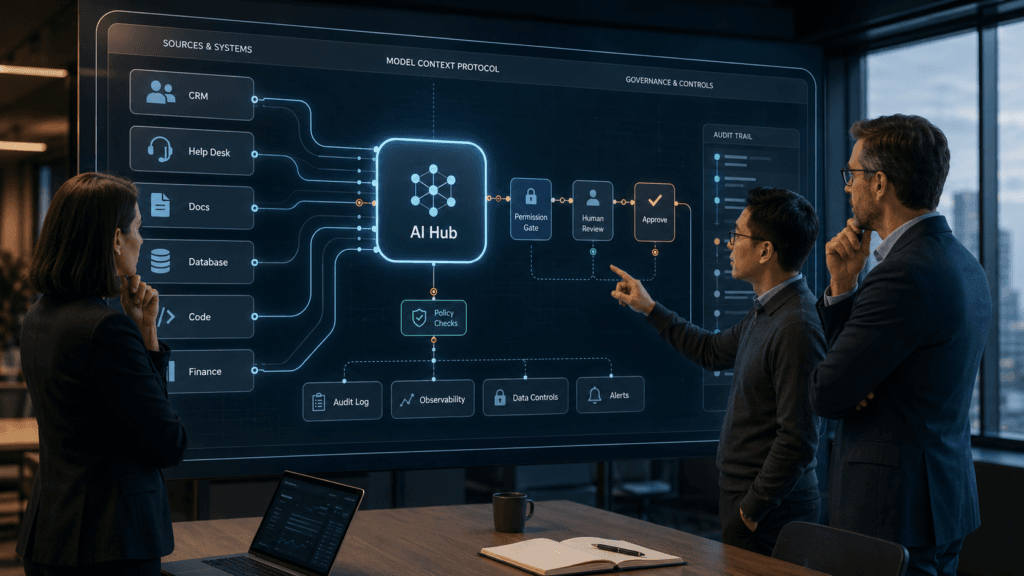
The next serious phase of business AI will be won less by companies with the flashiest model demos and more by companies that build secure, governed connector infrastructure around their data, tools, and workflows.
The demo was never the hard part.
A model that answers questions in a clean chat interface can look impressive in a conference room. It can summarize a document, draft an email, classify a ticket, or explain a policy in plain English. That is useful, but it is not the same thing as operational value. Real business work lives in systems: CRMs, help desks, code repositories, databases, document stores, calendars, finance tools, identity providers, approval queues, and internal APIs.
That is why the Model Context Protocol matters. MCP is not important because it gives the industry a new acronym. It matters because it points to a more serious phase of AI implementation: connecting models to the places where work actually happens.
The popular shorthand is that MCP is the “USB-C for AI.” That analogy is helpful, but it is also too small. For a developer, MCP can reduce connector chaos. For a business, the larger issue is infrastructure. Once AI systems can read from tools, call functions, retrieve records, and trigger actions, the connector layer becomes part of the company’s operating system. It affects access control, auditability, workflow design, vendor strategy, security, and accountability.
The mistake is treating that layer as plumbing. Plumbing is invisible until it fails. Connector infrastructure is visible in every downstream decision: what the AI can see, what it can do, who approves it, what gets logged, and what happens when it is wrong.
Why this matters now
The early phase of business AI was dominated by isolated interactions. A user pasted text into a chatbot. A team experimented with a document assistant. A department tested a writing tool. Those experiments helped people understand model capability, but they also hid the harder problem.
Most valuable workflows do not begin and end in a chat window. A support team needs account history, policy documents, ticket context, product status, and a place to record the outcome. A developer team needs access to repositories, issue trackers, documentation, test results, and CI signals. A finance operations team needs invoices, vendor records, purchase orders, exception rules, and audit trails.
MCP sits directly in that gap. The Model Context Protocol is an open protocol for connecting AI applications to external systems such as data sources, tools, prompts, files, APIs, and workflows through a standardized client-server pattern. The official specification describes hosts, clients, and servers: the AI application initiates connections, clients manage the connection inside the host, and servers expose context and capabilities.
That matters because AI value increasingly depends on external context and controlled action. A model that cannot reach current business data is limited. A model that can reach everything without boundaries is dangerous. The business problem is not access alone. It is governed access.
The mistake most teams make
Many AI strategies still start with the wrong question: “Which model or AI tool should we buy?”
That question is not irrelevant. Model quality, latency, cost, and provider fit matter. But model choice is not the whole system. The better question is: “Which workflows should AI participate in, what systems must it access, and what rules should govern that access?”
This is where MCP changes the conversation. The Model Context Protocol can make integration more standardized, but it does not decide whether a workflow is worth automating. It does not define your approval policy. It does not clean your data. It does not determine whether an agent should be allowed to write to a system of record. It does not prove that a connected workflow improves customer experience, cost, speed, or quality.
A successful demo can skip all of that. Production cannot.
| Common Belief | Production Reality | Better Question |
|---|---|---|
| MCP makes AI tool integration easy. | MCP can reduce connector friction, but production systems still need security, permissions, testing, and monitoring. | What can the AI access, and who approved that access? |
| Connecting AI to more tools makes it more useful. | More tool access can also increase failure modes, data exposure, and operational risk. | Which tools are necessary for this specific workflow? |
| A successful demo proves the workflow is ready. | Demos often skip edge cases, approvals, logging, exception handling, and cost controls. | What happens when the connector returns bad data, fails, or triggers the wrong action? |
The uncomfortable truth is that AI connectors are both business power and business risk. They are power because they let AI systems work with real context. They are risk because tool access can expose sensitive data, execute code, mutate records, or trigger actions that matter.
Model Context Protocol is connector infrastructure, not magic
The most useful way to think about MCP is simple: it standardizes a path between AI applications and external capabilities.
An MCP server can expose resources, prompts, and tools. Resources provide data and context. Prompts offer reusable workflows or templates. Tools let the model request operations, such as searching a database, creating a task, checking a calendar, querying documentation, or calling an internal API. The surrounding application still decides how those requests are authorized, executed, logged, reviewed, and returned to the model.
That last sentence is the part businesses cannot miss. Tool access does not mean business readiness.
OpenAI’s MCP and connector guidance, for example, treats approvals, allowed tools, prompt injection, trusted servers, and logging as practical safety concerns. Microsoft’s Windows MCP security architecture emphasizes user control, least privilege, auditing, registry trust, runtime isolation, and tool-level authorization. The MCP specification itself says the protocol enables powerful capabilities through data access and code execution paths and that implementers must address security and trust.
That is the right framing. MCP is useful because it creates a common interface. It is not sufficient because production systems need operational controls around that interface.
For technical readers, this distinction is obvious but often underfunded. A protocol can define how systems communicate. It cannot automatically provide enterprise authorization policy, secure credential handling, data minimization, sandboxing, domain-specific validation, business approvals, incident response, or meaningful success metrics.
For business leaders, the translation is blunt: funding MCP adoption without funding governance is not modernization. It is exposure.
Why AI connectors are becoming business infrastructure
Infrastructure is not just servers and networks. It is the repeatable foundation that other work depends on.
AI connectors are becoming infrastructure because the same patterns will repeat across departments. Support wants ticket and knowledge-base access. Sales wants CRM and calendar access. Finance wants invoice and vendor access. Engineering wants repository, documentation, and build-system access. Operations wants internal tools, reporting systems, and workflow queues.
If every team builds its own ad hoc connector logic, the company gets duplicated effort and inconsistent risk. One team may log tool calls. Another may not. One team may separate read and write permissions. Another may give broad access. One team may require approval for customer-facing messages. Another may allow automatic sends because the demo worked twice.
MCP-style standardization can reduce that fragmentation. The larger strategic opportunity is not merely faster integration. It is a more consistent operating model for AI-to-tool access.
| Audience | What They Often Assume | What They Need to Understand |
|---|---|---|
| Business leaders | MCP is a technical integration detail. | MCP-style connectors influence AI strategy, governance, workflow ownership, and operational risk. |
| Decision makers | Buying an AI platform solves the integration problem. | Tool access requires deliberate architecture, internal system readiness, and clear accountability. |
| Engineers and developers | MCP solves connector complexity by standardizing the interface. | Standardization helps, but scoped permissions, validation, observability, and security controls still need design. |
| AI enthusiasts | More connected agents automatically mean more capable AI. | Capability without control can create brittle, risky, or untrusted systems. |
The companies that benefit most will not be the ones that connect everything fastest. They will be the ones that decide what should be connected, at what permission level, for which workflow, with what measurement, and under whose ownership.
Three practical examples
Consider a customer support workflow. The team wants AI to summarize tickets, check account status, retrieve policy documents, draft a response, and update the help desk. MCP servers could expose the relevant systems through a more standardized interface. But the business still needs rules. The AI may be allowed to read ticket history and policies. It may draft a response. It may tag a ticket. But sending a customer-facing message about refunds, account termination, legal exposure, or safety issues may still require human review.
Now consider a developer workflow. An AI coding assistant connects to a repository, issue tracker, documentation system, and CI pipeline. The valuable question is not only whether the assistant can call tools. It is whether repository permissions are scoped, shell commands are constrained, generated changes are reviewed, secrets are protected, and risky operations are auditable. An MCP server that exposes too much local or production capability can become a serious attack surface.
Finally, consider finance operations. A team wants AI to read invoices, compare purchase orders, check vendor records, flag discrepancies, and route exceptions. The workflow could save time, but only if finance, IT, compliance, product, and engineering agree on evidence preservation, system access, approval requirements, exception routing, and audit completeness. The connector is only one piece. The operating model is the real product.
The failure modes are predictable
The first failure mode is over-connecting. Teams give an AI system access to more tools than the workflow requires because broad access feels impressive. That makes the system harder to reason about, test, monitor, and secure.
The second failure mode is confusing read access with write access. Reading a policy document is not the same as updating a customer record. Drafting a CRM note is not the same as committing it. Querying a deployment log is not the same as changing production infrastructure.
The third failure mode is ignoring prompt injection and tool poisoning. Once AI systems can consume untrusted content and call tools, malicious or misleading instructions hidden in documents, web pages, tickets, or tool metadata can matter. Research and platform guidance both point to this class of risk. The practical answer is not panic. It is layered control: trusted sources, scoped tools, approval gates, sandboxing, logging, and careful output handling.
The fourth failure mode is measuring the wrong thing. A demo measures whether the system can complete a happy-path task once. A business system must measure cycle time, exception rate, correction rate, approval latency, audit completeness, user adoption, cost per completed workflow, and error impact.
A better operating model
The better mental model is this: AI capability sits inside governed connector architecture.
The model is not the operating system. The connector layer is not the business strategy. The workflow is where value is created, and governance is what makes that workflow trustworthy enough to scale.
A serious MCP strategy should define five boundaries before broad deployment.
First, define the workflow boundary. What recurring business process is being improved? What input starts it? What output matters? Who owns the outcome?
Second, define the data boundary. Which data sources are required? Which are off-limits? What sensitive information should never enter model context or third-party systems?
Third, define the action boundary. Which actions are read-only, draft-only, write-capable, or prohibited? Which actions require human approval?
Fourth, define the trust boundary. Which MCP servers are official, reviewed, signed, sandboxed, or internally hosted? Which third-party services are allowed to receive context?
Fifth, define the measurement boundary. What would prove the connected workflow is working without increasing security incidents, review burden, operational confusion, or customer risk?
This is not bureaucracy. It is the difference between an AI pilot and an AI operating capability.
What leaders and builders should do next
Leaders should fund connector architecture, data readiness, access control, workflow redesign, evaluation, monitoring, security review, and human review capacity. Buying another AI interface may be easier to approve, but the value often depends on the less glamorous work underneath.
Product teams should start with workflows where the business outcome is measurable and the action risk is bounded. Read-only knowledge retrieval, internal summarization, draft generation with human review, ticket triage, document classification, and scoped developer assistance are better early candidates than unbounded autonomous action across sensitive systems.
Engineering teams should verify the basics before production use. Tool descriptions should be accurate. Permissions should follow least privilege. Read and write actions should be separated. Risky operations should require approval. Logs should capture tool calls and outcomes. Failures should degrade safely. Inputs and outputs should be validated. Secrets and credentials should be protected.
Decision makers should be especially cautious with writes to systems of record, customer-facing communications with legal or financial risk, refunds, approvals, account changes, production infrastructure, payments, regulated data, and any workflow where a wrong action is materially worse than slower manual handling.
| Decision Area | What to Ask | What to Measure |
|---|---|---|
| Workflow selection | Which recurring workflow needs external context or tool access? | Cycle time, completion rate, review rate, exception rate, user adoption. |
| Connector scope | Which systems should the AI read from or write to? | Number of approved tools, permission scope, denied actions, security events. |
| Governance | Which actions require human approval or audit trails? | Approval latency, correction rate, audit completeness, policy violations. |
| Reliability | What happens when tools fail, return stale data, or produce invalid outputs? | Retry rate, fallback rate, validation failures, manual correction rate. |
| Business value | Does the workflow improve an outcome that matters? | Cost per completed workflow, throughput, quality, customer impact, adoption. |
The connector layer is where AI becomes real
The Model Context Protocol deserves attention because it gives the AI ecosystem a shared way to connect models with tools and data. That is a meaningful step. It can reduce integration friction, encourage reuse, and help AI applications participate in real workflows instead of sitting outside them.
But MCP should not be treated as a shortcut around business design. A connector can expose a capability. It cannot decide whether using that capability is wise.
The next phase of business AI will not be defined only by better prompts, larger context windows, or stronger models. Those things matter, but they do not fix broken workflows, unclear ownership, weak permissions, or missing review paths.
The companies that win with AI will not simply connect models to tools. They will design the rules, workflows, and controls that decide when those tools should be used.
Key Takeaways
- MCP matters because it moves AI from isolated chat interactions toward connected business systems.
- AI connectors are becoming infrastructure because they shape access, workflow ownership, security, auditability, and operational control.
- Standardized connector architecture can reduce integration friction, but it does not make workflows automatically safe or valuable.
- The main business question is not “Can the AI call a tool?” It is “Should it call this tool, under these rules, for this workflow?”
- MCP servers should be evaluated through permission scope, trust, logging, failure handling, and human review requirements.
- Early pilots should favor bounded, measurable workflows before expanding into sensitive write actions.
- The companies that win with connected AI will combine model capability with workflow design, governance, and disciplined measurement.
Practical Decision Framework
Use MCP-style connector infrastructure only after the workflow is clear.
1. Define the workflow before the connector.
Start with the recurring business process, not the tool list. Identify the trigger, required context, desired output, downstream action, owner, and measurable business result.
2. Separate read, draft, and write permissions.
Reading a document, drafting a response, and updating a system of record are different risk categories. Treat them separately in architecture, approval flows, and audit logs.
3. Start with the smallest useful connector scope.
Expose only the tools and data needed for the specific workflow. Broad tool access may look impressive, but it increases cost, latency, testing burden, and security risk.
4. Require human review where the cost of error is high.
Customer-facing messages, financial actions, legal exposure, production changes, account modifications, and regulated data workflows should not be automated casually.
5. Make observability a launch requirement.
Track tool calls, approvals, failures, retries, data shared, outputs produced, downstream actions, latency, cost, and human correction rate.
6. Measure business value, not demo quality.
Look for improved cycle time, throughput, accuracy, review efficiency, user adoption, audit completeness, and lower operational friction without added security or quality problems.
7. Expand only after trust is earned.
Move from read-only access to draft generation, from drafts to supervised writes, and from supervised writes to limited automation only when evidence supports it.
FAQ
What is Model Context Protocol?
Model Context Protocol is an open standard that lets AI applications connect to external tools, data sources, and workflows through a standardized interface. In business terms, it is a connector layer that helps AI systems access context and request controlled actions beyond a chat prompt.
Why are AI connectors important for businesses?
AI connectors matter because most business value lives outside the model. Useful AI systems often need current records, policies, tickets, files, code, calendars, databases, and internal APIs. Without safe connectors, AI remains isolated. With poorly governed connectors, AI can create new operational and security risks.
Does MCP make AI agents safe for production?
No. MCP can standardize how AI applications connect to tools and data, but production safety still depends on authentication, authorization, least privilege, approval flows, validation, logging, sandboxing, monitoring, and incident response.
How does MCP relate to agentic AI workflows?
Agentic AI workflows often require models to retrieve context, call tools, and participate in multi-step processes. MCP provides a standardized way to expose those tools and resources. It is one part of the architecture, not the whole agent system.
What should leaders fund before scaling MCP-based AI systems?
Leaders should fund connector architecture, data readiness, access control, workflow redesign, evaluation, monitoring, security review, and human review capacity. The interface is only useful if the organization can govern what happens through it.
What should not be automated with MCP too early?
Avoid early automation of high-impact decisions, sensitive system writes, payments, credential handling, production infrastructure changes, regulated data workflows, and customer-facing actions where incorrect output could cause material harm.
Sources
- Model Context Protocol Documentation: https://modelcontextprotocol.io/
- Model Context Protocol Specification: https://modelcontextprotocol.io/specification/2025-11-25
- Anthropic, Introducing the Model Context Protocol: https://www.anthropic.com/news/model-context-protocol
- OpenAI, MCP and Connectors: https://developers.openai.com/api/docs/guides/tools-connectors-mcp
- Google Cloud, What is Model Context Protocol: https://cloud.google.com/discover/what-is-model-context-protocol
- Microsoft, Securing the Model Context Protocol: https://blogs.windows.com/windowsexperience/2025/05/19/securing-the-model-context-protocol-building-a-safer-agentic-future-on-windows/
- Microsoft Build 2025, The Age of AI Agents and Building the Open Agentic Web: https://blogs.microsoft.com/blog/2025/05/19/microsoft-build-2025-the-age-of-ai-agents-and-building-the-open-agentic-web/
- NIST AI Risk Management Framework: https://www.nist.gov/itl/ai-risk-management-framework
- OX Security, The Mother of All AI Supply Chains: https://www.ox.security/blog/the-mother-of-all-ai-supply-chains-critical-systemic-vulnerability-at-the-core-of-the-mcp/
Related articles from Kyle Beyke
- AI Workflow Anatomy: Essential Guide for Business: https://beykeworkflows.com/ai-workflow-anatomy-business-guide/
- How Modern Agentic AI Systems Are Built for Business: https://beykeworkflows.com/how-modern-agentic-ai-systems-are-built-for-business/
- LLM Integration: 7 Best Python Patterns: https://beykeworkflows.com/llm-integration-python-hugging-face-inference/
- Structured Outputs for AI Workflows: Reliable Guide: https://beykeworkflows.com/structured-outputs-for-ai-workflows-guide/
- Claude Code Leak: 7 Critical Lessons for Business: https://beykeworkflows.com/claude-code-leak-lessons-business-ai/