
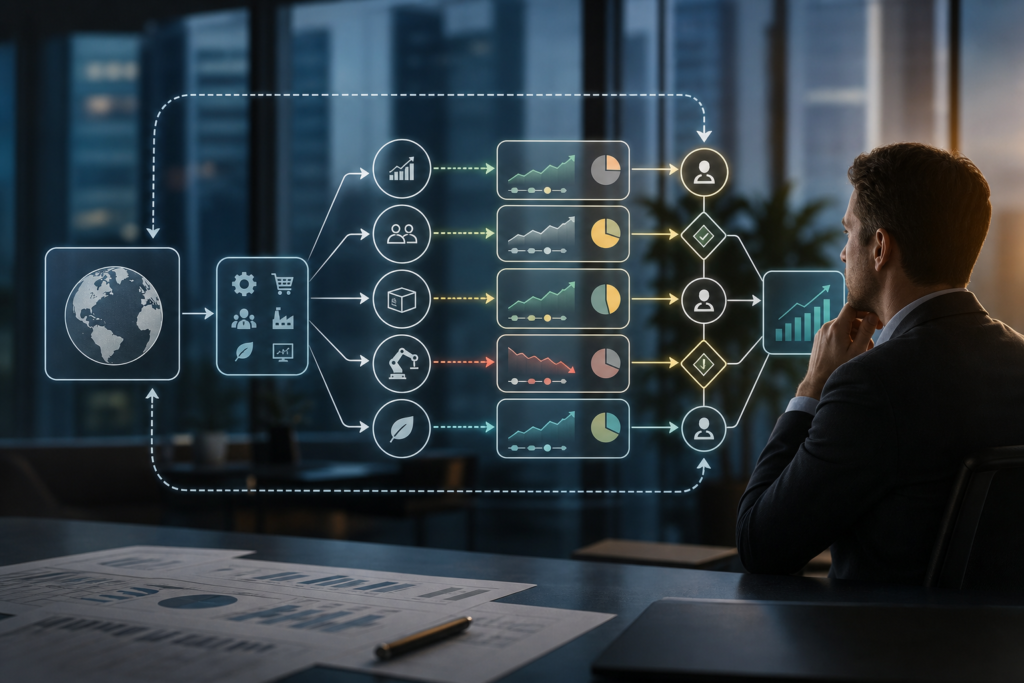
Thesis: The strategic value of AI world models is that they force businesses to ask whether their AI systems can represent changing state, predict consequences, and operate within real constraints instead of merely producing fluent responses.
The next serious AI strategy conversation is moving from words to state.
AI world models are AI systems that learn representations of an environment so they can predict how that environment may change over time in response to actions, inputs, or events. That sounds abstract until it is put beside the familiar language-model pattern. A conventional autoregressive language model is trained to predict the next token in a sequence. A world-model-style system is aimed at something closer to next-state prediction: what happens next in a scene, process, simulation, physical environment, workflow, or operating context.
That distinction matters because many high-value business problems do not end with a well-written answer. A warehouse robot has to understand where objects are and how movement changes the scene. A logistics planner has to reason about delays, capacity, weather, handoffs, and constraints. A field service workflow has to track job state, parts availability, technician location, customer priority, and safety rules. A customer operations process has to know what changed in the account, what action is allowed, and what consequence follows.
A fluent model can describe those situations. A useful state-aware system has to model them well enough to support decisions.
That is why AI world models deserve attention. They are not proof that large language models are obsolete. They are not a shortcut around workflow design. They are a signal that the AI market is slowly expanding from response generation toward simulation, planning, embodied intelligence, and governed action.
What Are AI World Models?
The term “world model” is used loosely, so business leaders should treat it with care.
In practical terms, AI world models learn internal representations of an environment and use those representations to predict how the environment may evolve. The “world” might be a physical scene, a game-like environment, a robot workspace, a driving scenario, a generated 3D space, or a business process with changing state.
The idea is not new. In reinforcement learning research, David Ha and Jürgen Schmidhuber’s 2018 NeurIPS paper showed how an agent could learn a compact representation of an environment and train a policy inside that learned internal model before transferring the policy back into the real environment. That research framing still matters because it separates the world model from the action policy. One part learns how the environment behaves. Another part decides what to do.
Modern usage is broader. Google DeepMind describes Genie 3 as a general-purpose world model that can generate photorealistic environments that can be explored in real time. Google’s Project Genie page defines a world model as a system that simulates environment dynamics, predicting how they evolve and how actions affect them. NVIDIA uses the phrase “world foundation models” for Cosmos, a platform focused on physical AI, predictive video worlds, robotics, autonomous systems, video data processing, evaluation, and post-training. World Labs describes Marble as a multimodal world model that can reconstruct, generate, and simulate 3D worlds from inputs such as text, images, video, and coarse 3D layouts.
Those are real technical and product directions. They are also early, bounded, and context-dependent.
A world model is not automatically a reliable model of your warehouse, your claims operation, your supply chain, your store network, your factory floor, or your customer lifecycle. It may simulate a kind of world. It may generate plausible state changes. It may help create synthetic data or evaluate embodied agents. That is different from proving that it understands the constraints that matter inside a specific business operation.
Next-Token Prediction Is Not the Enemy
The next-token versus next-state distinction is useful, but it can easily become a slogan.
OpenAI has described GPT-3 style models as trained to predict the next word on large datasets of internet text. That training objective helps explain why language models became strong at drafting, summarizing, classifying, coding, translating, and responding to natural-language instructions. It also helps explain why alignment, grounding, tool use, retrieval, and human feedback became necessary for many practical systems.
But it would be a mistake to dismiss next-token prediction as trivial. Large language models can learn useful representations of concepts, code, reasoning patterns, business language, and tool instructions. They remain useful for knowledge work, software development, retrieval interfaces, summarization, document processing, support drafting, CRM notes, and many forms of orchestration.
The limitation appears when the work depends on changing state.
A support assistant that drafts a response can succeed with language, retrieval, policy context, and human review. A support automation that changes refund status, updates an account, triggers shipment replacement, and alters customer eligibility needs stronger state controls. A model that writes a plausible answer is not enough. The system must know what the customer state is, what action is allowed, what changed, what evidence was used, and what downstream systems now believe.
The same pattern appears in physical AI. A video model may create a visually convincing clip. That does not prove it can serve as a validated simulator for robotics. Visual plausibility is not the same as operational fidelity. A robot training system has to care about geometry, contact, occlusion, force, timing, rare events, safety boundaries, sensor noise, and the difference between a nice-looking scene and an accurate state transition.
This is where AI world models become strategically interesting. They point toward systems that are evaluated by consequence prediction rather than output quality alone.
The Comparison Leaders Need
The words sound similar, but they describe different levels of system behavior.
| Concept | What It Predicts or Represents | Where It Helps | Common Mistake |
|---|---|---|---|
| Next-token prediction | The next token in a sequence | Writing, coding, summarization, classification, tool instructions, conversational interfaces | Assuming fluent output means grounded operational understanding |
| Next-state prediction | How a situation changes over time | Planning, simulation, robotics, operations, logistics, field work, dynamic workflows | Treating plausible predictions as validated forecasts |
| AI world models | Learned representations of environments and state transitions | Physical AI, interactive environments, embodied agents, synthetic data, scenario generation, simulation research | Buying the label without evidence in the target environment |
| Digital twins | Computer models of specific physical systems or assets | Manufacturing, maintenance, facilities, engineering, monitoring, optimization | Confusing a generated world with a validated model of a real asset |
| Traditional simulation | Explicitly designed models using rules, physics, constraints, or statistical assumptions | Engineering, operations research, scheduling, safety testing, process design | Assuming learned models always outperform explicit domain models |
NIST describes a digital twin as a computer model of a physical system, such as a machine or building, with potential for high accuracy, precision, and flexibility. NIST also emphasizes forecasting, monitoring, optimization, validation, and system integration. That is a different claim from “this model can generate a convincing 3D world.”
The distinction matters for procurement. A business should not ask whether a vendor “has a world model” as if the phrase settles the question. It should ask what state variables the system represents, what actions it can simulate, how predictions are validated, how uncertainty is handled, where the environment boundary sits, and which decisions the model is allowed to influence.
Why This Matters Now
The timing is not accidental.
AI labs and infrastructure vendors are pushing beyond chat interfaces into video, robotics, spatial intelligence, simulation, and physical AI. OpenAI’s Sora 2 page, which now notes that the Sora product is no longer available as of April 26, 2026, still frames video generation work as part of a broader effort toward more advanced world simulation capabilities. Google DeepMind’s Genie work has moved from generated playable environments toward Project Genie access for U.S. Google AI Ultra subscribers. NVIDIA Cosmos is positioned around world foundation models for physical AI. World Labs Marble is aimed at generative 3D world creation and editing.
Those developments do not mean every business needs to rush into world-model procurement. They mean the strategic vocabulary is changing.
For years, many companies treated AI as a better interface for text. Ask a question. Get an answer. Summarize a call. Draft an email. Extract a field. Classify a ticket. These workflows can be valuable, and many companies still have not implemented them well.
But physical operations, logistics, manufacturing, facilities, construction, robotics, autonomous systems, field service, and complex planning expose a different requirement. The system must reason about states, changes, actions, constraints, and consequences.
A company that understands this distinction will make better investment decisions. A company that misses it may either overbuy immature capabilities or keep forcing language-first tools onto state-dependent problems.
The Mistake Most Teams Make
The most common failure pattern is treating every AI problem as a prompt problem.
A team sees a model produce a strong answer and assumes the next step is automation. They add a connector, a workflow trigger, or an agent loop. The demo works on a clean example. Then production exposes the hidden state problem.
The model does not know that the customer’s account was updated three minutes ago. It does not know that a technician is reassigned unless the scheduling system says so. It does not know that a part is unavailable in one region but available in another. It does not know that a policy exception changed last week unless the retrieval system brings the right version. It does not know that an action has irreversible consequences unless the workflow enforces that boundary.
This is why AI procurement should be evidence based rather than demo based. Beyke Workflow Systems has covered that pattern in AI Procurement Is Broken: Demand Real Evidence and The AI Pilot Trap: Why Strong Demos Still Fail. The world-model version of the same mistake is harsher: a generated environment may look convincing while still failing on the state variables that matter.
A model can generate a warehouse scene without knowing your pick paths, scanner behavior, labor rules, replenishment logic, damaged-goods process, exception codes, or safety requirements. A model can generate a driving scenario without proving that it captures rare edge cases with the fidelity needed for validation. A model can simulate a customer journey without understanding the actual permissions, incentives, contracts, and system-of-record rules that shape that journey.
The business risk is not that the model looks bad. The risk is that it looks good enough to be trusted too early.
What Business Leaders Need to Understand
AI world models should change how leaders classify AI opportunities.
Some problems are language problems. Use language models, retrieval, review, and workflow integration.
Some problems are knowledge access problems. Use governed retrieval, permissions, citations, and source freshness.
Some problems are workflow automation problems. Use deterministic rules, APIs, queues, approvals, logs, and exception handling.
Some problems are planning problems. Use optimization, constraints, forecasting, scenario analysis, and human decision rights.
Some problems are simulation or state problems. This is where world-model thinking may matter.
That classification affects funding. If the work depends on changing state, leaders should fund instrumentation before autonomy. They should fund data pipelines before demos. They should fund evaluation sets before broad rollout. They should fund governance before irreversible action.
Three metrics become especially useful:
- Cost per successful outcome, not cost per generated output.
- Error rate or unsafe-action rate in state-dependent workflows.
- Human review burden and exception escalation rate.
A model that reduces drafting time but increases exception review may not improve the business. A simulation tool that creates impressive scenarios but fails to predict known operational edge cases should not be treated as decision-grade evidence. A robotics system that performs well in clean environments but fails under occlusion, clutter, latency, or rare events still needs containment.
For executives, the better question is: what business state must the AI system track, and what damage occurs if that state is wrong?
What Engineers and Developers Need to Build Around
For technical teams, AI world models should be evaluated through system properties, not through the label.
Start with state representation. What variables matter? In robotics, that may include pose, velocity, object identity, geometry, contact, camera position, and actuator limits. In operations, it may include inventory, order status, work queue state, capacity, SLA risk, permissions, ownership, customer tier, and policy version.
Then define the action space. What can change the state? A robot moves. A customer changes an address. A scheduler reassigns a worker. A system triggers a refund. A planner changes a route. A model that cannot represent the action space cannot reliably predict next state.
Next, define observability. Which parts of the environment are visible? Which are inferred? Which are missing? Real business environments are partially observed. Data is stale. APIs fail. People make undocumented decisions. Sensors drift. Records lag behind reality. If the model treats all state as clean and current, it will fail quietly.
Evaluation is the hardest part. Teams need representative scenarios, edge cases, counterfactuals, known failures, policy conflicts, uncertainty thresholds, and rollback paths. They need to compare predicted states against real outcomes. They need to know when the model is uncertain, when it is outside its environment boundary, and when a human must take over.
That work connects directly to governance. A state-aware AI system that can influence actions should fit inside the kind of operating controls discussed in AI Governance Is Infrastructure, Not Paperwork. If the system cannot be inspected, constrained, monitored, and stopped, it is not ready for serious operational use.
Common Belief vs. Production Reality
| Common Belief | Production Reality | Better Question |
|---|---|---|
| AI world models will replace LLMs. | Many future systems may combine language models, tools, memory, simulation, retrieval, and state prediction. | What kind of prediction does this workflow require? |
| A convincing generated video proves world understanding. | Visual plausibility is not the same as validated physical or operational accuracy. | How was the predicted state tested against real outcomes? |
| Next-token prediction is obsolete. | Language models remain useful for drafting, coding, retrieval interfaces, summarization, and orchestration. | Where does text generation fail because state changes matter? |
| Digital twins and world models are the same thing. | Digital twins usually model specific assets or systems with validation expectations. World models may be broader learned simulators. | Is this a validated model of our environment or a general generated environment? |
| More autonomy is the point. | Better state prediction can support human decisions, simulation, training, and review without full automation. | Which actions should remain governed or human approved? |
The Better Mental Model: State Before Autonomy
The most useful mental model is simple: state before autonomy.
Before asking whether AI should act, ask whether the system can represent the state that action depends on.
That sequence changes the implementation conversation. It prevents leaders from jumping from model capability to automation. It forces product and engineering teams to map the environment, identify state variables, define actions, test predictions, and contain failures.
A practical state-first workflow looks like this:
state_aware_ai_workflow(input):
 define_environment_boundary(input)
 identify_required_state_variables()
 observe_current_state_from_trusted_sources()
 predict_possible_next_states()
 compare_prediction_against constraints_and_policies()
 route_low_risk_actions_or_high_risk_review()
 log_state, action, evidence, outcome
 update_evaluation_set_with_real_results()
This is not a prescription for building a world model from scratch. Most companies should not do that. It is a way to decide whether world-model thinking is relevant at all.
If the workflow only needs a better draft, use a language model with review. If it needs current knowledge, use retrieval and source controls. If it needs deterministic action, use workflow automation. If it needs to predict how a dynamic environment responds to action, then world-model thinking belongs in the architecture discussion.
What Leaders and Builders Should Do Next
Leaders should avoid two opposite mistakes.
The first mistake is dismissing AI world models as hype because current systems are imperfect. The direction is real. Video, spatial AI, robotics, embodied agents, and simulation are becoming more important parts of the AI stack.
The second mistake is treating the phrase “world model” as proof of readiness. It is not.
Before funding a state-aware AI initiative, ask for evidence in six areas:
- Environment boundary: What world is being modeled, and what is outside scope?
- State variables: Which variables are represented, measured, inferred, or ignored?
- Action space: What actions can change the state, and which actions are prohibited?
- Validation: How are predictions compared with real outcomes or trusted simulations?
- Uncertainty: How does the system expose uncertainty, drift, missing data, or out-of-distribution scenarios?
- Governance: Who reviews, approves, pauses, overrides, and audits the system?
Product teams should pilot world-model thinking where state changes drive value. That may include warehouse exception planning, facilities maintenance simulation, route disruption response, manufacturing process monitoring, robotics training, spatial product design, safety scenario generation, or complex field operations.
Engineering teams should verify data readiness before model ambition. A business with weak instrumentation, stale records, unclear ownership, and unlogged exceptions is unlikely to benefit from advanced state prediction. The model cannot represent a world the organization itself has not measured.
Procurement teams should require vendors to show performance on representative scenarios, including failures. Polished examples are not enough. Ask for edge cases, evaluation methodology, environment limits, data requirements, human review design, cost assumptions, and integration proof.
The Next State Is the Strategy
AI world models are important because they make an uncomfortable point visible: many organizations are still buying AI as a response engine when their hardest problems are state problems.
The next phase of enterprise AI strategy will not be won by the team with the most impressive generated clip or the longest prompt. It will be won by teams that know which parts of their business must be represented, measured, simulated, governed, and improved.
Language remains valuable. Retrieval remains valuable. Automation remains valuable. Deterministic systems remain valuable. World-model thinking does not erase any of that. It adds a sharper test.
Can the system model what changes after an action?
If it cannot, keep it away from decisions where changing state is the work. If it can, prove it under real constraints before trusting it at scale.
The future of business AI will belong less to systems that answer beautifully and more to systems that understand consequences well enough to earn their place inside real operations.
Key Takeaways
- AI world models shift attention from fluent output to state representation, simulation, planning, and consequence prediction.
- Next-token prediction remains useful for many business workflows, especially language, coding, summarization, retrieval interfaces, and orchestration.
- Next-state prediction matters when value depends on how an environment, process, asset, or workflow changes over time.
- A generated video or 3D world is not the same as a validated operational model.
- Business leaders should classify AI initiatives by problem type before choosing tools or vendors.
- Engineers should evaluate world-model claims through state variables, action space, observability, validation, uncertainty, and failure containment.
- The safest path is state before autonomy: prove the system can represent and predict the relevant state before allowing it to act.
Practical Decision Framework
Use this framework before funding, buying, or scaling a world-model-style AI initiative. The goal is to decide whether the problem truly needs state prediction or whether a simpler pattern is enough.
| Decision Area | What to Ask | What to Fund or Verify |
|---|---|---|
| Problem type | Is this a language, knowledge, workflow, planning, simulation, or stateful action problem? | A clear use-case classification before vendor selection |
| State variables | What must the system know about the current environment or workflow state? | Instrumentation, data quality, state mapping, and source ownership |
| Action space | What actions can change the state, and which actions are irreversible or high risk? | Approval gates, action limits, rollback paths, and audit logs |
| Environment boundary | Where does the model work, and where should it refuse or escalate? | Scope definitions, out-of-distribution tests, and exception routing |
| Validation | How are predicted states compared with real outcomes or trusted simulations? | Evaluation sets, edge-case libraries, replay tests, and outcome tracking |
| Human review | Where should humans inspect, approve, override, or stop the system? | Review interfaces with evidence, authority, and escalation rules |
| Business metrics | What proves the system improves operations rather than creating hidden review work? | Cost per successful outcome, unsafe-action rate, correction rate, and exception burden |
A simple rule helps: if a wrong state prediction could trigger customer harm, financial loss, safety risk, compliance exposure, or operational disruption, do not treat the system as an autonomous actor until it has been validated inside the real workflow.
FAQ
What are AI world models?
AI world models are AI systems that learn representations of an environment so they can predict how that environment may change over time in response to actions, inputs, or events. The environment may be physical, simulated, visual, interactive, or operational.
How are AI world models different from large language models?
Many large language models are trained around next-token prediction and are strongest at language, code, reasoning over text, tool instructions, and knowledge workflows. AI world models focus more directly on state, dynamics, actions, and next-state prediction. Future systems may combine both.
Do AI world models replace next-token models?
No. Next-token models remain valuable in many workflows. The more practical view is architectural: some systems need language generation, some need retrieval, some need deterministic automation, and some need state prediction or simulation.
Are AI world models the same as digital twins?
No. A digital twin is usually a computer model of a specific physical system or asset, often with validation and monitoring expectations. A world model may be a broader learned simulator or generated environment. They can overlap, but the terms should not be treated as interchangeable.
Where should businesses care about AI world models first?
Businesses should pay attention where value depends on predicting consequences: robotics, manufacturing, logistics, field operations, facilities, autonomous systems, spatial products, safety testing, scenario planning, and complex operational workflows.
What is the biggest risk before investing in AI world models?
The biggest risk is mistaking plausible simulation for validated understanding. Leaders should require proof against representative scenarios, edge cases, known failures, real constraints, and business metrics before using state predictions for important decisions.
Sources
- Google DeepMind Genie 3: https://deepmind.google/models/genie/
- Google Project Genie: https://blog.google/innovation-and-ai/models-and-research/google-deepmind/project-genie/
- NVIDIA Cosmos: https://www.nvidia.com/en-us/ai/cosmos/
- OpenAI Sora 2: https://openai.com/index/sora-2/
- World Labs Marble: https://www.worldlabs.ai/blog/marble-world-model
- NeurIPS, Recurrent World Models Facilitate Policy Evolution: https://papers.nips.cc/paper_files/paper/2018/hash/2de5d16682c3c35007e4e92982f1a2ba-Abstract.html
- OpenAI, Aligning Language Models to Follow Instructions: https://openai.com/index/instruction-following/
- NIST Digital Twins: https://www.nist.gov/digital-twins
Related articles from Kyle Beyke
- AI Procurement Is Broken: Demand Real Evidence: https://beykeworkflows.com/ai-procurement-buy-evidence-not-demos/
- The AI Pilot Trap: Why Strong Demos Still Fail: https://beykeworkflows.com/ai-pilot-trap-why-strong-demos-fail/
- AI Governance Is Infrastructure, Not Paperwork: https://beykeworkflows.com/ai-governance-infrastructure-not-paperwork-business/
- AI Discovery Is Where Automation Succeeds or Fails: https://beykeworkflows.com/ai-discovery-business-automation/
- Model Context Protocol: The Critical Connector Shift: https://beykeworkflows.com/model-context-protocol-ai-connector-infrastructure/