
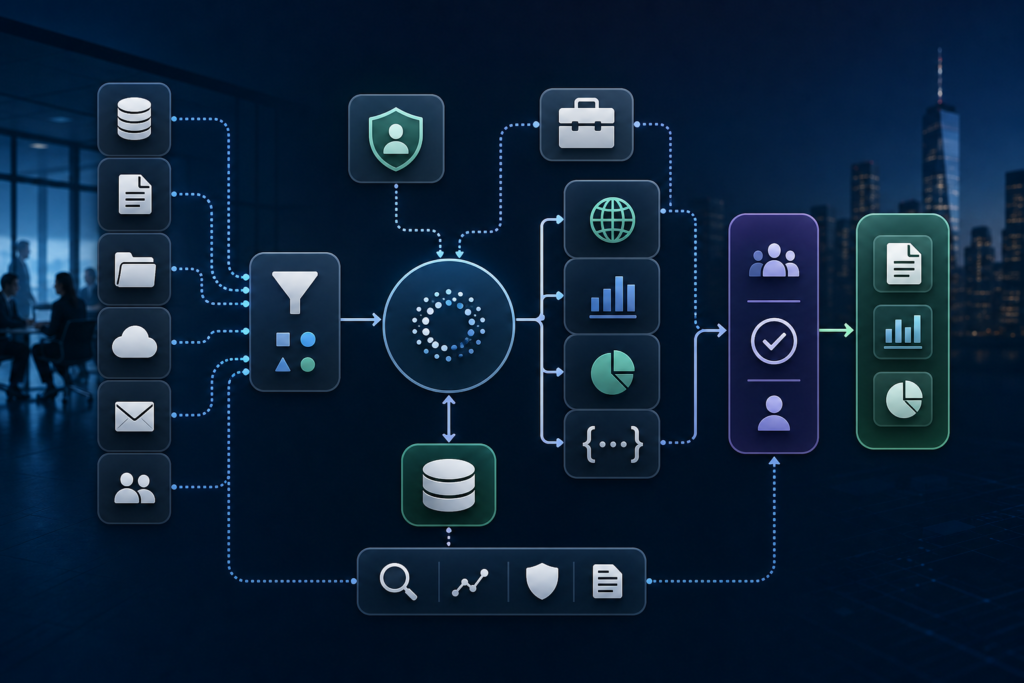
Context engineering is the unglamorous work that decides whether enterprise AI becomes a reliable operating capability or another impressive demo that cannot survive production.
The demo was never the context test.
A polished AI agent can summarize a policy, draft a customer email, query a database, or propose a CRM update in front of executives. That proves the model can perform under staged conditions. It does not prove the system knows which data it may use, which records are current, which permissions apply, which tool result should be trusted, which memory should persist, or how a reviewer can reconstruct the work later.
That is where context engineering for enterprise AI becomes the real work.
Context engineering for enterprise AI is the discipline of designing what an AI system is allowed to know, retrieve, remember, use, and act on inside a business workflow. It is broader than prompt writing. It includes the data environment, workflow state, tool access, memory strategy, role permissions, policy boundaries, provenance, evaluation, observability, and human review points around the model.
The uncomfortable truth is that many organizations do not have an AI capability problem. They have a context, ownership, and workflow-design problem.
What Context Engineering Means in Enterprise AI
Context is often described as the information placed in a model’s context window. That definition is useful, but too narrow for enterprise AI.
In a business system, context includes anything that shapes the AI system’s answer or action:
- The user’s role, department, customer, region, and authority level
- The current task state, such as draft, review, approved, rejected, escalated, or closed
- Retrieved documents, database records, tickets, emails, call transcripts, and knowledge-base articles
- Tool definitions, tool results, API responses, and workflow events
- System instructions, examples, output formats, and policy constraints
- Persistent memory, temporary scratchpads, summaries, and prior decisions
- Evidence trails, source identifiers, timestamps, approval records, and logs
Prompt engineering asks how to phrase instructions. Context engineering asks what the system should be allowed to see and use when the work matters.
That distinction matters because enterprise AI agents do not operate in a blank chat box. They operate in messy business environments full of partial records, stale policies, overlapping permissions, undocumented exceptions, and human judgment. A model can sound confident while using the wrong version of a policy. It can call the right tool with the wrong account identifier. It can remember a bad assumption from a prior session. It can retrieve a sensitive document the user should never have been allowed to access.
Those are not prompt problems in the ordinary sense. They are context architecture problems.
Prompt Engineering vs Context Engineering
Prompting still matters. Clear instructions, well-chosen examples, and structured outputs can improve behavior. The mistake is expecting prompts to carry production responsibility alone.
| Layer | What It Does | Why It Is Not Enough Alone |
|---|---|---|
| Prompt engineering | Writes instructions, examples, policies, and output formats for the model. | It cannot guarantee the right data, permissions, tool results, or workflow state. |
| Retrieval-Augmented Generation | Retrieves external knowledge for the model at runtime. | Retrieval can return stale, irrelevant, incomplete, or unauthorized context. |
| Model Context Protocol and connectors | Give AI applications a standardized way to connect with tools, data sources, and workflows. | Connectors expose capability. They do not decide business policy, least privilege, or task ownership. |
| Agent memory | Preserves information across steps or sessions. | Memory can preserve errors, sensitive data, poisoned instructions, or outdated assumptions. |
| Tool calling | Lets the model request data or actions through defined tools. | Tool access expands operational risk unless permissions, validation, and logging are designed. |
| Governance and permissions | Define what the system may access, change, retain, and escalate. | Policy on paper fails if the workflow does not enforce it at runtime. |
| Context engineering | Designs the information, permissions, memory, tools, state, evidence, and review environment around the AI system. | It still requires testing, measurement, incident response, and continuous improvement. |
Context engineering is not a replacement label for every AI architecture component. It is the operating discipline that decides how those components fit inside a real workflow.
Why This Matters Now
Enterprise AI is moving from isolated chat tools toward connected systems. Agents can retrieve records, call tools, follow multi-step loops, hand work to other agents, use memory, and produce outputs that affect customers, employees, systems of record, and business decisions.
OpenAI’s agent guidance describes agents as systems that use models, tools, instructions, orchestration, and guardrails. Anthropic’s context-engineering guidance frames context as a finite resource that must be curated across prompts, tools, examples, message history, retrieval, and memory. MCP documentation describes Model Context Protocol as an open-source standard for connecting AI applications to external systems such as data sources, tools, and workflows.
Those sources point in the same practical direction: enterprise AI reliability depends on the system around the model.
This is why a longer context window does not solve the enterprise problem by itself. More context can help when the right information is selected. It can also increase cost, latency, noise, confusion, and exposure risk. A model with access to thousands of pages can still miss the decisive clause, mix old and new policy language, or treat a low-quality document as authoritative.
The same is true for agents. More tool access can make an agent useful. It also increases the blast radius of failure. If an agent can read files, query databases, update tickets, send emails, and trigger refunds, the central question is no longer whether the model can produce a plausible response. The question is whether the workflow has boundaries strong enough for action.
That connects directly to related operating disciplines. AI observability gives teams evidence of what happened. AI agent guardrails shape what the system may do. Model Context Protocol infrastructure can standardize access patterns. Context engineering ties those concerns together around the working environment of the model.
The Mistake Most Teams Make
The common failure pattern is predictable.
A team starts with a promising demo. The model answers internal questions well, drafts clean responses, or uses a tool in a controlled test. Leadership sees speed. Product sees a feature. Engineering sees a path to automation. Everyone starts discussing model choice, agent frameworks, and launch timelines.
The context questions arrive late.
Which knowledge source is authoritative? How are permissions enforced at retrieval time? What happens when the CRM and support system disagree? Which tool calls are read-only, draft-only, or write-capable? Which memories expire? What evidence does the reviewer see? What gets logged? Who owns bad outcomes? How are retrieval failures, stale documents, and tool errors measured?
When those questions are postponed, production becomes the test environment.
A customer support AI might retrieve the wrong refund policy and draft a polished but invalid response. A sales assistant might enrich CRM fields using a partial account match. A finance workflow might summarize a vendor contract without seeing a recently approved amendment. An engineering agent might inspect code and propose changes while missing security rules stored in a separate repository.
The system did not fail because it lacked words. It failed because it lacked the right operating context.
That is the pattern behind many AI pilots that look strong in meetings and then stall. The AI pilot trap is rarely about whether AI can do something once. It is about whether the organization can repeat the work safely, inspectably, and economically across messy real cases.
The Technical Reality Behind the Business Decision
Business leaders do not need to become LLM infrastructure engineers. They do need to understand why technical context choices become business outcomes.
Retrieval is the first example. Retrieval-Augmented Generation became important because models have limits in accessing, updating, and proving knowledge. The original RAG research framed retrieval as a way to combine a model with external knowledge and improve knowledge-intensive generation. In the enterprise, retrieval is also a permissions and provenance problem.
A retrieval system must answer practical questions:
- Which sources are indexed?
- Which source wins when documents conflict?
- Is access filtered by user role and tenant?
- Are document versions tracked?
- Are retrieved chunks shown to reviewers?
- Can the system explain why a source was used?
- Are stale, duplicate, or low-quality documents removed?
Tool calling creates a second set of choices. OpenAI’s function calling documentation describes tool calling as a flow where a model can request a tool, the application executes code, and the result returns to the model. That sounds simple until the tool can touch real systems. A weather lookup is low risk. A refund, account update, vendor approval, code change, or customer message is different.
Once tools enter the workflow, context engineering must define authority. The agent may read a record, draft a change, request approval, or write directly. Those are different permissions. Treating them as one capability is how teams accidentally give AI systems more operational authority than intended.
Memory is the third issue. Persistent memory can improve continuity across long tasks. It can also preserve wrong assumptions, sensitive information, or malicious instructions. Temporary memory can help with multi-step work, but it may lose important nuance when compressed. Context compression can reduce cost and keep the model focused, yet it can remove uncertainty, provenance, or edge-case details.
A useful enterprise AI system needs a memory policy, not a memory feature.
Context poisoning is the fourth concern. If an AI system reads untrusted content, that content can contain instructions that try to manipulate behavior. OWASP’s LLM risk guidance includes prompt injection, sensitive information disclosure, excessive agency, vector and embedding weaknesses, and unbounded consumption among major LLM application risks. These are not abstract security categories. They map directly to context design.
If untrusted web pages, emails, documents, ticket comments, or tool outputs can influence an agent that has authority to act, the organization needs boundaries outside the prompt. Prompt injection risk becomes a business problem when context and authority collide.
What Business Leaders Need to Understand
Context engineering for enterprise AI is an operating investment.
It requires funding work that may not look impressive in a demo: data cleanup, source ownership, permission mapping, retrieval evaluation, tool design, logging, reviewer interfaces, incident response, and workflow measurement. Skipping that work creates hidden debt. The demo looks cheaper because production risk has been deferred.
Leaders should ask sharper questions before scaling:
- What business workflow is this AI system actually part of?
- What information must it know to do the job?
- Which sources are authoritative?
- Which information is excluded on purpose?
- What can the system read, draft, write, trigger, or never touch?
- What context is shown to human reviewers?
- What evidence is logged for audits and incidents?
- What metrics prove the workflow improved?
The metrics matter. Context engineering should connect to cycle time, throughput, error rate, correction rate, exception rate, approval latency, audit completeness, and cost per completed workflow. If the system reduces drafting time but increases correction work, the workflow may be worse. If it speeds triage but routes sensitive cases incorrectly, the risk has moved rather than disappeared.
Good AI governance also depends on context. NIST’s AI Risk Management Framework encourages organizations to govern, map, measure, and manage AI risk. For generative AI, NIST’s related profile emphasizes lifecycle risk management and organizational controls. Those ideas become practical only when the workflow produces evidence about what context was used, who approved an action, and what outcome followed.
Governance without runtime context is paperwork. Runtime context without governance is exposure.
What Engineers and Developers Need to Build Around
Technical teams should treat context as a designed control surface.
That starts with retrieval scope. Indexing every document is rarely the right first move. A bounded workflow usually needs a smaller, cleaner, permission-aware corpus tied to a specific job. For example, a support refund workflow may need active refund policies, account status, order history, entitlement rules, customer tier, and escalation rules. It probably does not need the entire company drive.
The second design area is tool shape. Tools should be specific enough that the model can choose them correctly. Bloated tool sets create ambiguity. Overlapping tools make behavior harder to test. Tool outputs should be structured where possible, with identifiers, timestamps, source names, confidence signals, and error states. A tool that returns a vague paragraph may be easy to demo and hard to govern.
The third area is state management. Workflow state should live outside the model. The application should know whether a case is new, awaiting evidence, ready for human review, approved, rejected, escalated, or closed. The model can help interpret and draft, but deterministic workflow state should not be trapped inside a conversation transcript.
The fourth area is evaluation. A context-engineered system needs tests for retrieval relevance, permission filtering, stale-source behavior, tool selection, tool arguments, output structure, review routing, and failure handling. AI evals should include realistic edge cases, conflicting records, missing data, unauthorized requests, adversarial content, and ambiguous user intent.
The fifth area is observability. Each workflow run should preserve enough evidence to reconstruct what happened: prompt version, retrieved source identifiers, model and tool calls, validation results, approval records, downstream actions, latency, cost, and outcome. That does not mean logging everything forever. It means deciding what evidence matters before the workflow touches systems of record.
The Better Operating Model: Context as a Control Layer
The better mental model is simple: context is the control layer between the model and the business.
A model without context is a language engine. A model with unmanaged context is a liability. A model with governed context can become part of a business system.
That control layer has several practical levels:
| Context Layer | Business Question | Production Risk If Ignored |
|---|---|---|
| Task context | What job is the AI doing, and where does the workflow start and stop? | The system drifts into work it was never designed to handle. |
| Data context | Which records, documents, and facts can it use? | The model relies on stale, incomplete, or unauthorized information. |
| Role context | Who is asking, and what are they allowed to see or approve? | Sensitive data leaks or actions occur outside authority. |
| Tool context | Which tools can it call, and under what conditions? | The agent acts beyond scope or calls the wrong tool with plausible confidence. |
| Memory context | What persists, what expires, and what is never stored? | Errors, sensitive data, or poisoned instructions shape future behavior. |
| Policy context | Which rules constrain the workflow? | Business exceptions, regulatory requirements, or customer commitments are missed. |
| Evidence context | What can be reconstructed later? | Incidents become guesswork and governance loses credibility. |
This model changes how teams decide what to fund. The most important investment may be a permission-aware retrieval layer, a better review screen, cleaner source ownership, or tool-call logging. It may not be a larger model or a more autonomous agent.
Context engineering for enterprise AI turns the conversation from capability theater to operating design.
How to Start Without Over-Engineering
The right starting point is a bounded workflow with real business value and tolerable risk.
Pick one workflow where AI can assist without being granted broad authority. Customer support triage, CRM note enrichment, internal knowledge search, procurement intake, policy drafting support, and engineering ticket summarization are better candidates than unrestricted cross-system automation.
Map the context before choosing the agent architecture:
- Define the business event that starts the workflow.
- List the minimum information needed to complete the task.
- Identify authoritative sources and source owners.
- Separate read, draft, recommend, approve, and write actions.
- Define permission checks for users, data, tools, and outputs.
- Decide what memory persists and what expires.
- Design the reviewer view around evidence, not final text alone.
- Instrument traces, outcomes, costs, corrections, and exceptions.
- Test against messy cases before expanding autonomy.
A simple rule helps: if a human reviewer cannot see the evidence needed to approve the work, the AI system is not ready for higher-risk automation.
Another rule is even more useful: give the AI the minimum useful context for the job, then measure what fails. Add context because evidence shows it is needed, not because a larger context window makes dumping information easier.
This avoids two bad extremes. One extreme starves the model of context and blames the model for weak results. The other floods the model with loosely governed information and calls it enterprise readiness. Neither is serious production design.
The Real Work Is Deciding What the AI Should Know
The next phase of enterprise AI will not be won by teams that treat agents as magic workers with access to everything. It will be won by teams that define the work precisely, expose context carefully, constrain authority deliberately, and preserve evidence when the system acts.
Context engineering for enterprise AI is not a buzzword to decorate an AI roadmap. It is a practical response to a production problem: models can produce fluent outputs without knowing which facts matter, which tools are safe, which memories are valid, which policies apply, or which actions require human judgment.
That is why context engineering deserves executive attention. It sits at the intersection of business ownership, product design, engineering architecture, security, governance, and operations. It is where AI strategy becomes workflow reality.
The companies that scale AI responsibly will not ask only what the model can do. They will ask what the system should know, what it should ignore, what it may change, and what evidence it must leave behind.
A clever prompt can win a demo. Governed context is what earns production trust.
Key Takeaways
- Context engineering for enterprise AI defines what an AI system may know, retrieve, remember, use, and act on inside a real workflow.
- Prompt engineering still matters, but prompts cannot carry data access, permissions, memory, tool safety, provenance, and auditability alone.
- Longer context windows do not solve context quality, relevance, cost, latency, or exposure risk.
- Enterprise AI agents become useful when they can retrieve data and call tools, but that usefulness expands the need for permission design and logging.
- Retrieval, MCP-style connectors, tool calling, memory, guardrails, evals, and observability are components of the broader context engineering discipline.
- Leaders should fund data readiness, access control, workflow ownership, evaluation, reviewer interfaces, and evidence trails before scaling agents.
- Technical teams should build around bounded workflows, permission-aware retrieval, structured tool outputs, external state, context versioning, and safe degradation.
- Production trust comes from governed context, measurable outcomes, and reconstructable evidence.
Practical Decision Framework
Use this framework when deciding whether an enterprise AI workflow has enough context discipline to move beyond demo stage.
| Decision Area | What to Verify | Production Readiness Signal |
|---|---|---|
| Workflow scope | The business event, user role, task boundary, and desired outcome are defined. | The team can explain where the workflow starts, stops, escalates, and records results. |
| Data access | Required sources are authoritative, current, and permission-filtered. | The AI retrieves only the information needed for the task and can show source provenance. |
| Tool authority | Tools are classified as read, draft, recommend, approve, or write. | High-impact actions require deterministic checks, human approval, or both. |
| Memory policy | Persistent and temporary memory rules are documented. | Sensitive data, stale assumptions, and task-specific notes have clear retention rules. |
| Context quality | Retrieval, compression, summaries, and tool outputs are tested against real edge cases. | The team measures relevance, missing context, stale context, and correction rates. |
| Human review | Reviewers see sources, tool results, policy flags, and proposed actions. | Approval records show what evidence was available when the decision was made. |
| Observability | Prompts, retrieved context, tool calls, approvals, costs, errors, and outcomes are traceable. | A failed workflow can be reconstructed end to end. |
| Governance ownership | Business, technical, security, and operations owners are named. | Incidents, corrections, policy updates, and expansion decisions have accountable owners. |
A practical threshold: do not increase autonomy until the workflow can prove three things under realistic conditions: the AI had the right context, it stayed within authority, and the organization can reconstruct what happened.
FAQ
What is context engineering in AI?
Context engineering is the practice of designing and managing the information available to an AI system when it generates an output or takes part in a workflow. In enterprise AI, that includes data access, retrieval, memory, tool results, permissions, workflow state, policy constraints, provenance, and review evidence.
How is context engineering different from prompt engineering?
Prompt engineering focuses on writing instructions, examples, and output formats. Context engineering is broader. It decides what information, tools, memory, permissions, and workflow state surround the model at runtime. Good prompts can improve behavior, but they do not replace governed data access or workflow control.
Is RAG the same as context engineering?
No. Retrieval-Augmented Generation is one component of context engineering. RAG helps bring external knowledge into the model’s working context. Context engineering also covers permissions, source quality, memory, tool access, state management, audit trails, evaluation, and human review.
Why does context engineering matter for enterprise AI agents?
Enterprise AI agents may retrieve records, call tools, use memory, and influence business actions. That makes context a risk and reliability issue. If the agent receives stale, unauthorized, incomplete, or poisoned context, it can produce plausible outputs or actions that are wrong, unsafe, or hard to audit.
What are the risks of poor context engineering?
Common risks include sensitive data exposure, stale or irrelevant retrieval, context overload, excessive tool authority, poisoned memory, untraceable decisions, weak human review, rising cost, and workflows that fail outside demo conditions.
How should companies start with context engineering?
Start with a bounded workflow. Define the task, required context, authoritative sources, permissions, tool actions, review points, memory rules, and evidence trail before expanding autonomy. Measure error rates, correction rates, exception rates, approval latency, cost per completed workflow, and audit completeness.
Sources
- Anthropic, Effective Context Engineering for AI Agents: https://www.anthropic.com/engineering/effective-context-engineering-for-ai-agents
- OpenAI, A Practical Guide to Building AI Agents: https://openai.com/business/guides-and-resources/a-practical-guide-to-building-ai-agents/
- OpenAI, Function Calling Documentation: https://developers.openai.com/api/docs/guides/function-calling
- Model Context Protocol, What Is MCP?: https://modelcontextprotocol.io/docs/getting-started/intro
- NIST, AI Risk Management Framework: https://www.nist.gov/itl/ai-risk-management-framework
- OWASP GenAI Security Project, OWASP Top 10 for LLM Applications 2025: https://genai.owasp.org/resource/owasp-top-10-for-llm-applications-2025/
- NeurIPS Proceedings, Retrieval-Augmented Generation for Knowledge-Intensive NLP Tasks: https://papers.nips.cc/paper/2020/hash/6b493230205f780e1bc26945df7481e5-Abstract.html
Related articles from Kyle Beyke
- AI Observability Is Automation’s Critical Control Layer: https://beykeworkflows.com/ai-observability-business-automation-control-layer/
- AI Agent Guardrails for Safe Workflow Permissions: https://beykeworkflows.com/ai-agent-guardrails-permissions-safe-business-workflows/
- Model Context Protocol: The Critical Connector Shift: https://beykeworkflows.com/model-context-protocol-ai-connector-infrastructure/
- RAG vs Fine-Tuning: 3 Reliable AI Choices for Business: https://beykeworkflows.com/rag-vs-fine-tuning-tool-use-for-business/
- The AI Pilot Trap: Why Strong Demos Still Fail: https://beykeworkflows.com/ai-pilot-trap-why-strong-demos-fail/
- Prompt Injection Business Risk, Not a Prompting Problem: https://beykeworkflows.com/prompt-injection-business-risk-not-prompting-problem/