
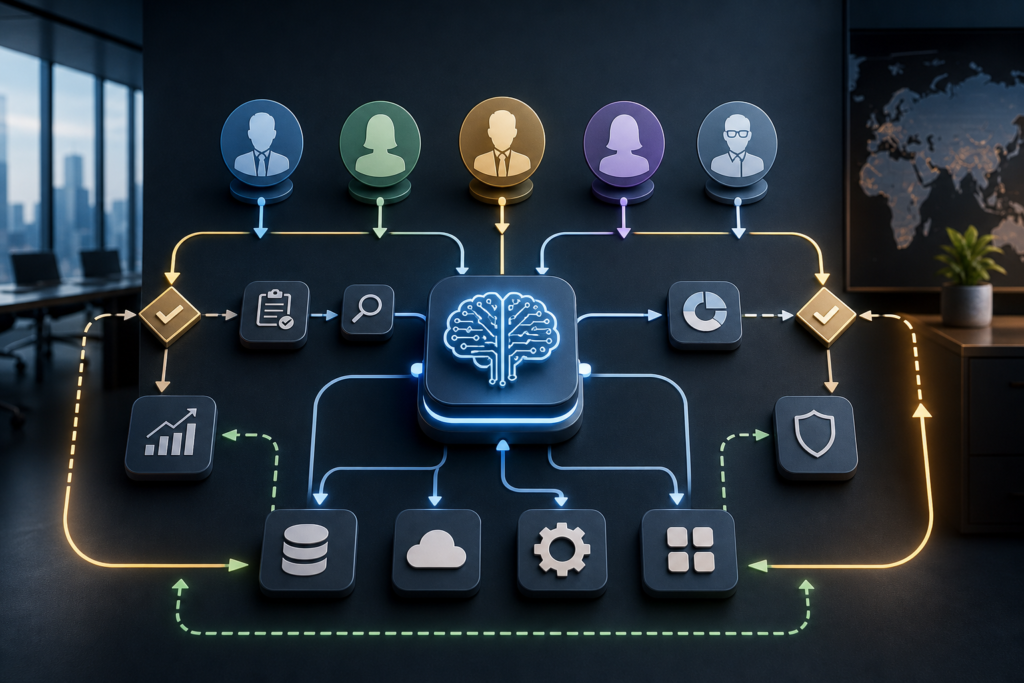
The real AI bottleneck is not whether the model can do the task once. It is whether the company can change the work so the task gets done better every day.
The Model Worked. The Company Did Not Change.
A familiar AI story now ends in a quiet stall.
The demo looked useful. The model summarized calls, drafted support replies, searched documents, extracted invoice fields, or wrote a first version of a technical brief. Leaders saw enough to fund a pilot. Employees saw enough to believe the tool might help. The vendor or internal team showed that the technology could perform the task under controlled conditions.
Then the old process stayed intact.
AI change management is the organizational discipline of redesigning workflows, roles, habits, incentives, governance, training, trust, and measurement so AI becomes part of daily operations instead of a side tool. Most AI initiatives do not stall because the model is incapable. They stall because the company has not changed the workflow, decision rights, review process, incentives, training, or metrics needed to capture value.
That distinction matters because enterprises are no longer asking whether generative AI can produce useful outputs. They are asking why useful outputs have not changed operating performance.
McKinsey's 2025 State of AI survey reported broad AI use, with 88 percent of respondents saying their organizations regularly use AI in at least one business function. The same report also found that most organizations were still in experimentation or pilot phases and that scaled enterprise impact remained uneven. Deloitte's State of Generative AI research made a similar point from a different angle: organizational change moves at business speed, not technology speed.
That is the uncomfortable gap. Model capability can improve every quarter. Operating change still has to move through people, systems, budgets, habits, approvals, managers, and consequences.
What AI Change Management Actually Means
AI change management is often reduced to communications and training. That is too small.
Yes, people need training. Yes, leaders need to explain why AI is being introduced. Yes, employees need permission to experiment safely. But those are support activities. They do not, by themselves, change how work moves.
A serious AI change management effort answers harder questions:
- Which workflow is changing?
- Which task moves from human-only work to AI-assisted work?
- Who reviews the output?
- What does the human remain accountable for?
- What system does the AI read from or write to?
- What evidence does the user need before trusting the output?
- Which metric will prove the work improved?
- What happens when the AI is wrong?
- What behavior will managers reward?
If those questions are unanswered, the organization does not have AI change management. It has a rollout plan.
This is why AI adoption strategy has to be tied to AI workflow redesign. A company cannot buy a tool, announce availability, and assume daily behavior will shift. People usually keep using the old process if the new one feels risky, unclear, slower, poorly integrated, or unrewarded.
A support agent may like an AI drafting tool but still ignore it if the draft appears in a separate window, lacks policy citations, and adds review burden. A sales rep may appreciate call summaries but reject CRM field suggestions if managers punish data errors more than they reward speed. A finance team may see value in invoice extraction but refuse to rely on it without exception routing, audit evidence, and vendor master validation.
The issue is not resistance in the abstract. It is workflow fit.
Why This Matters Now
The first phase of generative AI adoption rewarded curiosity. Companies ran demos, explored tools, funded pilots, and encouraged experimentation. That phase was useful. Nobody learns a new capability by waiting for perfect governance.
The second phase is less forgiving.
Budgets are under scrutiny. Leaders want to know which AI investments changed throughput, quality, cycle time, rework, cost per outcome, customer experience, or revenue. Employees are tired of tool sprawl. Engineering teams are tired of inheriting vague requests that sound simple because a demo looked clean. Risk teams are being asked to approve systems that touch customer data, confidential documents, workflows, and decisions.
BCG's 2025 AI at Work research reported that regular AI use had gone mainstream among surveyed workers, while the companies capturing stronger value were the ones redesigning workflows rather than stopping at tool deployment. The same research highlighted practical adoption gaps around frontline use, training, leadership guidance, and shadow AI.
That pattern should get executive attention. If employees use unauthorized AI because the approved path is slow, unclear, or unhelpful, the problem is bigger than IT control. It is a work-design problem. People route around systems that do not match reality.
Enterprise AI adoption now has a credibility problem. Many organizations have licenses, pilots, committees, and strategy decks. Fewer have changed the operating routines that convert AI capability into repeatable business value.
The Mistake Most Teams Make
The most common mistake is assuming better models will fix weak adoption.
Better models help. A model with stronger reasoning, better tool use, lower latency, larger context, or higher accuracy can make more workflows viable. Technical capability still matters. Weak retrieval, poor permissions, bad prompts, missing evaluations, and unreliable integrations can absolutely kill an AI initiative.
But many stalled AI initiatives are not waiting on a breakthrough model. They are waiting on a changed operating system.
| Common Belief | Production Reality | Better Question |
|---|---|---|
| If the model works, adoption will follow. | Users adopt workflows that fit their roles, trust needs, tools, and incentives. | What behavior must change for this to matter? |
| Training is the main change plan. | Training fails when the process, metrics, and review burden stay the same. | What part of the workflow has been redesigned? |
| A broad rollout proves progress. | Access without usage quality can create tool sprawl and shadow process. | Which roles are using AI in which workflow, and with what outcome? |
| Managers can measure productivity later. | Without baseline metrics, teams cannot prove cycle time, quality, or cost improvement. | What metric will change within one operating cycle? |
| Governance slows adoption. | Good governance can create trusted paths that employees are willing to use. | Where should review, logging, permissions, and escalation live in the workflow? |
| Stronger models reduce the need for human review. | Higher capability can increase scope, risk, and dependency unless controls mature too. | What should remain human-owned until evidence supports more automation? |
The faulty assumption is that AI value is mostly a model-selection issue. In production, AI value is a systems issue.
A model can draft a response. The business has to decide whether that response can be sent, edited, escalated, logged, measured, and improved. A model can summarize a meeting. The business has to decide which fields are reliable enough for CRM update suggestions and which remain human judgment. A model can classify a ticket. The business has to decide how misroutes are detected, corrected, and counted.
The task is technical. The adoption is operational.
The Technical Reality Behind the Business Decision
The phrase "the model works" is often too vague to guide investment.
A model may work in a prompt window. That does not mean the system works inside the business. Production AI depends on inputs, data access, identity, permissions, retrieval, user interface, structured outputs, validation, human review, downstream actions, logging, feedback, cost control, monitoring, and accountability.
Technical readers already know that a production system is more than a successful call to a model API. Business readers need the translation: AI output has to land inside a process where somebody knows what to do with it.
Consider customer support. An AI assistant can draft a plausible answer. To be trusted in production, the workflow may need approved knowledge retrieval, citation display, customer context, policy constraints, risk flags, escalation logic, human review, edit tracking, QA sampling, and feedback into the knowledge base.
Consider finance. An invoice extraction model can identify a vendor name and total amount. That does not mean the workflow can release payment. Finance may need document classification, purchase order matching, duplicate detection, confidence thresholds, exception routing, approval states, audit logs, and ERP write-back rules.
Consider internal knowledge search. A fluent answer may still be wrong if retrieval pulls stale, unauthorized, or incomplete material. The adoption issue becomes technical and organizational at the same time: source ownership, document freshness, permission inheritance, answer citations, refusal behavior, and user feedback all shape trust.
This is where AI change management crosses into engineering. It is not soft work around the system. It is part of the system's operating environment.
NIST's AI Risk Management Framework frames trustworthy AI across the design, development, use, and evaluation of AI systems. OECD AI Principles emphasize transparency, human oversight, robustness, lifecycle risk management, and accountability. Those ideas sound policy-oriented until a team has to decide where they live in software and operations. In practice, they become review queues, logs, permissions, escalation paths, user notices, evaluation sets, and rollback procedures.
If the organization cannot place those controls in the workflow, it will struggle to earn trust.
What Business Leaders Need to Understand
Business leaders should stop treating AI change management as a post-launch communications task.
If AI changes the work, leaders own the conditions that make the new work possible. That means funding more than licenses and proofs of concept. It means funding workflow discovery, process redesign, training by role, governance review, integration, evaluation, adoption telemetry, and operating support.
The leadership questions are concrete:
- Who owns the business outcome after launch?
- Who owns technical maintenance?
- Which existing workflow will be retired, changed, or reduced?
- What metric will improve?
- What review burden is acceptable?
- What risk requires human approval?
- What incentive tells employees the new behavior matters?
- What feedback loop improves the system after real use?
- What would cause the workflow to pause or roll back?
A broad AI transformation effort can fail because nobody owns the boring middle. A chief executive may sponsor AI. A CIO may approve tools. A data team may manage platforms. A vendor may provide capability. None of that guarantees a department manager will change the weekly operating cadence, update job expectations, measure new behavior, and hold people accountable for using the improved process.
Ownership has to reach the workflow level.
For a support AI workflow, the support leader owns handle time, quality, escalation, and agent behavior. For a sales AI workflow, the revenue leader owns follow-up discipline, CRM quality, and pipeline hygiene. For a finance AI workflow, finance owns approval standards, auditability, and exception management. Technology supports the workflow, but the business owns the outcome.
That is where many AI adoption strategies break. They assign sponsorship at the top and tooling at the bottom, with no accountable operator in the middle.
What Engineers and Developers Need to Build Around
Engineering teams should expect adoption to be a design requirement.
A technically correct system can still fail if users do not understand when to trust it, if feedback disappears into a backlog, if managers never review adoption metrics, or if the system adds steps without removing any. Developers cannot fix every organizational issue, but they can design systems that make better behavior easier to observe and sustain.
Useful production patterns include:
- Role-based access tied to the user's actual job.
- Clear review states such as draft, suggested, approved, rejected, escalated, and overridden.
- Evidence display where users need confidence, such as citations, source timestamps, policy references, or extracted document locations.
- Structured outputs that downstream systems can validate.
- Feedback capture that distinguishes model error, retrieval error, policy gap, user preference, and workflow mismatch.
- Adoption telemetry by role, workflow, team, task type, and outcome.
- Cost and latency tracking tied to accepted outputs rather than raw usage.
- Human review paths for high-impact, low-confidence, novel, or regulated cases.
- Rollback and pause mechanisms when model behavior, retrieval quality, or business rules change.
This is not overengineering. It is how trust becomes operational.
A good AI workflow does not ask users to choose between blind faith and total rejection. It gives them enough context to make a reasonable decision. It makes escalation obvious. It records what happened. It lets managers see whether AI is improving work or creating hidden rework.
Engineers also need protection from vague adoption demands. "Make employees use AI more" is not a technical requirement. "Reduce tier-one ticket response drafting time by 20 percent while keeping QA pass rates stable and requiring human approval for refund language" is closer to a buildable target.
The better the operating definition, the better the technical system.
The Better Mental Model: Capability, Adoption, Impact
A useful way to diagnose stalled AI work is to separate three layers: capability, adoption, and impact.
Capability asks whether the AI can perform the task under realistic conditions.
Adoption asks whether the people and systems use the capability as part of normal work.
Impact asks whether the changed work improves a business outcome.
Many teams measure capability and assume impact. That shortcut creates false confidence.
A model that drafts 100 good support replies in testing has capability. If agents do not use the drafts, adoption is weak. If agents use the drafts but QA corrections increase, impact is mixed. If agents use the drafts, QA remains stable, handle time drops, escalations improve, and customers get faster answers, impact is real.
The three layers have different evidence.
| Layer | Evidence Needed | Common Failure |
|---|---|---|
| Capability | Task accuracy, retrieval quality, latency, cost, edge-case performance, evaluation results | The demo uses clean examples and avoids production variance. |
| Adoption | Active usage by role, repeat usage, acceptance rates, edit rates, override reasons, user feedback | Users try the tool once and return to old channels. |
| Impact | Cycle time, throughput, rework, quality, customer experience, revenue, cost per completed outcome | Usage increases but business metrics do not move. |
AI change management lives mostly in the adoption layer, but it has to connect capability to impact. If the model is weak, adoption will not save it. If adoption is weak, capability will not matter. If impact is undefined, both teams and leaders will argue from anecdotes.
This mental model prevents the easiest mistake: celebrating AI activity as if it were operational value.
A Practical Example: Support Triage
A company wants to use AI for customer support triage and drafting.
The model can classify tickets, retrieve relevant policy content, propose priority, and draft a response. The pilot looks promising. The old process, however, routes every ticket into the same queue, agents use tribal knowledge, managers track volume more than quality, and policy updates live in scattered documents.
If the company rolls out the tool without changing the workflow, adoption will be uneven. Some agents will use drafts. Others will ignore them. Some will trust unsupported outputs. Others will over-edit everything. Managers will struggle to tell whether the system saved time or shifted work into QA.
A better AI change management plan would redesign the operating path:
- Define ticket categories where AI assistance is allowed.
- Require approved knowledge retrieval for drafted responses.
- Show source evidence in the agent interface.
- Route low-confidence or high-risk cases to senior review.
- Track acceptance, edit rate, escalation accuracy, QA score, handle time, and customer satisfaction.
- Train agents on when to trust, edit, reject, or escalate.
- Assign support operations ownership for weekly metric review.
- Feed repeated correction patterns into knowledge management and evaluation updates.
The model still matters. But the value comes from the redesigned support system.
A Practical Example: Sales Follow-Up
A sales team wants AI-generated call summaries and follow-up emails.
The model can summarize calls and draft next steps. The adoption problem appears when reps are expected to review drafts, update CRM fields, send emails, and still hit the same activity targets. If the AI tool adds work, reps may bypass it.
The change-management issue is incentive design.
If leadership wants better CRM quality, managers must reward clean data and faster follow-up, not only raw call volume. The workflow should place AI suggestions where reps already work. Field updates should be labeled as suggestions, not silent writes. Managers should track which fields are accepted, corrected, ignored, and later proven useful.
The business goal is not "use AI for sales." It is improved follow-up discipline, cleaner account context, shorter time from call to action, and better pipeline visibility.
That requires more than a model. It requires a changed management system.
What Leaders and Builders Should Do Next
A serious AI change management effort starts before scale.
Leaders and builders should use the next AI initiative as a test of operating maturity. Pick one meaningful workflow, not a vague department-wide rollout. Map the current process. Identify where AI changes a task, decision, handoff, review, or system write. Decide who owns the metric. Define the trust conditions. Instrument adoption. Then scale only after evidence supports the change.
A practical implementation checklist should include:
- Named business owner and technical owner.
- Current-state workflow map.
- Clear AI-assisted task definition.
- Role-level behavior change.
- Training tied to the actual workflow.
- Human review rules.
- Data access and permission boundaries.
- Evaluation plan before launch.
- Adoption metrics by role and workflow.
- Impact metrics tied to business outcomes.
- Feedback loop into product, engineering, operations, and governance.
- Incentives or manager routines that reinforce the new behavior.
- Rollout gates for pilot, controlled production, and scale.
- Pause, rollback, and incident response path.
This may sound slower than buying another tool. It is usually faster than funding six pilots that never become operating change.
The organizations that improve with AI will not be the ones with the most experimentation theater. They will be the ones that know how to absorb capability into work.
The Bottleneck Is the Work System
AI capability will keep improving. That does not remove the burden of organizational design. In many cases, it makes the burden more visible.
As models become more capable, leaders will see more impressive demonstrations and more tempting automation proposals. The temptation will be to assume the organization can absorb those capabilities at the same speed the technology produces them. It cannot.
Work has gravity. Roles, incentives, review habits, system permissions, audit requirements, customer expectations, and management routines all resist vague transformation language. They change when leaders and builders redesign them with enough specificity to survive Monday morning.
AI change management is the discipline that closes the gap between possible and operational. It asks whether the company can make the new behavior normal, trusted, measured, governed, and worth repeating.
The model may be ready. The harder question is whether the work is.
Key Takeaways
- AI change management is the operating discipline that turns AI capability into changed daily work.
- Most stalled AI initiatives fail at workflow redesign, ownership, incentives, trust, training, governance, or measurement.
- Better models matter, but model capability alone does not create enterprise AI adoption.
- Leaders should fund workflow redesign and adoption measurement alongside tools, pilots, and integrations.
- Engineers should treat adoption telemetry, review states, feedback loops, permissions, and observability as production requirements.
- AI value should be diagnosed across capability, adoption, and impact rather than assumed from demos.
- The strongest AI adoption strategy connects technical reliability to business-owned operating change.
Practical Decision Framework
Use this framework when an AI initiative looks promising but adoption or impact is unclear. The goal is to identify the real bottleneck before funding another tool, model upgrade, or broad rollout.
| Diagnostic Question | If the Answer Is Weak | Likely Bottleneck | Better Next Move |
|---|---|---|---|
| Can the AI perform the task on realistic data? | Outputs vary widely or fail on edge cases. | Technical capability | Improve evaluation, retrieval, prompts, data quality, or model fit before scaling. |
| Is the workflow actually redesigned? | People still use the old process around the AI tool. | Workflow design | Map the process, remove duplicate steps, define handoffs, and place AI inside existing systems. |
| Does someone own the business outcome? | IT, engineering, or a vendor owns a process they do not manage. | Ownership | Assign a business owner and technical owner before launch. |
| Do users know when to trust, verify, escalate, or override? | Users either over-trust or ignore the system. | Trust and training | Provide role-based training, evidence display, review rules, and escalation paths. |
| Are incentives aligned with the new behavior? | Managers reward the old process while asking for AI usage. | Incentive design | Update team metrics, manager routines, and performance expectations. |
| Can adoption and impact be measured? | Usage exists, but business improvement is unclear. | Measurement | Track adoption by role and workflow, then connect it to quality, cycle time, cost, or revenue. |
| Are governance controls built into the workflow? | Policy exists, but the system lacks permissions, logs, review, or rollback. | Governance execution | Convert policy into technical and operational controls. |
A useful rule: do not scale an AI workflow until you can name the changed behavior, the accountable owner, the trust mechanism, and the business metric.
FAQ
What is AI change management?
AI change management is the discipline of redesigning workflows, roles, training, incentives, governance, trust mechanisms, and measurement so AI tools become part of normal business operations instead of unused side applications.
Why do AI adoption projects fail?
AI adoption projects often fail because teams focus on access, demos, or model capability while leaving the work system unchanged. Common failure points include unclear ownership, weak workflow design, poor training, missing review paths, misaligned incentives, weak trust signals, and no measurable business outcome.
Who should own AI change management?
AI change management should be jointly owned by business and technical leaders. The business owner should own the workflow outcome, behavior change, and performance metric. Technical teams should own system reliability, integration, evaluation, permissions, observability, and maintainability. Governance, legal, security, HR, and operations may also need defined roles depending on risk.
How is AI change management different from AI governance?
AI governance defines rules, risk controls, accountability, and acceptable use. AI change management focuses on making the new way of working usable, trusted, measured, and adopted. They overlap when governance controls become part of the workflow through permissions, review queues, logging, escalation, and rollback.
How do you measure successful AI adoption?
Measure adoption by role, workflow, frequency, repeat usage, acceptance rate, correction rate, override reasons, and user feedback. Then connect those metrics to business outcomes such as cycle time, throughput, quality, rework, customer satisfaction, cost per completed outcome, revenue impact, or risk reduction.
Will better models reduce the need for AI change management?
Better models can reduce some technical friction, but they do not remove the need for workflow redesign, ownership, incentives, human review, training, governance, and measurement. In higher-impact workflows, stronger AI capability can increase the need for clearer operating controls because the system can influence more consequential work.
Sources
- McKinsey: The State of AI in 2025: https://www.mckinsey.com/capabilities/quantumblack/our-insights/the-state-of-ai/
- Deloitte: The State of Generative AI in the Enterprise: https://www.deloitte.com/us/en/about/press-room/state-of-generative-ai.html
- NIST: AI Risk Management Framework: https://www.nist.gov/itl/ai-risk-management-framework
- OECD: AI Principles: https://www.oecd.org/en/topics/ai-principles.html
- Boston Consulting Group: Companies Must Go Beyond AI Adoption to Realize Its Full Potential: https://www.bcg.com/press/26june2025-beyond-ai-adoption-full-potential
- Microsoft WorkLab: 2025 Work Trend Index Annual Report: https://www.microsoft.com/en-us/worklab/work-trend-index/2025-the-year-the-frontier-firm-is-born
Related articles from Kyle Beyke
- The Practical AI Operating Model for Mid-Market Companies: https://beykeworkflows.com/ai-operating-model-mid-market-companies/
- The AI Pilot Trap: Why Strong Demos Still Fail: https://beykeworkflows.com/ai-pilot-trap-why-strong-demos-fail/
- AI Governance Is Infrastructure, Not Paperwork: https://beykeworkflows.com/ai-governance-infrastructure-not-paperwork-business/
- AI Evals Are the Critical Layer Between Demo and Production: https://beykeworkflows.com/ai-evals-management-layer-demos-production/
- AI Observability Is Automation's Critical Control Layer: https://beykeworkflows.com/ai-observability-business-automation-control-layer/