
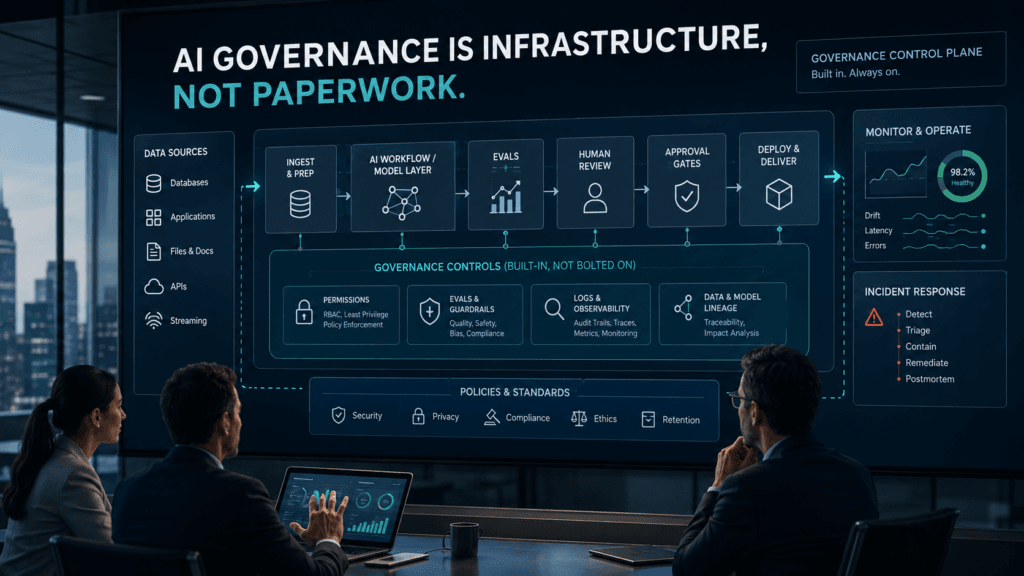
AI governance that does not touch the workflow, the data, the permissions, the logs, and the deployment process is not governance. It is paperwork.
A lot of companies are about to learn that distinction the expensive way.
They have acceptable-use policies. They have steering committees. They have vendor questionnaires. They have slide decks that say humans remain accountable. Some have even appointed an AI council and circulated approved-tool lists.
That is not worthless. Policies matter. Legal review matters. Procurement discipline matters. But none of those things, by themselves, can control what an AI system sees, what it does, what it stores, who approved it, how it fails, or whether anyone can reconstruct what happened later.
AI governance is moving out of the binder and into the stack.
That shift matters because AI is no longer just a side experiment where employees ask a chatbot for writing help. It is moving into customer support, contract review, invoice processing, software development, internal knowledge search, sales workflows, operations, analytics, product features, and decision support. In those environments, governance has to become executable. It has to show up as identity, permissions, approved data sources, evaluation pipelines, audit logs, human review gates, monitoring, change control, and incident response.
The hard truth is simple: if your governance program cannot change system behavior, it cannot govern production AI.
Your AI Policy Is Not Your AI Governance
The most common mistake is treating AI governance as a documentation project.
A policy can say employees should not paste sensitive customer data into unapproved tools. But the operating question is different: Which tools are actually approved? Can employees access unapproved ones from managed devices? Are sensitive documents classified? Are uploads logged? Are vendors reviewed? Are prompts and outputs retained? Who investigates exceptions? What happens when a policy violation is detected?
A policy can say a human must review AI-generated customer messages. But again, the workflow question is sharper: Does the reviewer see the source data, model output, confidence signals, policy flags, and escalation path? Or are they just clicking approve on a draft they do not have time to inspect?
A policy can say AI should not make high-impact decisions. But the system question is unavoidable: What counts as a high-impact decision? Which workflow steps are blocked from automation? Where is the approval gate? Can an AI-triggered action update a record, send a message, reject an application, change a price, or release a payment?
Paper governance describes intent. Infrastructure governance enforces behavior.
That is the difference between saying “humans stay in control” and being able to prove who reviewed what, what evidence they had, what the model saw, what the system changed, and how the organization responded when something went wrong.
Why AI Governance Is Becoming Infrastructure
AI governance is becoming infrastructure because AI systems are becoming operational systems.
A chatbot used for brainstorming has a limited blast radius. A support workflow that retrieves customer records, drafts replies, categorizes tickets, recommends refunds, and updates a helpdesk is different. An invoice review system that extracts payment details, matches purchase orders, flags exceptions, and routes approvals is different. A coding agent that can inspect files, suggest patches, run commands, or interact with development tools is different.
Once AI systems connect to data, tools, APIs, workflows, and customers, governance has to move closer to execution.
That does not mean every AI use case needs the same level of control. A low-risk internal writing assistant does not need the same governance burden as an AI system used in hiring, lending, healthcare, finance, cybersecurity, legal review, or customer-impacting automation. The operating model has to be risk-based.
But “risk-based” should not mean vague. It should mean the organization can answer practical questions:
Which AI systems exist? Which models and vendors do they use? What data can they access? What actions can they take? What logs are captured? What has been evaluated? What requires human approval? Who owns the workflow? Who can pause, roll back, or shut it down?
If those answers live only in a spreadsheet that no system depends on, governance is fragile. If those answers are reflected in access control, deployment gates, monitoring, routing rules, and audit trails, governance becomes operational.
Common Belief vs. Production Reality
| Common Belief | Production Reality | Better Question |
|---|---|---|
| AI governance means having a policy. | A policy is only useful if it changes how systems are built, deployed, monitored, and stopped. | Where is this policy enforced in the workflow? |
| Governance slows AI adoption. | Weak governance slows adoption later through risk, rework, failed pilots, and executive distrust. | What reusable controls would let safe projects move faster? |
| Legal or compliance owns AI governance. | AI governance spans legal, security, product, engineering, data, operations, procurement, and leadership. | Who owns each part of the AI lifecycle? |
| Human review solves the risk. | Human review only works when reviewers have context, authority, time, evidence, and escalation paths. | What does the reviewer actually see and control? |
| Model choice is the core AI strategy. | Model choice matters, but workflow design, data boundaries, evaluation, and monitoring often decide business outcomes. | What system are we building around the model? |
The Technical Reality Behind the Business Decision
For business leaders, AI governance often sounds like a risk or compliance topic. For engineers, it increasingly looks like architecture.
A governable AI workflow needs boundaries. Those boundaries are not philosophical. They are system design decisions.
Identity determines who can use the AI system. Access control determines what data, files, records, tools, and APIs the system can reach. Retrieval boundaries determine which knowledge sources can be used. Structured outputs make model responses easier to validate before they enter downstream systems. Evaluation pipelines test whether the system performs well enough on real examples, edge cases, and known failure modes. Logging and tracing make behavior inspectable. Human approval gates define where autonomy stops. Incident response defines what happens when the system behaves unexpectedly.
None of this is exotic. It is familiar software, security, and operations discipline applied to AI systems whose behavior can be probabilistic, context-sensitive, and difficult to fully predict.
The difference is that AI systems create new pressure on old controls. A traditional application usually follows code paths engineers wrote directly. An AI workflow may interpret language, retrieve context, call tools, draft outputs, classify exceptions, or recommend actions based on changing prompts, changing data, changing models, and changing user behavior.
That is why governance cannot be bolted on after the pilot. By then, the workflow may already have weak data boundaries, incomplete logs, unmeasured failure modes, unclear ownership, and no clean rollback path.
The best time to design AI governance is before the system becomes important.
What Business Leaders Need to Understand
AI governance is not a tax on innovation. Weak governance is.
Poor governance creates the kind of adoption drag leaders often blame on risk teams. Projects stall because nobody knows who owns approval. Pilots cannot scale because evaluation was never designed. Security raises objections because data flows are unclear. Legal slows procurement because vendor claims are vague. Operations refuses handoff because no one knows how to monitor failures. Executives lose trust because the team cannot explain whether the system is working.
Good governance should do the opposite. It should make safe adoption faster by turning repeated questions into reusable infrastructure.
Instead of debating every AI project from scratch, leaders should fund a common operating layer: use-case inventory, risk classification, approved vendors and models, data access patterns, evaluation templates, human review standards, logging requirements, and incident response playbooks.
That does not remove judgment. It focuses judgment where it belongs.
A low-risk internal summarization tool might need lightweight review, clear usage boundaries, and basic monitoring. A customer-facing support assistant needs stronger retrieval controls, human escalation, output review, logging, and performance measurement. An invoice automation workflow needs finance ownership, exception handling, approval gates, auditability, and controls that prevent premature payment release. A hiring or credit-related system requires much stricter governance and may not be appropriate for automation at all without specialized legal, compliance, and technical review.
The leadership question is not, “Do we allow AI?” That question is too blunt.
The better question is, “Under what conditions can this AI workflow act, and what evidence proves those conditions are being met?”
What Engineers and Developers Need to Build Around
Technical teams should not wait for governance to arrive as a late-stage compliance review. If AI is part of the workflow, governance is part of the architecture.
That means engineers need to design for inspection, restriction, evaluation, and recovery.
A customer support AI workflow, for example, should not be treated as a prompt connected to a helpdesk. It should have approved data sources, retrieval boundaries, structured draft formats, policy checks, human review for high-risk cases, escalation rules, input and output logs, evaluation sets built from real tickets, and monitoring for latency, cost, error rates, correction rates, and drift.
An invoice review workflow should not jump from extraction to payment. It should classify the document, extract fields, preserve evidence, match purchase orders, flag mismatches, route exceptions, and require approval before irreversible financial action. Governance is not a separate document. It is the workflow design.
A coding agent should not be evaluated only by whether it writes plausible code. It should be governed by repository permissions, environment separation, command restrictions, review requirements, test execution, dependency controls, secrets handling, logs, and rollback paths.
This is where the phrase “AI control plane” becomes useful.
The control plane is not the model. It is the surrounding layer that determines what AI can access, which actions are allowed, how outputs are checked, what gets logged, which approvals are required, how changes are versioned, and who can intervene.
Policies define intent. The control plane enforces behavior.
The AI Governance Control Plane
A practical AI governance control plane has several parts.
Inventory means knowing where AI is being used, by whom, in which workflow, with which model or vendor, and for what business outcome. Without inventory, the organization is governing rumors.
Risk tiering means classifying use cases by data sensitivity, decision impact, customer exposure, autonomy, reversibility, and regulatory context. Not all AI systems deserve the same burden, but high-impact workflows deserve real scrutiny.
Access control means defining what systems, records, files, tools, and APIs an AI workflow can reach. The more autonomy a system has, the more important least privilege becomes.
Data governance means tracking what data is sent to models, retrieved from internal systems, retained, logged, masked, reused, or restricted. Generic privacy claims are not enough. Scope matters.
Evaluation means testing the system against real workflow examples, edge cases, policy conflicts, and known failure modes before and after deployment. Demos are not evaluations.
Human review means placing approval gates where the downside is high and making sure reviewers have enough context and authority to act. A rubber-stamp approval step is not meaningful oversight.
Observability means logging the inputs, outputs, retrieval events, tool calls, user actions, cost, latency, exceptions, and failure modes appropriate to the workflow. If no one can inspect what happened, accountability is mostly symbolic.
Change control means versioning prompts, models, policies, tools, workflows, and deployment decisions. AI behavior can change when any of those pieces change.
Incident response means defining how to pause, roll back, investigate, notify, remediate, and learn from AI failures.
Ownership means assigning accountable owners for workflow outcomes, technical operations, risk decisions, data controls, and vendor management.
That is governance infrastructure. It is not glamorous, but it is what lets AI move from isolated experiments into durable business systems.
Business Decision Framework
| Decision Area | What to Ask | What to Measure |
|---|---|---|
| Use-case inventory | Where is AI being used, by whom, and for what outcome? | Percentage of AI use cases registered and risk-classified |
| Data access | What data can the system retrieve, store, expose, or reuse? | Sensitive-data access events, policy violations, access-review completion |
| Model and vendor control | Which models, vendors, and deployment paths are approved? | Approved-model usage rate, unapproved-tool detection, vendor-review completion |
| Evaluation | How is performance tested before and after deployment? | Eval pass rate, regression rate, exception rate, human correction rate |
| Observability | Can teams inspect inputs, outputs, tool use, cost, and failures? | Trace coverage, audit-log completeness, incident detection time |
| Human accountability | Who approves, escalates, rolls back, or shuts down the system? | Approval latency, escalation rate, rollback frequency, owner coverage |
The Failure Pattern to Avoid
The weakest AI governance programs usually follow the same path.
First, the organization writes a policy. Then it approves a few tools. Then business units start experimenting. Then usage spreads into real workflows. Then sensitive data appears in places nobody mapped. Then a customer-facing or internal decision workflow starts depending on AI output. Then risk, security, legal, and engineering discover they do not have clean logs, evals, ownership, or rollback plans.
At that point, governance becomes retrofit work.
Retrofit work is expensive because the team is no longer designing from a blank page. It is trying to add controls to a workflow people already use, with vendors already selected, integrations already built, data already flowing, and executives already expecting value.
That is where organizations get stuck. The AI pilot looked successful, but the system cannot scale because it is not governable.
The lesson is not to bury teams in process before they can test anything. The lesson is to separate experimentation from production.
Experimentation should be easy, but bounded. Production should require evidence.
Before scaling an AI workflow, teams should be able to show what data it uses, how it was tested, what failure modes are known, what humans review, what actions are blocked, what logs exist, who owns the workflow, and how the system can be paused or rolled back.
If that feels heavy, the workflow may be more important than the organization has admitted.
What to Do Next
Leaders should fund AI governance as shared infrastructure, not as a committee side project. The goal is not to create more meetings. The goal is to create repeatable patterns that product, engineering, security, legal, compliance, procurement, and operations can actually use.
Start with the AI workflows that have the most business impact or the highest risk: customer-facing systems, sensitive-data workflows, financial operations, legal or compliance processes, employee-impacting decisions, and systems that can trigger downstream actions.
Build a real inventory. Classify risk. Identify approved tools and vendors. Define data boundaries. Require evaluation before production. Make human review meaningful. Log what matters. Assign owners. Create pause and rollback procedures. Review changes when prompts, models, tools, data sources, or workflow logic change.
Product teams should pilot AI where the workflow is measurable and the error consequences are bounded. Engineering teams should verify permissions, schemas, logs, tests, deployment controls, and rollback paths. Security teams should focus on data exposure, tool access, prompt injection, excessive agency, and monitoring. Compliance and legal teams should translate obligations into operational requirements, not just documents. Executives should make explicit risk decisions instead of leaving them hidden inside tool choices.
The practical test is direct: can the organization explain and control what the AI system is allowed to do?
If not, the work is not finished.
Governance That Cannot Be Enforced Is Governance Theater
The next phase of business AI will not be won by the companies with the longest AI policy. It will be won by the companies that can turn policy into operating discipline.
That means governance has to become visible in the places where AI actually behaves: workflows, permissions, data access, evaluations, logs, monitoring, approvals, deployments, and incident response.
The point is not to make AI adoption timid. The point is to make it durable.
A company that cannot audit an AI workflow will eventually struggle to trust it. A company that cannot evaluate it will struggle to improve it. A company that cannot stop it will struggle to scale it responsibly.
AI governance is not paperwork anymore. It is the control layer that determines whether AI can become a reliable part of the business.
Key Takeaways
- AI governance is becoming an infrastructure problem because AI systems are moving into real workflows, tools, data, and decisions.
- Policies matter, but they are weak unless translated into permissions, logs, approvals, evaluations, monitoring, and ownership.
- Governance should be risk-based: low-risk internal tools do not need the same controls as high-impact or customer-facing systems.
- Human review only works when reviewers have context, authority, evidence, and a clear escalation path.
- The right mental model is an AI control plane: policies define intent, infrastructure enforces behavior, evaluation measures performance, and operations handles change.
- Weak governance often slows adoption later by creating rework, uncertainty, failed pilots, and executive distrust.
- Before scaling an AI workflow, teams should prove it can be audited, evaluated, monitored, paused, and owned.
Practical Decision Framework
Use The AI Governance Control Plane as the practical operating model.
- Inventory: Identify where AI is used, by whom, in which workflow, and with which model, vendor, or internal system.
- Risk tiering: Classify each use case by data sensitivity, customer exposure, decision impact, autonomy, reversibility, and regulatory context.
- Access control: Define what the AI system can access, retrieve, store, expose, update, or trigger.
- Data governance: Decide what data can be sent to models, what must be masked, what can be logged, and what must not be retained.
- Evaluation: Test against real examples, edge cases, failure modes, policy conflicts, and regression risks before production.
- Human review: Require approval where the downside is high, and give reviewers enough context to make a real decision.
- Observability: Log inputs, outputs, retrieval, tool calls, user actions, costs, latency, exceptions, and failure modes where appropriate.
- Change control: Version prompts, models, tools, policies, data sources, and deployment decisions.
- Incident response: Define how to pause, roll back, investigate, notify, remediate, and improve after failure.
- Ownership: Assign accountable owners for business outcomes, technical operations, data controls, risk decisions, and vendor management.
A workflow is not ready to scale until the organization can answer: what can this AI system do, how do we know it is working, who is accountable, and how do we stop it when needed?
FAQ
What is AI governance in a business context?
AI governance is the operating model for deciding where AI can be used, what it can access, what it can do, how it is evaluated, who is accountable, and how risks are controlled. In production, it should include both policies and enforceable system controls.
Why is AI governance becoming infrastructure?
AI governance is becoming infrastructure because AI systems increasingly interact with business data, tools, workflows, customers, and operational decisions. Documents alone cannot control those interactions. Organizations need permissions, logging, evaluation, monitoring, human review, and incident response built into the workflow.
What is the difference between governance paperwork and governance infrastructure?
Governance paperwork states expectations. Governance infrastructure changes behavior. A policy may say sensitive data should be protected; infrastructure defines which data sources an AI workflow can access, what gets logged, who can approve exceptions, and what happens when a violation occurs.
Does every AI use case need heavy governance?
No. Governance should be risk-based. A low-risk internal drafting assistant may need lightweight controls, while customer-facing, high-impact, sensitive-data, or autonomous workflows require stronger evaluation, access control, monitoring, documentation, and human accountability.
Who should own AI governance?
AI governance should have executive ownership, but it cannot belong to one function alone. Legal, compliance, security, product, engineering, data, procurement, operations, and business owners all have roles. The key is assigning clear responsibility across the AI lifecycle.
How can leaders tell whether AI governance is working?
Leaders should look for evidence: registered AI use cases, risk classifications, approved models and vendors, access controls, evaluation results, audit logs, human review metrics, incident response procedures, and named owners. If governance cannot produce operational evidence, it is probably too paper-based.
Sources
- NIST AI Risk Management Framework: https://www.nist.gov/itl/ai-risk-management-framework
- NIST AI Risk Management Framework 1.0: https://www.nist.gov/publications/artificial-intelligence-risk-management-framework-ai-rmf-10
- NIST Generative AI Profile: https://www.nist.gov/publications/artificial-intelligence-risk-management-framework-generative-artificial-intelligence
- ISO/IEC 42001:2023 AI Management System: https://www.iso.org/standard/42001
- European Commission AI Act: https://digital-strategy.ec.europa.eu/en/policies/regulatory-framework-ai
- OWASP Top 10 for Large Language Model Applications: https://owasp.org/www-project-top-10-for-large-language-model-applications/
- OpenAI Safety Best Practices: https://platform.openai.com/docs/guides/safety-best-practices
- Anthropic Tool Use with Claude: https://docs.anthropic.com/en/docs/agents-and-tools/tool-use/overview
Related articles from Kyle Beyke
- Claude Code Leak: 7 Critical Lessons for Business: https://beykeworkflows.com/claude-code-leak-lessons-business-ai/
- Amazon AI Incidents: 7 Hard Lessons for Business: https://beykeworkflows.com/amazon-ai-incidents-lessons-business/
- AI Cybersecurity: 7 Best Defense Moves: https://beykeworkflows.com/ai-cybersecurity-7-best-defense-moves/
- AI Workflow Anatomy: Essential Guide for Business: https://beykeworkflows.com/ai-workflow-anatomy-business-guide/
- AI Use Cases: 7 Smart Rules for Business: https://beykeworkflows.com/ai-use-cases-rules-business/
- AI Model Selection: Powerful Guide for Smart Business AI: https://beykeworkflows.com/ai-model-selection-business-ai-guide/
- Structured Outputs for AI Workflows: Reliable Guide: https://beykeworkflows.com/structured-outputs-for-ai-workflows-guide/
- Production Prompting: Essential Business AI Guide: https://beykeworkflows.com/production-prompting-business-ai-guide/