
Lesson
Deterministic AI Workflows vs AI Agents: A Practical Decision Guide
Learning Objectives
- Distinguish deterministic AI workflows, AI agents, and hybrid patterns in plain English.
- Apply a decision framework to choose the right autonomy level for a use case.
- Design a hybrid architecture with bounded agentic steps and human approvals.
- Implement structured outputs, tool/function calling, and state machines for reliability.
- Plan evaluation, observability, and governance before any write-back to business systems.
Prerequisites
Helpful: basic familiarity with LLMs, prompts, API calls, retrieval (RAG), and how business systems (CRM/helpdesk/ERP) integrate via webhooks or APIs. No advanced ML math required.
Main Lesson Body
Why this decision matters
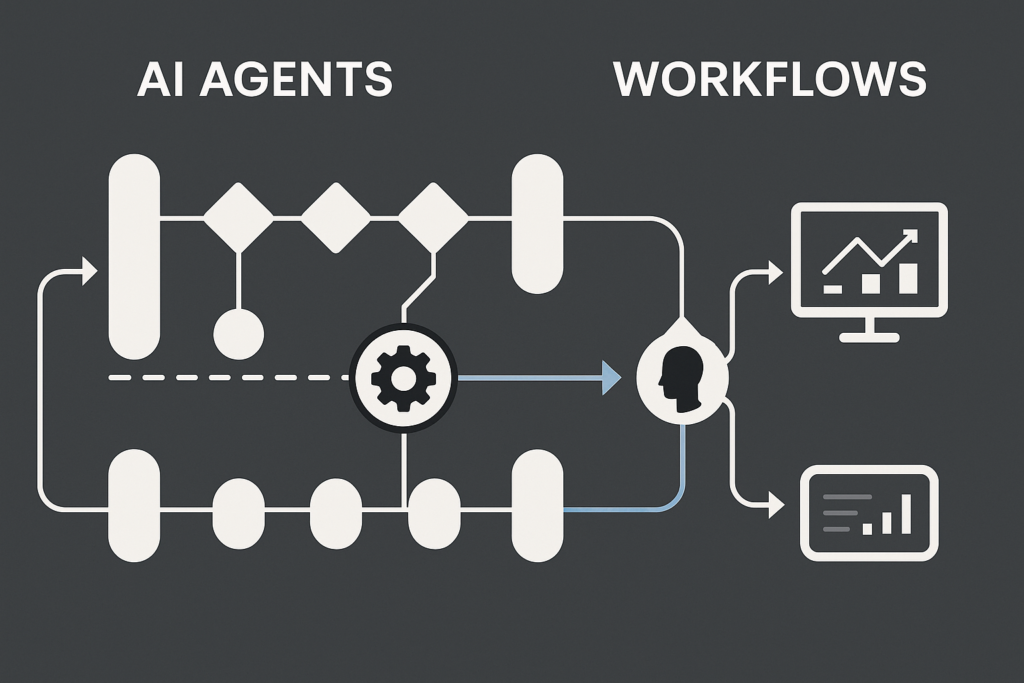
AI agents vs workflows is not a branding question. It is an operating model decision. Deterministic AI workflows give you predictability, auditability, and tight governance. AI agents promise flexible autonomy where inputs are messy and next steps are not obvious. Most production systems that work well use a hybrid: a deterministic backbone with bounded agentic steps and human approval where the downside is high.
Within the first 150 words, here is the core answer: deterministic AI workflows are orchestrated, rule-bound sequences (often state machines or BPMN-modeled processes) that may call models but follow predefined paths; AI agents are goal-directed systems that plan next actions, select tools, and act under permissions. Choose deterministic when reliability, cost predictability, and auditability are paramount; consider agentic steps where open-ended reasoning or multi-step planning materially improves outcomes; deploy a hybrid when you want both control and adaptability.
Direct definitions (anchor your vocabulary)
- Deterministic AI workflow: A predefined, inspectable sequence of steps that may include LLM calls but enforces structure through code, schemas, and rules (for example, “receive event → collect context → classify → draft → validate → human review → write-back → log”). Think state machines or BPMN-modeled processes with clear transitions.
- AI agent: A goal-directed system that can interpret context, choose actions, use tools/functions, maintain state, and act under permissions (often in a perceive-reason-act loop). The next step is not hard-coded; the system decides what to do within boundaries.
- Hybrid pattern: A deterministic backbone with one or more bounded agentic steps (for planning, exception handling, research, or multi-tool orchestration) and explicit review gates before any irreversible action.
Activate prior knowledge with a mental model
Use a traffic system analogy:
- Deterministic workflow = fixed signals and lanes. You always know what green and red mean. Great for throughput and safety.
- AI agent = a skilled traffic officer who can flex when signals fail, direct around hazards, and make judgment calls within rules.
- Hybrid = signals by default. An officer shows up only when conditions are unusual.
Carry that forward: fixed signals give scale and auditability. A human (or agent) handles rare, ambiguous situations.
What business leaders need to weigh
- Reliability and SLAs: Deterministic paths simplify meeting SLAs because variance is bounded. Agentic loops can add tail latency if planning or tool calls branch unpredictably.
- Governance and risk: The more a system can act, the stronger your permissions, reviews, logging, and rollback must be.
- Cost: Deterministic flows constrain model tokens and tool calls. Agentic loops can explode tokens if poorly scoped.
- Change control: Deterministic workflows change via code or config. Agent behavior changes with prompts, tools, and data. You must version and test them like code.
- Customer impact: Draft-only assistance is safer. Autonomous customer-facing actions need strong evidence and monitoring.
- Ownership: Treat the workflow as a product with clear accountable owners across business, engineering, and risk.
Where these fit in an AI system
- Deterministic workflows excel at:
- Classification, extraction, routing, drafting-for-review, and structured updates to systems.
- Regulated contexts where auditability, approvals, and reversibility are mandatory.
- High-volume, narrow tasks with stable schemas.
- Agentic steps help when:
- The next action is unclear and depends on dynamic context.
- You need multi-step planning across tools or systems.
- Exceptions and ambiguous inputs dominate the value case.
- Hybrid shines when:
- Most of the pipeline is predictable, but specific steps benefit from flexible reasoning (for example, exception handling or troubleshooting).
- You need to scale safely. Autonomy only where it pays for its added controls.
Comparison table: deterministic vs agent vs hybrid
| Dimension | Deterministic Workflow | Agent | Hybrid |
|---|---|---|---|
| Reliability/SLAs | High predictability; bounded variance | Variable; depends on planning/tool path | High for most paths; variable in bounded steps |
| Governance | Straightforward approvals and audits | Heavier: permissions, guardrails, evaluation | Governance focused on agentic steps and write-backs |
| Latency | Consistent; easy to budget | Can spike with multi-step loops | Mostly consistent; spikes isolated |
| Cost predictability | Strong; schema-limited tokens | Can drift; careful scoping needed | Strong overall; controlled agent budgets |
| Observability | Clear traces via orchestrator logs | Requires detailed tool-call and state tracing | Orchestrator plus agent tracing in one view |
| Change management | Code/config releases | Prompts, tools, models, and data impact behavior | Both: code releases + agent versioning |
| Best use | Stable, high-volume tasks | Ambiguous, multi-step reasoning | Mixed workloads needing control and adaptability |
Implementation realities that change business outcomes
- Structured outputs and schemas: Constrain model outputs to JSON schemas for routing and validation. This keeps downstream systems safe and debuggable.
- Tool/function calling: Treat tools as products: clear inputs and outputs, permission scopes, and error handling. Log every call and result.
- Orchestration: Use a workflow engine or state machine (or BPMN-modeled process) for the backbone. Add agent nodes only where appropriate.
- Human-in-the-loop: Require approvals before any irreversible action (payments, customer messaging, data mutation) when risk is non-trivial.
- Evaluation: Test on real, messy examples: happy paths, edge cases, policy conflicts, and failure handling. Demos are not evaluations.
- Security: Apply LLM-specific security guidance (prompt injection, insecure output handling, excessive agency). Autonomy increases the governance burden.
- Observability: Log inputs, retrieval context, tool calls, outputs, approvals, costs, and errors. If you cannot inspect it, you cannot trust it.
A safe default: start deterministic, add bounded autonomy
Most teams succeed by: 1) mapping the workflow, 2) implementing a deterministic backbone with schemas and validation, 3) inserting one bounded agentic step where ambiguity is high, 4) requiring human approval for high-impact actions, 5) measuring outcomes before expanding autonomy.
This keeps cost, risk, and complexity in check while proving real value.
Referenced technologies and standards (for context)
- Structured outputs and function or tool calling are supported in mainstream APIs. Use them to enforce schemas and integrate tools safely.
- Agent frameworks (for example, graph-based orchestration libraries) support stateful, multi-step agentic systems.
- BPMN (Business Process Model and Notation) and state machines help document and enforce workflows in business terms.
- Risk and security frameworks (for example, NIST AI RMF, OWASP guidance for LLM applications) provide shared language for governance questions.
Where possible, prefer first-party documentation and align your controls and terminology with recognized standards used by security, audit, and IT.
Worked hybrid pattern (overview)
Below, you will build a support triage and response-drafting workflow that is deterministic end to end except for one agentic planning step used only for exceptions. You will use:
- deterministic steps for triggers, retrieval, classification, drafting-to-schema, validation, and review routing;
- one agentic “exception planner” node that proposes safe next actions only for uncertain cases.
This marries control with targeted flexibility.
Worked Example
A hybrid support triage and drafting system
Scenario: A B2B SaaS support queue receives tickets ranging from routine “how-to” questions to tricky refund exceptions.
Backbone (deterministic): 1) Event received (new ticket webhook) → enqueue job → fetch full ticket and customer context. 2) Retrieval step → approved knowledge base and relevant documentation. 3) Classification → issue_type, product_area, urgency, escalation_risk (structured output). 4) Drafting → generate a reply draft with required fields: summary, sources, required next info, and suggested queue. 5) Validation → enforce schema, approved source IDs, and business rules (for example, “security” always requires escalation). 6) Review routing → human review for high-risk categories or low confidence. 7) Write-back → private internal note or draft reply, never auto-send without approval. 8) Logging → log inputs, retrieval, outputs, review outcome, latency, and cost.
Bounded agentic step:
- Exception Planner (agent): Triggered only when classification confidence is low or escalation_risk is high. The agent can:
- propose clarifying questions,
- suggest additional evidence to retrieve,
- recommend safe, human-reviewed next actions.
- It cannot perform write-backs or issue refunds. Its outputs feed the deterministic flow (clarification requests or flagged review). A human must approve any irreversible action.
Why it works:
- Most tickets flow predictably with reliable SLAs and costs.
- Ambiguity gets flexible reasoning without exposing customers to unapproved actions.
- Observability is unified: deterministic logs plus agent traces for the exception path.
Implementation Checklist
| Step | What to Do | How to Verify It |
|---|---|---|
| Map the workflow | Draw the end-to-end process (BPMN/state machine). Identify write-backs and review gates. | Stakeholders agree on swimlanes, inputs/outputs, and stop/go points. |
| Define schemas | Specify JSON schemas for classification and drafts. Enumerate allowed values. | Validate sample outputs. Reject invalid enums or missing fields automatically. |
| Scope autonomy | Decide which single step (if any) benefits from agentic planning. | Document agent permissions and strict no-write boundaries. |
| Tool contracts | Define tool/function inputs/outputs, timeouts, and error handling. | Unit tests and contract tests pass. Errors return safe fallbacks. |
| Human review | Place approvals before any irreversible action (email send, refund). | Review UI shows evidence, sources, risk, and edit/diff. |
| Security controls | Apply least privilege. Sanitize tool outputs. Rate-limit. Redact sensitive data. | Security review maps to OWASP LLM categories. Run a red-team checklist. |
| Evaluation | Build a test set: happy paths, edge cases, policy conflicts. | Pre-deploy eval thresholds met. Regression tests block releases. |
| Observability | Log inputs, retrieval items, tool calls, costs, outputs, and approvals. | Dashboards show success/error rates, latency, token/cost budgets. |
| Rollout plan | Start draft-only. Enable limited auto-actions only after evidence. | Change log shows staged expansion with metrics improving or stable. |
Common Mistakes and Failure Modes
- Calling a demo an evaluation: Demos avoid edge cases. Use real, messy data and negative tests.
- Over-automating too early: Sending customer messages or making payments without human review creates outsized risk.
- Treating model choice as the strategy: Orchestration, schemas, tools, and approvals often decide outcomes.
- Vague tool definitions: Ambiguous inputs and outputs cause flaky agent behavior and hard-to-debug errors.
- No output validation: Unstructured free text flows into systems and creates data quality debt.
- Missing observability: Without tool-call traces and context logs, you cannot explain or fix failures.
- Excessive autonomy: Granting write permissions broadly without guardrails increases the blast radius.
Knowledge Check
1) A support workflow has stable categories and strict approval rules. Which architecture is the best starting point and why?
2) Where would you place a bounded agentic step in an invoice-processing workflow, and what permissions would you deny?
3) Name two reasons structured outputs improve reliability in production.
4) What evidence should you gather before allowing limited auto-actions?
5) Which three events must be logged to make an agentic step auditable?
Practical Exercise
Objective Choose the right autonomy level for one of your real use cases and define the controls that make it safe.
Task
- Pick a live process (support triage, invoice review, CRM updates, or another text-heavy task).
- Map it as a deterministic backbone: triggers, retrieval, model calls, validation, human review, write-back, logging.
- Identify no more than one step that could benefit from an agentic planner. Clearly state what the agent can and cannot do.
- Define the structured outputs (JSON schemas) for at least one step.
- Specify the review gate(s) and who approves.
Starter instructions
- Draw the process on a whiteboard (or BPMN/state machine tool).
- Write the schema for one model output (classification or draft).
- Write a tool contract (name, inputs, outputs, timeouts, errors).
- Draft three evaluation cases: one happy path, one ambiguous input, one policy conflict.
What success looks like
- A diagram with deterministic steps and exactly one bounded agentic step.
- A JSON schema that validates on 10 sample outputs.
- A tool contract with unit tests for argument validation and error handling.
- A short rollout note: start draft-only. Define metrics to enable limited auto-actions.
Reflection questions
- Did the bounded autonomy meaningfully improve outcomes in your chosen step?
- What risks did it introduce? How did your controls mitigate them?
- Which metrics will you track before expanding autonomy?
Optional stretch goal
- Implement a minimal orchestration using your preferred stack with tracing for the agentic step and schema validation.
Key Takeaways
- Deterministic workflows deliver predictable SLAs, auditability, and cost control. Start here.
- Use agentic steps only where flexible reasoning adds clear value, and bound their permissions.
- Hybrid designs win in production: deterministic backbone plus small, well-governed autonomy.
- Schemas, tool contracts, reviews, and logs turn “AI” into an operable system.
- Evaluate with real failures, not just demos. Measure before expanding autonomy.
- Security and governance effort rises with autonomy. Plan for it up front.
- Treat your AI workflow as a product with ownership, change control, and observability.
FAQ
When do AI agents beat deterministic workflows?
When the next action depends on open-ended reasoning across tools or incomplete context, and you can afford the added governance and evaluation work. Otherwise, keep the backbone deterministic.
How do SLAs change with autonomy?
Deterministic paths offer bounded latency and simpler SLAs. Agentic loops add variance from planning and multi-tool calls. In hybrids, isolate the variance to a small, budgeted step.
What frameworks or standards help?
- Use structured outputs and function or tool calling for safe integrations.
- Consider graph or state-machine orchestrators for multi-step flows.
- Model processes in BPMN when business stakeholders need a shared diagram.
- Align risk and governance with well-known frameworks used by security and audit teams.
Do I need human-in-the-loop?
For any irreversible or customer-impacting action, yes, until you have strong, ongoing evidence of safe performance. Keep a review UI with sources, diffs, and approve or deny logging.
How do I prove value quickly without over-automating?
Start with draft-only assistance and deterministic routing. Measure time saved, draft acceptance rates, and error reductions. Add limited, reversible auto-actions later under approvals.
Sources
- NIST AI Risk Management Framework: https://www.nist.gov/itl/ai-risk-management-framework
- NIST AI RMF 1.0 (PDF): https://nvlpubs.nist.gov/nistpubs/ai/NIST.AI.100-1.pdf
- OpenAI Structured Outputs overview: https://openai.com/index/introducing-structured-outputs-in-the-api/
- OpenAI Structured Outputs (docs): https://platform.openai.com/docs/guides/structured-outputs
- OpenAI Function/Tool Calling (docs): https://platform.openai.com/docs/guides/function-calling
- Anthropic Messages API (tool use examples): https://docs.anthropic.com/en/api/messages-examples
- OWASP Top 10 for Large Language Model Applications: https://owasp.org/www-project-top-10-for-large-language-model-applications/
- LangGraph (agents and workflows overview): https://langchain-ai.lang.chat/langgraph/agents/overview/
- LangGraph Python reference: https://reference.langchain.com/python/langgraph/overview
- OMG BPMN official page: https://www.omg.org/bpmn/
Related articles from Kyle Beyke
- Event-Driven AI Workflows: Reliable Guide: https://beykeworkflows.com/event-driven-ai-workflows-webhooks-queues-apis/
- AI Governance Is Infrastructure, Not Paperwork: https://beykeworkflows.com/ai-governance-infrastructure-not-paperwork-business/
- Customer Support AI: Reliable Triage and Drafting Guide: https://beykeworkflows.com/customer-support-ai-triage-response-workflow-guide/
- Agent Washing: Real AI Agents vs. Rebranded Automation: https://beykeworkflows.com/agent-washing-real-ai-agents-vs-automation/