
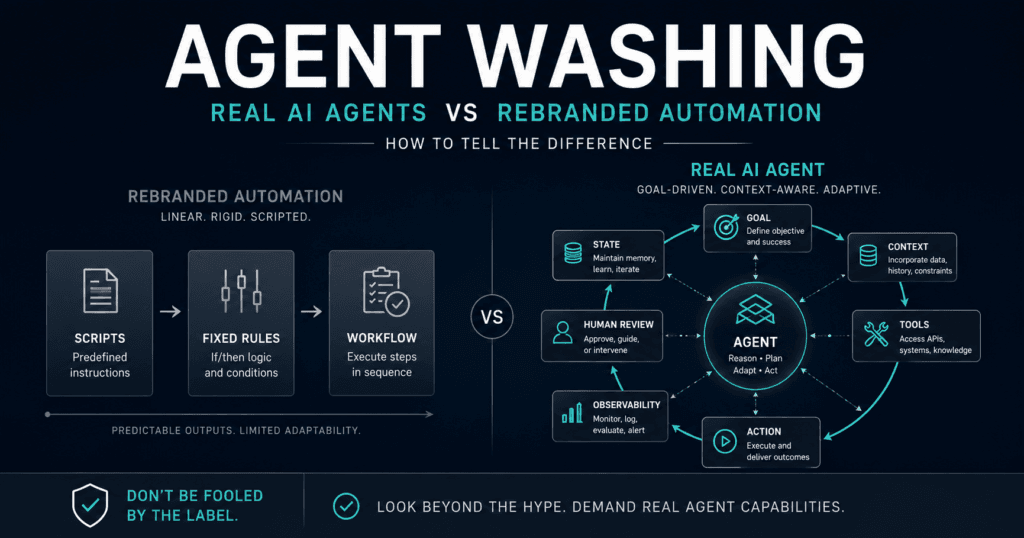
Agent washing turns a useful technical distinction into a marketing blur, and businesses pay for that blur through wasted budget, weak governance, and failed AI pilots.
The AI agent label has become too cheap.
That does not mean AI agents are fake. It does not mean automation is bad. It means the market has started using one phrase to describe too many different things: chatbots, copilots, robotic process automation, scripted workflows, API wrappers, task routers, and genuinely agentic systems that can use tools, maintain state, and act across a workflow.
That confusion has a name: agent washing.
Agent washing is the practice of labeling chatbots, scripted workflows, RPA, narrow AI automations, or assistive copilots as AI agents without meaningful autonomy, tool use, state management, governance, or production accountability.
The business problem is not the vocabulary. The business problem is what happens after the vocabulary gets muddy.
If every automation is called an agent, executives start funding “agent strategies” without knowing what level of autonomy they are buying. Product teams start promising capabilities the system does not have. Engineering teams inherit risk that was hidden in the sales language. Operators are told a process is intelligent when it is really just brittle automation with an AI interface.
A real AI agent is not defined by what a vendor calls it. It is defined by whether it can pursue a goal through controlled reasoning, context, tools, state, permissions, evaluation, and accountable action.
That distinction matters.
Why Agent Washing Matters Now
AI agents are one of the dominant enterprise AI narratives. Vendors want to show they are no longer selling simple assistants. Executives want to show they are moving beyond experimentation. Teams want to prove AI is producing operational value.
That pressure creates a perfect environment for agent washing.
A chatbot that answers questions from a knowledge base becomes a “support agent.” A workflow that drafts sales emails becomes a “sales agent.” A script that classifies tickets becomes an “operations agent.” A dashboard with an LLM summary becomes a “decision agent.”
Some of those systems may be useful. Many may be worth building. But usefulness is not the same as agency.
Gartner used the phrase agent washing in a 2025 press release warning that many vendors were rebranding existing products such as assistants, RPA, and chatbots without substantial agentic capabilities. Gartner also predicted that many agentic AI projects would be canceled by the end of 2027 because of cost, unclear value, or inadequate risk controls.
Whether any specific forecast proves exact is less important than the warning behind it: the label is running ahead of production reality.
That is where leaders need to slow down.
The question is not “Do we have AI agents?” The better question is: “What can this system actually decide, access, change, measure, and recover from?”
Real AI Agents vs Automation: The Difference That Matters
Automation follows a predefined path. It may be simple or sophisticated, but its behavior is largely scripted: when this happens, do that. It can route tickets, update fields, send notifications, apply rules, or trigger downstream processes.
AI assistance helps a human work faster. It might draft a response, summarize a meeting, answer a question, or suggest a next step. The human remains the decision maker and action taker.
An AI workflow combines models with business logic. It may classify, extract, retrieve, validate, route, and prepare actions. It can be extremely valuable, but much of the process may still be predefined.
A real AI agent sits further along the autonomy spectrum. It has a goal, interprets context, chooses actions, uses tools, tracks progress, handles uncertainty, and works inside boundaries. It may pause for human approval when the downside is high. It may retry or escalate when it encounters a blocker. It should leave an auditable trail of what happened and why.
Anthropic’s engineering guidance draws a practical distinction between workflows and agents: workflows orchestrate LLMs and tools through predefined code paths, while agents dynamically direct their own processes and tool usage. Google Cloud’s architecture guidance describes agents as applications that process input, reason with available tools, and take actions based on decisions. OpenAI’s agent tooling similarly frames agents as systems built with models, tools, orchestration, guardrails, tracing, and evaluation.
That is a much higher bar than “uses an LLM.”
A model call plus a workflow trigger is not automatically an agent. A chatbot with a button is not automatically an agent. A copilot that drafts text for approval is not automatically an agent.
Those patterns can still be useful. The mistake is pretending they carry the same operational implications as a system that can act.
Common Belief vs Production Reality
| Common Belief | Production Reality | Better Question |
|---|---|---|
| If a product uses an LLM, it is an AI agent. | An LLM call may only generate text; agency requires goal-directed action, context, tools, state, and controls. | What can the system actually decide and do without a human? |
| More autonomy always means more value. | More autonomy increases leverage and risk at the same time. | Where does autonomy improve the workflow enough to justify stronger controls? |
| A good demo proves the agent works. | Demos often avoid edge cases, permissions, failures, bad data, and long-running state. | How does the system perform on real workflows with real failure modes? |
| Automation is inferior to agents. | Many business problems are better solved with constrained automation or assistive AI. | Does this use case actually need agency, or just a reliable workflow? |
The Mistake Most Teams Make
The most common mistake is starting with the label instead of the job.
A leader says, “We need agents.” A vendor says, “We have agents.” A team says, “We can build an agent.” Then everyone moves forward before agreeing on what the system is supposed to do, what autonomy it needs, and what controls are required.
That path creates predictable failure.
The system may be called an agent, but it only drafts suggestions. Or it may actually take action, but no one has defined permission boundaries. Or it may perform well in a scripted demo, but break when the input is incomplete, the customer history is messy, the policy document has changed, or the downstream system returns an unexpected error.
This is how agent washing becomes operational debt.
It hides the real implementation questions:
- What systems can the AI read from?
- What systems can it write to?
- What decisions can it make without approval?
- What happens when it is uncertain?
- How are tool calls logged?
- How are failures detected?
- How is performance evaluated?
- Who owns the workflow?
- Who is accountable when the system causes damage?
Those are not edge questions. They are the core questions.
If the system can only draft a recommendation, the governance model is one thing. If it can update a CRM, issue a refund, approve an invoice, change a production setting, or message a customer, the governance model is completely different.
The agent label should raise the standard of scrutiny, not lower it.
The Technical Reality Behind the Business Decision
A real AI agent is a system, not a prompt.
The model matters, but it is only one component. Production-grade agentic systems usually need an orchestration layer, tool interfaces, context retrieval, memory or external state, structured outputs where appropriate, permission boundaries, evaluation, observability, and human review points.
The orchestrator decides what happens next. Should the system answer directly, retrieve information, call a tool, ask for clarification, escalate, retry, or stop? If everything depends on a model improvising the next step, the system becomes hard to debug and harder to govern.
Tools define what the system can actually do. A sales follow-up agent might read CRM data, retrieve call notes, draft an email, create a follow-up task, and update an opportunity stage. Each tool needs clear inputs, outputs, permissions, and error handling. Vague tools create vague behavior.
State tracks progress. Business work is not a single prompt. A customer support case may span multiple messages, policy checks, order lookups, refund rules, and escalations. If the system cannot track where it is in the task, it cannot be trusted to operate across the task.
Retrieval supplies context. Real business decisions depend on policies, records, tickets, contracts, product documentation, customer history, and current system status. A model that lacks the right context will improvise or ask the wrong question.
Observability makes the system inspectable. Teams need to know what the agent saw, what it retrieved, what tool it called, what action it took, what failed, and where a human intervened. Without that, a business cannot improve the system or explain its behavior.
Evaluation keeps the system honest. A demo tests the happy path. A production evaluation should test messy inputs, missing context, wrong tool selection, permission errors, policy ambiguity, cost spikes, retries, escalations, and unacceptable actions.
Security and governance are not optional. OWASP’s LLM application security guidance explicitly identifies risks such as prompt injection, insecure output handling, sensitive information disclosure, excessive agency, and overreliance. The more an AI system can act, the more these risks matter.
This is why agent washing is dangerous. It makes a complex system sound like a feature.
A Practical Example: The Sales Follow-Up “Agent”
Imagine a vendor sells a “sales follow-up agent.”
In the demo, it listens to a sales call transcript, summarizes the discussion, drafts an email, and suggests next steps. That may be useful. It may save time. It may improve consistency.
But if a human reviews and sends everything, the system is closer to an assistant than an agent.
Now imagine a stronger version. It checks the CRM, retrieves the account history, identifies open opportunities, compares the call to qualification criteria, drafts a follow-up email, creates a task for the account executive, updates the opportunity with structured fields, and routes risky cases for review.
That is closer to an agentic workflow.
But even then, the business needs to ask: can it send emails directly, or only draft them? Can it change pipeline stages, or only recommend changes? Can it access all accounts, or only assigned accounts? Can it create tasks without approval? Are updates reversible? Are actions logged? Is performance measured against sales outcomes or just user satisfaction?
The label does not answer those questions.
The architecture does.
A Technical Example: Support Triage
A support triage system that classifies tickets by category and urgency is automation. If the categories are stable and the task is narrow, automation may be exactly right.
A more agentic version would do more. It would inspect the ticket, retrieve customer history, check relevant policy, determine whether it can resolve the issue, call approved tools, draft or send a response depending on risk, update the ticket, log evidence, and escalate uncertain cases.
That could create real operational leverage.
It could also create real risk.
If the tool can issue refunds, the permission model matters. If it can update customer records, validation matters. If it can answer policy questions, retrieval quality matters. If it can close tickets, escalation logic matters. If it can talk to customers, tone, accuracy, and compliance matter.
This is the core business tradeoff: autonomy increases potential speed, but it also increases the need for control.
A Cross-Functional Example: Invoice Approval
Finance operations is a useful place to see the difference between agent washing and real system design.
A company might say it wants an “invoice approval agent.” The phrase sounds efficient. It also hides a lot.
Should the system approve invoices on its own? Should it extract invoice fields? Match purchase orders? Flag anomalies? Route exceptions? Prepare an approval packet? Recommend payment? Trigger payment release?
Those are different levels of autonomy.
A sensible first pilot may not approve anything automatically. It may classify invoices, extract key fields, match purchase orders, detect missing data, flag unusual vendors or amounts, and route exceptions to the right human reviewer. Payment release remains human-approved.
That is not a failure of ambition. It is good operating design.
Finance, IT, compliance, product, and engineering all have ownership because the system touches money, records, audit trails, permissions, and vendor relationships. Calling it an agent too early can obscure those responsibilities.
Stakeholder Impact
| Audience | What They Often Assume | What They Need to Understand |
|---|---|---|
| Business leaders | The agent label means the system is more advanced and valuable. | Value depends on measurable workflow outcomes, not branding. |
| Decision makers | Vendor demos are enough to compare agent platforms. | Evaluation should include autonomy, permissions, integration, observability, and failure handling. |
| Engineers/developers | Adding tool calls makes the system agentic enough. | Tool use needs orchestration, state, schemas, evals, permissions, and logging. |
| AI enthusiasts | Agent washing is only a marketing annoyance. | It distorts the public understanding of what real agentic systems can and cannot do. |
The Better Mental Model: The Agency Test
The practical way to cut through agent washing is to stop asking whether something “is an agent” and start asking how much agency it actually has.
Use the Agency Test.
A system becomes more agentic as it gains the ability to pursue a defined goal, retrieve context, use tools, track state, make bounded decisions, recover from errors, and act under governance.
The Agency Test asks ten questions:
- Goal: Can the system pursue a defined outcome, or does it only respond to isolated prompts?
- Context: Can it retrieve and use the right business context at the right time?
- Tools: Can it use approved tools safely and correctly?
- State: Can it track progress across steps without losing task history?
- Judgment: Can it make bounded decisions under uncertainty, or does it follow fixed rules?
- Controls: Are permissions, approvals, and escalation paths built into the workflow?
- Observability: Can the team inspect what happened, why it happened, and where failure occurred?
- Evaluation: Is success measured against real workflow outcomes rather than demo impressions?
- Recovery: Can the system stop, retry, escalate, or roll back when something goes wrong?
- Accountability: Is it clear who owns the system, the workflow, the data, the risk, and the outcome?
A system does not need to score perfectly to be useful. In fact, many good AI systems should remain deliberately constrained. The point is to match the label, design, controls, and investment to the actual level of agency.
Implementation Decision Table
| Decision Area | Why It Matters | What Can Go Wrong |
|---|---|---|
| Autonomy | Defines what the system can do without human approval. | The system takes actions the business never intended to delegate. |
| Tool access | Determines what systems the agent can read from or write to. | Weak tool boundaries create security, privacy, or operational risk. |
| Context and state | Allows the system to work across multi-step tasks. | The agent loses track of progress or acts on incomplete information. |
| Governance | Controls approvals, logging, permissions, and rollback. | Mistakes become hard to detect, explain, or reverse. |
| Evaluation | Tests whether the system works on real workflows. | Teams scale a demo that fails under real operating conditions. |
| Business value | Connects technical capability to measurable outcomes. | The project becomes expensive experimentation without operational payoff. |
What Leaders Should Fund
Leaders should fund AI agent work where autonomy changes the economics of the workflow.
That usually means the task is frequent, expensive, context-heavy, and constrained enough to evaluate. It should have measurable outcomes: shorter cycle time, lower manual effort, fewer errors, faster routing, improved customer response, or better throughput.
Leaders should be careful funding agent projects that are mostly branding exercises. If the work can be solved with a rules-based workflow, use a rules-based workflow. If the work only needs a human-approved draft, build an assistant. If a narrow classifier does the job, do not add an agent loop just because it sounds more modern.
The best AI strategy is not maximum autonomy. It is appropriate autonomy.
What Decision Makers Should Question
Decision makers should ask vendors and internal teams for evidence, not adjectives.
Ask for the workflow map. Ask what actions the system can take. Ask what tools it can call. Ask how permissions work. Ask where human approval is required. Ask how failures are logged. Ask what evaluation set was used. Ask what happens when data is missing, contradictory, stale, or out of policy.
Also ask what the system is not allowed to do.
That question is often more revealing than the feature list.
A serious agent proposal should be able to explain boundaries. A weak one usually hides behind demos and vague claims about intelligence.
What Technical Teams Should Verify
Technical teams should verify the operating behavior before accepting the agent label.
They should inspect tool definitions, schemas, permission models, retry logic, memory design, state transitions, logging, eval coverage, cost behavior, and escalation paths. They should test adversarial inputs, ambiguous requests, missing data, bad tool responses, and policy conflicts.
They should also push back when the word agent creates unrealistic expectations.
A constrained workflow with strong validation may be better than a flexible agent with weak controls. A human-reviewed assistant may be better than autonomous write access. A deterministic rule may be better than a model decision.
Engineering credibility comes from choosing the right system, not the most fashionable one.
What to Pilot Before Scaling
Pilot the narrowest version that proves the real business claim.
If the claim is faster support resolution, pilot ticket triage plus recommended responses with human review. If the claim is better sales follow-up, pilot CRM-ready drafts and task creation before allowing direct customer outreach. If the claim is finance automation, pilot extraction, matching, anomaly detection, and routing before approving payments.
The pilot should measure workflow outcomes, not just model quality.
Useful metrics include completion rate, human review rate, escalation rate, error rate, tool-call success rate, correction rate, cycle time, cost per completed task, and user adoption. For higher-risk workflows, teams should also measure policy violations, unauthorized action attempts, and rollback frequency.
Scaling should be earned.
Useful Automation Is Not the Enemy
Agent washing often creates a false choice: either build agents or fall behind.
That is the wrong lesson.
Useful automation is still valuable. Assistive AI is still valuable. Structured workflows are still valuable. Many businesses would get more value from improving workflow design, retrieval, validation, and measurement than from adding autonomy.
The problem is not automation. The problem is vague autonomy.
A company should be able to say, plainly: this is a chatbot, this is an assistant, this is a workflow automation, this is a constrained agent, and this is a system with higher autonomy. Each category can be useful. Each category needs different controls.
The agent label should describe a system’s operating reality, not its marketing ambition.
The Agent Label Is Cheap; Accountability Is Not
Agent washing will not disappear soon. The phrase “AI agent” is too useful in sales decks, roadmaps, product launches, and executive conversations.
That makes disciplined evaluation more important, not less.
The next time a product, vendor, or internal proposal claims to offer agents, do not start by arguing over terminology. Start with the operating model.
What goal can it pursue? What context can it use? What tools can it call? What state can it maintain? What can it change? What must a human approve? What gets logged? What gets measured? What happens when it fails?
A real AI agent is not a personality wrapped around a model. It is a controlled execution system connected to business context and business consequences.
That is why agent washing matters. It turns a serious systems question into a branding exercise.
Businesses do not need more vague agent claims. They need accurate names, appropriate autonomy, strong controls, and measurable outcomes.
The best question is not “Is it agentic?”
The best question is: “What can it safely do?”
Key Takeaways
- Agent washing happens when chatbots, copilots, RPA, or scripted workflows are relabeled as AI agents without meaningful agentic capability.
- The agent label should be evaluated by autonomy, tool use, context, state, governance, observability, evaluation, and accountability.
- Useful automation is not inferior to agents; many business problems are better solved with constrained automation or human-reviewed assistance.
- Demos do not prove production readiness because they often avoid messy data, permissions, failures, edge cases, and long-running state.
- More autonomy can create more operational leverage, but it also increases risk and control requirements.
- Leaders should fund agentic systems only where autonomy clearly improves a measurable workflow outcome.
- Technical teams should verify tool design, permissions, logging, state management, evaluation, and recovery before calling a system an agent.
Practical Decision Framework
Use The Agency Test before buying, building, or approving an AI agent initiative.
| Question | What It Reveals | Evidence to Request |
|---|---|---|
| Can the system pursue a defined goal? | Whether it is more than a prompt response or static workflow. | Workflow map, task scope, completion criteria. |
| Can it retrieve the right context? | Whether it can operate on real business information. | Retrieval design, data sources, freshness controls. |
| Can it use tools safely? | Whether it can act in business systems without excessive risk. | Tool list, schemas, permission model, error handling. |
| Can it maintain state? | Whether it can handle multi-step work. | State design, session handling, audit trail. |
| Can it make bounded decisions? | Whether autonomy is real and constrained. | Decision rules, confidence thresholds, escalation logic. |
| Are controls built in? | Whether the system is governable. | Approval gates, role permissions, policy checks. |
| Is it observable? | Whether teams can inspect and improve behavior. | Logs, traces, tool-call history, failure reports. |
| Is it evaluated against real work? | Whether performance is proven beyond a demo. | Evaluation set, acceptance criteria, failure-case testing. |
| Can it recover from failure? | Whether the system is production-ready. | Retry logic, rollback paths, human escalation. |
| Is ownership clear? | Whether the business can govern the outcome. | Named owners for workflow, data, model, risk, and operations. |
Use the answers to classify the system honestly:
- Assistant: helps a human think, draft, summarize, or decide.
- Automation: follows predefined rules or workflow triggers.
- AI workflow: combines models, retrieval, validation, and business logic.
- Constrained agent: uses tools and state to pursue goals inside narrow boundaries.
- High-autonomy agent: acts across systems with stronger decision authority and stronger governance needs.
The goal is not to force every system into the agent category. The goal is to match autonomy to the business case and controls to the autonomy.
FAQ
What is agent washing?
Agent washing is the practice of calling chatbots, scripted workflows, RPA, narrow AI automations, or copilots “AI agents” without meaningful autonomy, tool use, state management, governance, or production accountability.
How are real AI agents different from automation?
Automation usually follows predefined steps. A real AI agent can pursue a goal across steps by interpreting context, selecting tools, tracking state, making bounded decisions, and operating inside explicit controls.
Is agent washing always intentional?
No. Sometimes it is marketing exaggeration. Sometimes it is internal confusion. Sometimes teams use “agent” as shorthand for any AI-powered workflow. The risk is the same: unclear language leads to unclear decisions.
Are AI agents better than automation?
Not always. Many business problems are better served by reliable automation, structured workflows, or human-reviewed AI assistance. Agents are useful when flexibility, tool use, and multi-step decision-making create enough value to justify the added complexity.
What should business leaders ask before buying an AI agent platform?
Ask what the system can decide, what tools it can use, what systems it can write to, where human approval is required, how actions are logged, how failures are handled, and how performance is measured on real workflows.
What is the biggest risk of agent washing?
The biggest risk is overtrust. A business may give budget, access, or authority to a system that sounds autonomous but lacks the controls, evaluation, and architecture needed for safe production use.
Sources
- Gartner: https://www.gartner.com/en/newsroom/press-releases/2025-06-25-gartner-predicts-over-40-percent-of-agentic-ai-projects-will-be-canceled-by-end-of-2027
- Reuters: https://www.reuters.com/business/over-40-agentic-ai-projects-will-be-scrapped-by-2027-gartner-says-2025-06-25/
- OpenAI Agents SDK Documentation: https://platform.openai.com/docs/guides/agents
- OpenAI New Tools for Building Agents: https://openai.com/index/new-tools-for-building-agents/
- Anthropic Building Effective Agents: https://www.anthropic.com/engineering/building-effective-agents
- Google Cloud Choose Your Agentic AI Architecture Components: https://docs.cloud.google.com/architecture/choose-agentic-ai-architecture-components
- Google Developers Blog Agent2Agent Protocol: https://developers.googleblog.com/en/a2a-a-new-era-of-agent-interoperability/
- NIST AI Risk Management Framework: https://www.nist.gov/itl/ai-risk-management-framework
- OWASP Top 10 for Large Language Model Applications: https://owasp.org/www-project-top-10-for-large-language-model-applications/
Related articles from Kyle Beyke
- Building Brilliant Modern Agentic AI Systems for Business: https://beykeworkflows.com/how-modern-agentic-ai-systems-are-built-for-business/
- 9 BEST Agentic AI Business Tips: https://beykeworkflows.com/9-best-agentic-ai-business-tips/
- AI Workflow Anatomy: Essential Guide for Business: https://beykeworkflows.com/ai-workflow-anatomy-business-guide/
- AI Use Cases: 7 Smart Rules for Business: https://beykeworkflows.com/ai-use-cases-rules-business/
- AI Model Selection: Powerful Guide for Smart Business AI: https://beykeworkflows.com/ai-model-selection-business-ai-guide/
- Structured Outputs for AI Workflows: Reliable Guide: https://beykeworkflows.com/structured-outputs-for-ai-workflows-guide/
- Production Prompting: Essential Business AI Guide: https://beykeworkflows.com/production-prompting-business-ai-guide/
- Claude Code Leak: 7 Critical Lessons for Business: https://beykeworkflows.com/claude-code-leak-lessons-business-ai/