
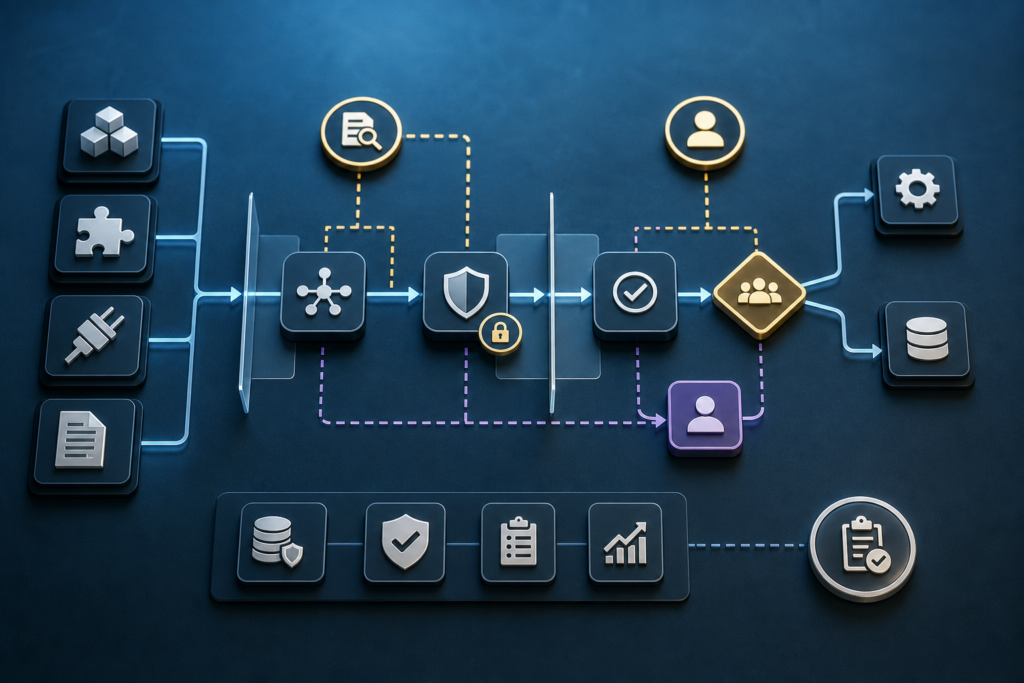
Thesis: The next serious AI supply chain failure may not come from the model or the package manager. It may come from the trusted skill your agent was allowed to run.
AI supply chain risk is shifting from “what packages are installed?” to “what trusted skills, connectors, templates, tools, and external components can an AI agent use?” That shift matters because agentic AI systems are moving into workflows where they can retrieve sensitive context, call APIs, update records, trigger automations, and influence customer or operational outcomes.
A compromised package can sit inside an application. A compromised or over-privileged agent skill can become an execution path.
That distinction changes the business conversation. The risk is no longer confined to engineering hygiene, dependency scanning, or vendor questionnaires. Once reusable AI components can shape behavior and invoke tools, they belong in the same governance conversation as procurement, access control, operational resilience, customer trust, compliance, and incident response.
The uncomfortable pattern is simple: many companies are preparing for yesterday’s software supply chain problem while adopting tomorrow’s agentic dependency model.
What AI supply chain risk means now
Traditional software supply chain security focuses on the components that make up software: open-source packages, third-party libraries, build systems, container images, developer tools, commercial dependencies, and deployment artifacts. The goal is to know what is inside the software, where it came from, whether it was tampered with, whether it contains known vulnerabilities, and whether updates can be trusted.
That work remains necessary. SBOM guidance from NTIA and CISA-style software transparency efforts exist because modern systems are assembled from many components. SLSA exists because build provenance, tamper resistance, and artifact integrity are now part of basic trust infrastructure. OpenSSF describes SLSA as a framework for improving trust across the software supply chain, including sources, builds, and dependencies.
Agentic AI adds another layer.
AI supply chain risk now includes external or reusable AI components such as models, packages, APIs, connectors, tool definitions, agent skills, prompts, templates, retrieval indexes, vector databases, memory systems, model wrappers, workflow automation bundles, and registries. Some of these components look like code. Some look like configuration. Some look like instructions. In production, that distinction can mislead teams.
If a skill can tell an agent how to complete a multi-step task, access files, call a connector, interpret policies, or trigger a workflow, it is more than a prompt. It is a behavioral dependency.
OWASP’s Agentic Skills Top 10 describes skills as an execution layer that gives agents real-world impact. Its risk categories include malicious skills, supply chain compromise, over-privileged skills, weak isolation, update drift, poor scanning, and lack of governance. That framing is important because it treats agent skills security as a lifecycle problem, not as a one-time prompt review.
The new dependency layer: behavior that can act
The most important change is that agentic AI components can influence both behavior and execution.
A normal software dependency may expose a vulnerable function. An agent skill may define how an agent searches logs, edits code, prepares an incident summary, contacts a customer, reviews a contract, creates a ticket, or updates a CRM record. A connector may define what systems the agent can reach. A template may embed assumptions about who should approve a decision. A retrieval component may decide which version of a policy the agent sees.
That creates a new dependency category: operational behavior packaged for reuse.
Consider a support operations team that adopts an agent skill from a public registry. The skill claims to help triage refund requests. It includes instructions for reviewing tickets, retrieving account records, checking policy text, drafting responses, and escalating exceptions. It also asks for access to helpdesk records, CRM account details, and a refund workflow connector.
The demo looks useful. The business sees faster triage. The technical team sees a reusable workflow asset.
The risk sits in the permissions and behavior:
- Does the skill require write access when draft-only access would work?
- Does it depend on external instructions that can change later?
- Does it route sensitive customer data to an external tool?
- Does it include hidden instructions that change how the agent responds?
- Is the skill version pinned, reviewed, and owned?
- Can the team identify which workflow used it if something goes wrong?
A leader does not need to become a security engineer to understand the issue. If a component can influence what an AI system sees, decides, calls, or changes, the business needs proof that it should be trusted.
Traditional package risk vs. agent-skill risk
| Common Belief | Production Reality | Better Question |
|---|---|---|
| Supply chain risk is mainly about open-source packages. | Agentic systems also depend on skills, connectors, prompts, templates, retrieval assets, and tool definitions. | What reusable AI components can influence behavior or trigger actions? |
| A skill is just instructions. | A skill can shape multi-step behavior, tool use, permissions, and downstream workflow outcomes. | What can this skill cause the agent to do? |
| A trusted platform makes all components safe. | Registries, marketplaces, shared repos, and internal templates can introduce separate trust problems. | What evidence exists for this specific component? |
| Updating skills automatically keeps teams current. | Silent updates can change behavior, permissions, or dependencies without business review. | Which components are pinned, staged, tested, and approved before rollout? |
| Scanning code is enough. | Natural language, manifests, tool descriptions, external references, and scripts may all carry risk. | Can the review process inspect both code and behavior? |
| Logs of final answers are sufficient. | Teams need records of inputs, retrieved context, tool calls, versions, approvals, and write-backs. | Can we reconstruct what happened after an incident? |
This is why AI supply chain risk cannot be reduced to “scan dependencies and move on.” The agentic AI supply chain includes components that may never look like a conventional package but still affect production behavior.
Why business leaders should care
The business exposure is not abstract. Agentic AI systems are being connected to places where mistakes have consequences: CRMs, helpdesks, code repositories, data warehouses, ticketing systems, identity systems, finance workflows, procurement workflows, knowledge bases, and customer communication channels.
That creates four management problems.
First, unknown components become unknown authority. If teams copy skills from public repositories or vendor examples without a registry, leaders cannot know which agents are using which instructions, connectors, or templates.
Second, permission creep becomes operational risk. A skill built for convenience may request broad access because broad access makes the demo easier. Production systems should resist that pressure. Read access, draft creation, external communication, write-back, deletion, financial action, and privileged administration are different levels of authority.
Third, procurement evidence becomes weaker than the risk. AI vendors may demonstrate impressive workflows, but the buyer still needs to know how third-party AI components are reviewed, signed, versioned, monitored, and revoked. A good demo does not prove provenance.
Fourth, incident response becomes harder. If a customer email, refund, code change, or data movement was influenced by an agent, the organization needs to know which model, skill, connector, prompt version, retrieved context, tool call, approval path, and identity were involved.
Beyke Workflow Systems has covered related controls in AI Agent Guardrails for Safe Workflow Permissions, AI Governance Is Infrastructure, Not Paperwork, and AI Incident Response Is the Missing Discipline. Agent skills bring those ideas into the supply chain conversation.
The technical reality: skills sit between models and tools
A production AI workflow may include a model API, application code, orchestration logic, prompts, retrieval, memory, connectors, function calls, workflow state, approval gates, and logging. Agent skills often sit in the middle of that stack.
That position makes them useful. It also makes them risky.
A skill can encode “how we do this task” in a reusable package. For example:
- How to review a pull request against internal engineering standards.
- How to summarize an incident and open follow-up tickets.
- How to classify customer requests and draft helpdesk replies.
- How to search an internal knowledge base and cite approved sources.
- How to prepare a procurement comparison from vendor documents.
- How to update a CRM record after a sales call.
In each case, the skill may combine instructions, examples, tool references, scripts, metadata, external documents, and platform-specific manifests. Some skills may rely on connectors. Some may call MCP servers. The Model Context Protocol specification defines authorization capabilities for HTTP transports and relies on established OAuth specifications when supported, but protocol support is not the same as business-level approval for every server, tool, or skill an agent can use.
This is where teams often get confused. MCP can help standardize how agents connect to tools. It does not decide whether a tool should be trusted, whether a skill should have access to it, whether the skill should be allowed in production, or whether a high-impact action needs human approval.
Common failure patterns
The mistakes are predictable because they mirror earlier software supply chain failures, with added autonomy.
One team treats a shared skill like a helpful prompt and lets it spread through Slack, GitHub, or a vendor marketplace. Another team installs a connector because it works in the demo, then discovers it has broader permissions than the workflow needs. A third team allows automatic updates from a registry because manual review feels slow. Six weeks later, behavior changes and no one can explain why.
The failure is rarely one dramatic mistake. It is usually a chain of small shortcuts:
- No inventory of skills, connectors, templates, and model wrappers.
- No owner for each reusable AI component.
- No version pinning or staged rollout process.
- No permission manifest review.
- No distinction between read, draft, write, send, delete, and administer.
- No sandbox before production.
- No review of external instruction sources.
- No tool-call logging tied to component versions.
- No revocation plan when a component is compromised or deprecated.
The result is shadow infrastructure. AI components affect real workflows, but they sit outside normal governance.
OWASP’s Agentic Skills Top 10 calls out “No Governance” as a risk category because lack of inventory, approval, audit, and revocation creates a layer security teams cannot see or control. That should also concern business leaders. Invisible dependencies become invisible accountability gaps.
Provenance helps, but it does not prove judgment
Provenance is necessary. It is not magic.
SLSA-style provenance can help teams verify where a software artifact came from and how it was built. SBOM thinking can help teams inventory software components. NIST’s AI Risk Management Framework gives organizations a broader structure for governing, mapping, measuring, and managing AI risk.
Those ideas should be adapted to AI components, but leaders should understand their limits.
An AI Bill of Materials can tell you what components exist in an AI system. It should include more than models and packages. It should cover skills, connectors, prompts, retrieval sources, datasets, model wrappers, tool definitions, workflow templates, memory stores, policy files, and automation assets.
Provenance can help answer “where did this come from?” Versioning can answer “what changed?” Approval records can answer “who accepted the risk?” Logs can answer “what happened?” Evals can answer “how did it perform under expected conditions?” Red teaming can answer “how might it fail under pressure?”
None of those alone can answer “is this component safe in every context?”
That is why AI supply chain risk needs a workflow-based control model. Trust is not a label attached to a component forever. Trust depends on purpose, permissions, environment, data sensitivity, update behavior, observability, and the business impact of failure.
What to require before production use
A serious review of third-party AI components should be practical, not theatrical. The goal is to make adoption safer without creating a process so slow that teams route around it.
Before a third-party or internally shared skill enters production, require answers to these questions:
- Identity and source: Who authored it, where did it come from, and is the source trusted?
- Purpose: What job is it allowed to perform, and what business workflow uses it?
- Owner: Which team owns approval, maintenance, incident response, and retirement?
- Version: Which version is approved, and are updates pinned or staged?
- Permissions: What data, tools, APIs, files, records, and systems can it access?
- Behavior: What instructions, scripts, tool calls, external references, or templates does it include?
- Isolation: Does it run in a sandbox or within a broader agent security context?
- Review gates: Which actions require human approval?
- Observability: Are inputs, outputs, tool calls, retrieved sources, approvals, errors, and write-backs logged?
- Revocation: How quickly can the component be disabled, rolled back, or replaced?
This checklist works for public skills, internal skills, vendor-provided templates, MCP servers, workflow automation bundles, and reusable AI connector configurations.
It also gives procurement a stronger evidence model. Instead of asking only whether a vendor “has AI security,” ask whether the vendor can show component inventory, provenance, permission boundaries, update controls, audit logs, and incident procedures for the agentic ecosystem around the product.
The better mental model: trusted execution paths
Treat agent skills and reusable AI workflow components as trusted execution paths.
That phrase is useful because it forces teams to think beyond files. The risk is not only that a component exists. The risk is that a component is trusted enough to shape behavior, access context, call tools, or trigger work.
A trusted execution path should have five properties:
- Known: It appears in an inventory with owner, purpose, version, and environment.
- Bounded: It has the minimum permissions needed for the job.
- Reviewed: Its source, manifest, behavior, dependencies, and update path are checked.
- Observable: Its use produces logs that support debugging, audit, and incident response.
- Revocable: It can be disabled or rolled back without breaking the whole operation.
This mental model helps business and technical teams talk about the same problem. Business leaders can ask, “What execution paths are we trusting?” Engineers can answer with registries, manifests, API scopes, version pins, policy checks, sandboxes, and logs.
What leaders and builders should do next
Leaders should fund the control plane before demanding broad agent autonomy. That means an inventory of AI components, a review process for new skills and connectors, permission templates, logging requirements, and incident response procedures. These are not bureaucratic extras. They are the operating system for responsible scale.
Procurement teams should demand evidence from AI vendors and platform providers. Ask how skills, connectors, templates, tools, registries, and model wrappers are reviewed. Ask whether components are signed or otherwise traceable. Ask how permissions are scoped. Ask whether updates are pinned or automatic. Ask what logs exist when an agent calls a tool.
Engineering teams should design AI components as versioned dependencies. Treat prompts, skills, tool definitions, and workflow templates as reviewable assets. Store them where change history is visible. Separate read from write. Use dedicated agent identities where possible. Validate tool arguments. Require human review for high-impact actions. Preserve enough logs to reconstruct the path from request to action.
Product teams should pilot with narrow authority. A skill that drafts a recommendation is easier to test than a skill that updates records or contacts customers. Start with workflows where the blast radius is limited, measurement is clear, and exceptions can be routed to humans.
Security teams should avoid turning this into a blanket “no.” The goal is not to block reusable AI components. Reuse is how teams scale useful AI. The goal is to know what is being reused, where it came from, what it can do, and how to stop it when something changes.
The package manager was the warning
The software industry learned the hard way that reuse creates speed and dependency at the same time. Package managers made teams faster. They also made trust transitive, hidden, and fragile.
Agent skills are heading toward the same tradeoff, with a sharper edge. They do not merely sit inside software. They can help operate it.
AI supply chain risk is becoming a workflow control problem. The winning teams will not be the ones that ban every external component or approve every shiny agent demo. They will be the ones that build a disciplined path between reuse and authority.
Before you let an agent run a skill, ask a plain question: if this component behaved badly tomorrow, would we know where it came from, what it could touch, what it changed, who approved it, and how to shut it off?
If the answer is no, the skill is not ready for production trust.
Key Takeaways
- AI supply chain risk now includes agent skills, connectors, templates, prompts, retrieval assets, model wrappers, and workflow automation bundles.
- Agent skills are behavioral dependencies when they shape tool use, data access, decisions, or business actions.
- Traditional software supply chain controls such as SBOMs, SLSA-style provenance, versioning, and signing are useful, but they must be extended to AI workflow components.
- The biggest failure pattern is treating reusable skills as harmless instructions while granting them real workflow authority.
- Leaders should require inventory, ownership, permission boundaries, approval workflows, observability, and revocation before production use.
- Engineers should treat skills, prompts, connectors, and tool definitions as versioned, reviewable, permissioned dependencies.
- The better mental model is trusted execution paths: every AI component that can influence action needs evidence, limits, logs, and a shutdown path.
Practical Decision Framework
Use this framework when deciding whether an agent skill, connector, template, MCP server, model wrapper, retrieval component, or reusable workflow asset should be approved for production.
| Decision Area | What to Ask | Production Requirement |
|---|---|---|
| Inventory | Do we know this component exists and where it is used? | Record owner, workflow, version, environment, and dependency path. |
| Provenance | Can we verify where it came from and who maintains it? | Prefer trusted sources, signed artifacts where available, review history, and documented publisher identity. |
| Permission scope | What data, tools, APIs, records, or systems can it access? | Apply least privilege and separate read, draft, write, external communication, financial action, and administration. |
| Behavioral review | What instructions, scripts, external references, or tool-use patterns does it contain? | Review both code and natural-language behavior before approval. |
| Update control | Can it change without review? | Pin approved versions, stage updates, test behavior changes, and document approvals. |
| Isolation | Does it run with broad agent privileges? | Use sandboxing, scoped identities, limited credentials, and environment separation where possible. |
| Human review | What happens before high-impact actions execute? | Require approval for irreversible, external, financial, sensitive, or uncertain actions. |
| Observability | Can we reconstruct what happened? | Log component version, prompt or skill version, retrieved context, tool calls, approvals, outputs, errors, and write-backs. |
| Revocation | Can we disable it quickly? | Maintain a kill switch, rollback path, dependency map, and incident owner. |
A useful rule: the more authority a component has, the more evidence it needs. Draft-only components may need light review. Components that can write to business systems, access sensitive data, or trigger external actions require stronger controls.
FAQ
What is AI supply chain risk?
AI supply chain risk is the risk that external, reusable, or third-party AI components introduce vulnerabilities, hidden behavior, excessive permissions, unreliable dependencies, or untrusted changes into an AI system or workflow. It includes models, packages, APIs, tools, connectors, prompts, templates, skills, datasets, retrieval systems, and workflow automation assets.
How do agent skills create supply chain risk?
Agent skills create supply chain risk because they can package repeatable behavior for an AI agent. If a skill can access context, call tools, follow external instructions, or trigger workflow actions, a compromised or poorly governed skill can affect real systems and business outcomes.
Are agent skills different from software packages?
Yes. Software packages usually execute as code dependencies inside applications. Agent skills may combine prompts, metadata, scripts, tool references, and workflow instructions that influence how an AI agent behaves. Some skills may include code, but the distinctive risk is behavioral authority combined with tool access.
How does this relate to SBOMs and SLSA?
SBOMs and SLSA help with software transparency, component inventory, and provenance. Agentic systems need similar thinking, but the inventory should include AI-specific components such as skills, prompts, connectors, tool definitions, model wrappers, retrieval assets, and workflow templates. Provenance helps, but teams still need permission review, behavior review, monitoring, and revocation.
Does MCP solve AI connector security?
MCP helps standardize how AI systems connect to tools and services. It does not automatically decide whether a specific MCP server, connector, skill, or tool should be trusted in a business workflow. Teams still need authentication, authorization, least privilege, review, monitoring, and approval gates.
What should non-security leaders do first?
Start with inventory and ownership. Ask which AI skills, connectors, templates, tools, model wrappers, and retrieval components are being used in production or pilots. Then require each component to have an owner, purpose, permission boundary, version, approval status, logging plan, and revocation path.
Sources
- OWASP Agentic Skills Top 10: https://owasp.org/www-project-agentic-skills-top-10/
- OWASP Agentic Skills Top 10 Visual Overview: https://owasp.org/www-project-agentic-skills-top-10/top10
- OWASP Top 10 for Large Language Model Applications: https://owasp.org/www-project-top-10-for-large-language-model-applications/
- SLSA Supply-chain Levels for Software Artifacts: https://slsa.dev/
- OpenSSF SLSA Project: https://openssf.org/projects/slsa/
- NTIA Software Bill of Materials: https://www.ntia.gov/page/software-bill-materials
- NTIA Minimum Elements for a Software Bill of Materials: https://www.ntia.gov/blog/2021/ntia-releases-minimum-elements-software-bill-materials
- NIST AI Risk Management Framework: https://www.nist.gov/itl/ai-risk-management-framework
- Model Context Protocol Authorization Specification: https://modelcontextprotocol.io/specification/2025-06-18/basic/authorization
- MITRE ATLAS: https://atlas.mitre.org/
Related articles from Kyle Beyke
- AI Agent Guardrails for Safe Workflow Permissions: https://beykeworkflows.com/ai-agent-guardrails-permissions-safe-business-workflows/
- Context Engineering for Enterprise AI Is the Real Work: https://beykeworkflows.com/context-engineering-enterprise-ai/
- AI Governance Is Infrastructure, Not Paperwork: https://beykeworkflows.com/ai-governance-infrastructure-not-paperwork-business/
- AI Incident Response Is the Missing Discipline: https://beykeworkflows.com/ai-incident-response-governance-operations/