
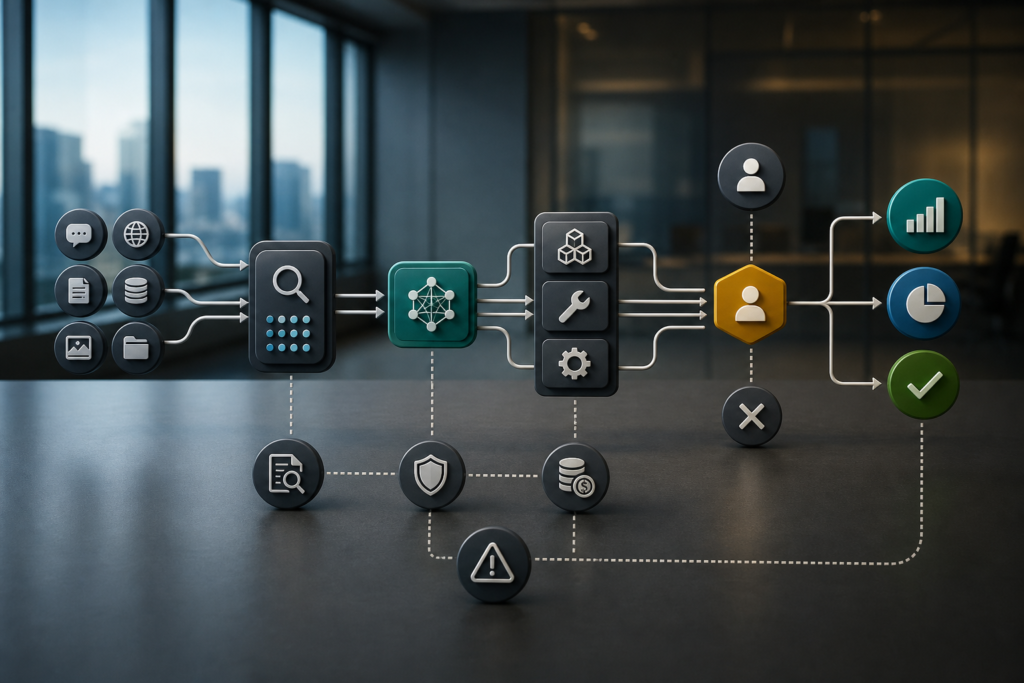
If a company cannot trace what an AI system saw, decided, used, changed, cost, and escalated, it does not have production automation. It has a black box with workflow access.
AI observability is the ability to inspect how an AI system behaved across prompts, context, retrieval, model calls, tool calls, approvals, costs, latency, errors, and outcomes. That definition matters because AI is moving out of isolated chat windows and into business workflows that touch live data, APIs, customer records, internal knowledge, and operational decisions.
The uncomfortable truth is that many AI automation efforts are not failing because the model is too weak. They are failing because no one can see enough of the workflow to trust it, debug it, govern it, or improve it.
A demo can hide that problem. Production exposes it.
The demo is not the operating evidence
AI demos usually show the best part of the system: a clean request, a plausible answer, a fast response, and a smooth handoff. The hard parts stay offstage.
Where did the context come from? Which document version was retrieved? Was the customer record current? Did the model choose a tool or did the application force a rule? What arguments were passed to the API? Was the action reversible? Who approved it? What did the reviewer see? How many retries happened? What did the workflow cost? Did the final action improve the business outcome?
Those questions sound technical, but they are management questions. They determine accountability, cost control, risk exposure, vendor evaluation, customer experience, and whether automation can safely expand.
Traditional software teams already understand the value of observability. OpenTelemetry describes observability through signals such as traces, metrics, and logs, with distributed tracing used to follow a request across services. Google’s SRE materials make a similar practical point: monitoring data helps teams alert, investigate, diagnose, visualize, plan, and compare system behavior before and after changes.
AI observability extends that discipline into a messier kind of system. The request path is no longer only service A calls service B, which queries database C. The path may include prompt assembly, retrieval from multiple sources, a model response, a structured output validator, a tool call, a permission check, a retry, a human review step, and a downstream workflow action.
That is why uptime and latency are insufficient. A fast AI workflow can still retrieve the wrong policy, call the right tool with the wrong arguments, produce a confident but unsupported summary, or route a sensitive action without the right approval record.
What AI observability actually means
AI observability is the practice of capturing and analyzing the telemetry of AI systems so teams can reconstruct behavior, diagnose failures, control cost, govern risk, and improve outcomes.
In a production AI workflow, that evidence usually includes:
- User request or business event metadata
- Prompt template and prompt version
- Model provider, model name, model version or deployment identifier where available
- System instructions and runtime configuration
- Retrieved documents, chunks, source identifiers, and ranking metadata
- Input and output token usage
- Latency by workflow step
- Structured output validation results
- Tool names, arguments, responses, and errors
- Permission checks and policy flags
- Human review, approval, rejection, override, and escalation records
- Downstream actions taken in business systems
- Outcome metrics tied to the real workflow
This is broader than LLM observability if that term is used only to mean model-call tracing, token counts, or prompt debugging. It is also broader than agent observability if that term is used only for multi-step tool use. For business automation, the useful scope is the full workflow.
| Layer | What It Observes | Why It Is Not Enough Alone |
|---|---|---|
| Traditional observability | Service health, latency, errors, traces, logs, infrastructure metrics | It may miss prompt versions, retrieved context, model behavior, and tool reasoning paths. |
| LLM observability | Prompts, completions, model metadata, tokens, latency, evaluation traces | It may stop at the model boundary and miss approvals, permissions, and business outcomes. |
| Agent observability | Tool calls, multi-step trajectories, handoffs, retries, agent state | It may explain the agent path without proving whether the workflow produced a valid business result. |
| Business-level AI observability | Prompts, retrieval, model calls, tools, approvals, cost, risk flags, outcomes | It connects technical behavior to operating evidence leaders can govern. |
OpenTelemetry’s generative AI semantic conventions are a sign of where the field is heading. The project now defines conventions for generative AI operations across signals such as events, exceptions, metrics, model spans, and agent spans. Its generative AI span guidance includes attributes for model calls, token usage, providers, models, errors, and related metadata. That does not solve every business problem, but it does create a more portable vocabulary for AI tracing.
Why normal monitoring misses AI failure
A normal monitoring dashboard might tell you that a workflow is up, response time is acceptable, and no API returned a server error.
An AI workflow can pass those checks and still fail operationally.
Consider a support automation flow. A customer asks for a refund. The system retrieves a policy document, summarizes the customer’s history, estimates eligibility, drafts a response, and proposes a CRM update. The workflow returns quickly. The API calls succeed. The response sounds professional.
But the retrieved policy was superseded two weeks ago. The CRM lookup returned a partial account match. The draft omitted an exception for enterprise customers. The proposed update changed the wrong field. The human reviewer approved it because the review screen showed the final draft but not the retrieved policy or tool-call arguments.
From a traditional monitoring view, nothing broke. From a business view, the system failed.
AI observability must make that difference visible.
The same problem appears in sales, finance, HR, legal operations, engineering support, procurement, and internal knowledge systems. The failure is often semantic, contextual, or procedural rather than purely technical. The server did not crash. The workflow did the wrong thing in a way that looked plausible.
That is the risk leaders underestimate when they treat AI automation as a feature launch instead of an operating system change.
The business case is evidence, not dashboards
Executives do not need prettier AI dashboards. They need evidence that answers operating questions.
Can we reconstruct an incident? Can we identify whether a bad outcome came from retrieval, prompting, model behavior, tool arguments, data quality, permission design, human review, or downstream integration? Can we see cost per successful outcome instead of total token spend? Can we detect when a prompt change increased retries or when a new model improved drafting quality but worsened tool-call accuracy?
Without AI observability, those questions become guesswork.
For procurement, this changes what a buyer should demand. A vendor claiming production readiness should be able to show how its system records model calls, retrieval context, tool use, approvals, errors, costs, admin actions, exports, retention controls, and incident evidence. That aligns closely with the evidence-first buying posture discussed in AI Procurement Is Broken: Demand Real Evidence.
For operating teams, observability changes what a pilot should prove. A successful pilot should not only show that users like the experience. It should show that the workflow can be inspected, measured, corrected, and governed under realistic conditions.
For engineering teams, observability changes the implementation plan. Instrumentation cannot be postponed until after scale. If a system is hard to observe in the pilot, it will be harder to govern after three departments depend on it.
The technical tradeoffs are real
High-quality AI observability is not free. Teams have to make design choices.
Full prompt capture can help debug failures, but prompts and retrieved context may contain sensitive customer data, employee data, trade secrets, credentials, legal information, or regulated records. Tool-call logs can expose business operations. Human review records can reveal decision-making patterns. Long retention can help audits but increase privacy and security risk.
OpenAI’s Agents SDK tracing documentation reflects this reality in a vendor-specific way. It describes traces and spans for agent workflows, including LLM generations, tool calls, handoffs, guardrails, and custom events. It also warns that certain spans may capture sensitive data and provides configuration for sensitive trace data. For organizations operating under OpenAI API Zero Data Retention, the documentation says tracing is unavailable in that SDK context.
The broader lesson is not tied to one provider: observability needs a data policy.
Teams should decide what to log, what to hash, what to redact, what to sample, what to retain, who can access traces, and how incident evidence is preserved. Security and privacy teams should be part of the design before production data flows through the system.
The second tradeoff is cost. High-cardinality telemetry, full transcripts, retrieved chunks, token usage, tool payloads, and evaluation records can create storage and analysis overhead. Sampling may be necessary. So may tiered logging, where low-risk workflows capture less content while high-impact workflows preserve more evidence.
The third tradeoff is speed. Real-time AI workflow monitoring helps detect incidents, cost spikes, policy violations, and failure patterns quickly. Offline evaluation helps teams compare behavior across model changes, prompt changes, retrieval changes, and tool schema changes. Both matter. A production system needs live alerting for urgent issues and deeper review for quality improvement.
Observability, evals, and governance must connect
Teams often confuse observability, evaluations, guardrails, and governance. They are related controls, but they do different jobs.
Observability records what happened. Evaluations test whether the system behaves well under defined conditions. Guardrails constrain or route behavior. Governance defines ownership, policy, risk tolerance, review, and accountability.
A strong AI operating model connects them.
Anthropic’s guidance on agent evaluations describes a transcript, also called a trace or trajectory, as the record of a trial that includes outputs, tool calls, reasoning, intermediate results, and other interactions. It also distinguishes the final statement from the actual outcome in the environment. That distinction is crucial for business automation. The answer “Your refund has been processed” is less important than whether the refund record exists, is correct, and followed policy.
NIST’s AI Risk Management Framework and Generative AI Profile also point leaders toward lifecycle risk management rather than one-time approval. They emphasize governing, mapping, measuring, and managing AI risks. AI observability supplies evidence that those activities can use.
OWASP’s 2025 Top 10 for LLM Applications adds the security lens. Risks such as prompt injection, sensitive information disclosure, improper output handling, excessive agency, vector and embedding weaknesses, misinformation, and unbounded consumption are easier to discuss seriously when teams have traces, logs, policy flags, and incident timelines. Observability does not eliminate those risks. It makes them harder to ignore and easier to investigate.
Common belief vs. production reality
| Common Belief | Production Reality | Better Question |
|---|---|---|
| If the model is good, the workflow will be reliable. | Model quality is only one part of retrieval, prompting, tools, permissions, validation, and review. | Can we trace every step from request to outcome? |
| A dashboard with token usage is AI observability. | Token usage is useful, but it does not explain context quality, tool behavior, or approvals. | Can we diagnose why a specific workflow failed? |
| Human review is enough control. | Reviewers may approve bad outputs if they cannot see evidence, source context, and tool arguments. | What exactly did the reviewer see before approval? |
| Agent logs are an engineering detail. | Tool calls can change records, trigger actions, and create customer impact. | Which agent actions require business-level audit trails? |
| Evals solve production risk. | Evals test defined scenarios. Production monitoring catches live behavior and new failure modes. | How do eval results connect to production traces? |
| Observability can be added later. | Missing trace IDs, prompt versions, approval records, and tool metadata are hard to recreate after incidents. | What must be instrumented before scale? |
A practical example: CRM enrichment with review
Imagine a sales AI workflow that summarizes call notes and proposes CRM updates.
A weak implementation logs only the final summary and whether the user clicked save. If a bad update appears later, the team sees the wrong output but not the path that produced it.
A stronger implementation records the workflow trace:
- The source call transcript identifier
- The prompt template and version
- The account and contact records retrieved
- The model and settings used
- The structured fields proposed for update
- Validation results against CRM field rules
- The reviewer’s screen state
- The user approval or edits
- The final CRM write
- The downstream outcome, such as accepted update, correction, rollback, or reopened task
This turns AI workflow monitoring into operating evidence. Sales leadership can see adoption and correction rates. RevOps can identify fields that create frequent conflicts. Engineering can find prompt or retrieval regressions. Security can verify permissions. Finance can estimate cost per accepted update.
The point is not to monitor everything forever. The point is to know which evidence matters before the workflow is allowed to touch systems of record.
What leaders should require before scaling
AI observability should be part of the production readiness conversation. Leaders do not need to review span schemas, but they should ask sharper questions.
Before a workflow moves from pilot to production, require answers to these:
- What business event starts the workflow?
- What data can the AI access, and how are permissions enforced?
- What prompt, retrieval, model, tool, approval, and action metadata is captured?
- Can the team reconstruct one failed workflow end to end?
- What sensitive information is excluded, redacted, hashed, or retained?
- Which actions require human review?
- What alerts exist for cost spikes, error spikes, risky tool calls, policy flags, and abnormal retry patterns?
- What outcome metrics determine whether the workflow is improving the business?
- Who owns incidents, corrections, rollback, and continuous improvement?
This overlaps with the governance argument in AI Governance Is Infrastructure, Not Paperwork. Governance becomes real when systems produce evidence, and teams know who is responsible for acting on it.
What builders should instrument first
Technical teams should avoid treating AI observability as a giant logging project. Start with the path that matters most.
For most production AI systems, the minimum useful trace includes:
- A stable trace ID for each workflow run
- The business workflow name and version
- User, tenant, department, or system context where allowed
- Prompt template identifier and version
- Model provider and model identifier
- Retrieval source identifiers and chunk references
- Input and output token usage
- Tool calls, arguments, results, errors, and retries
- Validation failures and fallback paths
- Human review records
- Downstream action identifiers
- Final outcome status
The trace should connect to evaluation records where possible. If a model or prompt change improves benchmark performance but production traces show higher escalation rates, the team needs to know. If tool-call errors rise after a schema change, the team needs to see the relationship quickly.
For agents, the need is stronger. An agent that can plan, call tools, retry, hand off, and alter state creates a trajectory, not a single response. AI Agents vs Workflows: A Practical, Reliable Decision Guide covers the autonomy tradeoff; observability is what lets that tradeoff be managed after launch.
The better mental model: the flight recorder
The mental model leaders should use is a flight recorder, not a dashboard.
A dashboard tells you what is happening now. A flight recorder lets you reconstruct what happened when the stakes matter.
Business AI systems need both. Real-time signals show cost, latency, error rate, escalations, approval queues, and abnormal behavior. Flight-recorder evidence shows the sequence of context, decisions, tools, approvals, and outcomes behind a specific run.
That distinction changes funding priorities. Buying an AI tool without observability is like buying automation without an incident record. It might work during normal conditions, but the organization becomes fragile when something unusual happens.
The most responsible AI automation programs will not be the ones with the most agents. They will be the ones with the clearest evidence about where AI helps, where it fails, where humans must remain accountable, and what should change before autonomy expands.
The control layer separates automation from guesswork
AI observability will not make models perfectly reliable. It will not remove the need for good workflow design, careful permissions, strong data quality, evaluation, security review, or human judgment.
Its value is more practical than that.
It gives the organization a way to see.
When AI systems answer questions, visibility is useful. When they retrieve internal knowledge, visibility becomes important. When they call tools, update records, recommend actions, draft customer communication, or trigger downstream workflows, visibility becomes a control layer.
The companies that scale AI responsibly will ask for more than impressive outputs. They will ask for traceable behavior, inspectable context, governed tool use, measurable outcomes, and clear ownership.
A black box can produce a good answer. A production system has to leave evidence.
Key Takeaways
- AI observability is the evidence layer that makes production AI workflows inspectable, governable, and improvable.
- Traditional monitoring is necessary but incomplete for AI systems that use prompts, retrieval, model calls, tools, approvals, and downstream actions.
- LLM observability and agent observability are useful, but business automation needs workflow-level visibility tied to outcomes.
- Leaders should require traceability before allowing AI systems to touch systems of record or high-impact decisions.
- Observability must be balanced with privacy, security, retention, redaction, and telemetry cost.
- Evals, guardrails, governance, and observability work best as connected controls rather than separate initiatives.
- The right mental model is a flight recorder: the system must preserve enough evidence to reconstruct what happened when outcomes matter.
Practical Decision Framework
Use this framework when deciding whether an AI workflow is ready to move from experiment to production, or from supervised recommendation to deeper automation.
| Decision Area | What to Verify | Production Readiness Signal |
|---|---|---|
| Workflow scope | The exact business event, user, system, and outcome are defined. | The team can describe where the workflow starts, stops, escalates, and records results. |
| Traceability | Prompts, retrieval, model calls, tool calls, approvals, errors, costs, and outcomes are linked by trace ID. | A failed workflow can be reconstructed end to end. |
| Data governance | Sensitive data capture, redaction, access, retention, and export rules are documented. | Security and privacy teams understand what is recorded and why. |
| Tool access | Tool schemas, permissions, validation, retries, and write actions are logged. | Risky actions require approval or deterministic policy checks. |
| Human review | Reviewers see the evidence needed to make a real decision. | Approval records show what was reviewed, changed, rejected, or escalated. |
| Cost control | Token usage, retries, model routing, latency, and cost per successful outcome are measured. | Cost can be attributed to workflows, teams, and outcomes. |
| Incident response | Owners, alerts, rollback paths, and investigation steps are defined. | The team can respond to a bad output, bad action, or cost spike without guesswork. |
| Continuous improvement | Production traces connect to evals, prompt changes, model changes, and workflow metrics. | Teams can identify whether changes improved outcomes or moved risk elsewhere. |
A simple rule helps: if the workflow cannot be reconstructed, it should not be scaled into higher-risk automation.
FAQ
What is AI observability?
AI observability is the practice of capturing and analyzing telemetry from AI systems, including prompts, retrieved context, model calls, tool calls, outputs, costs, latency, approvals, errors, and outcomes. The goal is to make production AI behavior inspectable enough to debug, govern, audit, and improve.
How is AI observability different from normal monitoring?
Normal monitoring focuses on signals such as uptime, latency, errors, logs, metrics, and traces across software systems. AI observability includes those signals but adds AI-specific evidence such as prompt versions, retrieval context, model metadata, token usage, structured output validation, tool-call arguments, human review records, and business outcomes.
Why do AI agents need observability?
AI agents may take multiple steps, call tools, retry, hand off tasks, and change state in external systems. Without agent observability, teams may see the final output but miss the trajectory that produced it. That makes incidents harder to diagnose and autonomy harder to govern.
What should be logged in a production AI workflow?
At minimum, teams should capture a trace ID, workflow name, prompt version, model identifier, retrieval source references, token usage, tool calls, validation results, approval records, downstream action IDs, errors, latency, cost, and final outcome status. Sensitive content should be handled through clear redaction, access, and retention policies.
Does AI observability prevent hallucinations?
No. AI observability does not prevent hallucinations by itself. It helps teams detect, investigate, classify, and reduce failures by showing what context was used, what the model produced, what validation occurred, and how the output affected the workflow.
How should leaders evaluate AI observability in a vendor product?
Ask whether the vendor can provide trace records, audit logs, model and prompt metadata, retrieval evidence, tool-call records, approval history, cost data, retention controls, exports, access controls, and incident investigation support. A strong demo is not a substitute for operating evidence.
Sources
- OpenTelemetry Observability Primer: https://opentelemetry.io/docs/concepts/observability-primer/
- OpenTelemetry Semantic Conventions for Generative AI Systems: https://opentelemetry.io/docs/specs/semconv/gen-ai/
- OpenTelemetry Semantic Conventions for Generative Client AI Spans: https://opentelemetry.io/docs/specs/semconv/gen-ai/gen-ai-spans/
- OpenAI Agents SDK Tracing Documentation: https://openai.github.io/openai-agents-python/tracing/
- NIST Artificial Intelligence Risk Management Framework AI RMF 1.0: https://www.nist.gov/publications/artificial-intelligence-risk-management-framework-ai-rmf-10
- NIST Artificial Intelligence Risk Management Framework Generative AI Profile: https://nvlpubs.nist.gov/nistpubs/ai/NIST.AI.600-1.pdf
- OWASP Top 10 for LLM Applications 2025: https://genai.owasp.org/resource/owasp-top-10-for-llm-applications-2025/
- Anthropic Demystifying Evals for AI Agents: https://www.anthropic.com/engineering/demystifying-evals-for-ai-agents
- Google SRE Workbook Monitoring: https://sre.google/workbook/monitoring/
Related articles from Kyle Beyke
- AI Function Calling: Practical Tool-Use Lesson: https://beykeworkflows.com/ai-function-calling-tool-use-business-systems/
- The Practical AI Operating Model for Mid-Market Companies: https://beykeworkflows.com/ai-operating-model-mid-market-companies/
- AI Decision Support: When AI Should Recommend, Not Decide: https://beykeworkflows.com/when-ai-should-recommend-not-decide/
- AI Agents vs Workflows: A Practical, Reliable Decision Guide: https://beykeworkflows.com/ai-agents-vs-workflows-deterministic/
- Model Context Protocol: The Critical Connector Shift: https://beykeworkflows.com/model-context-protocol-ai-connector-infrastructure/
- AI Governance Is Infrastructure, Not Paperwork: https://beykeworkflows.com/ai-governance-infrastructure-not-paperwork-business/