
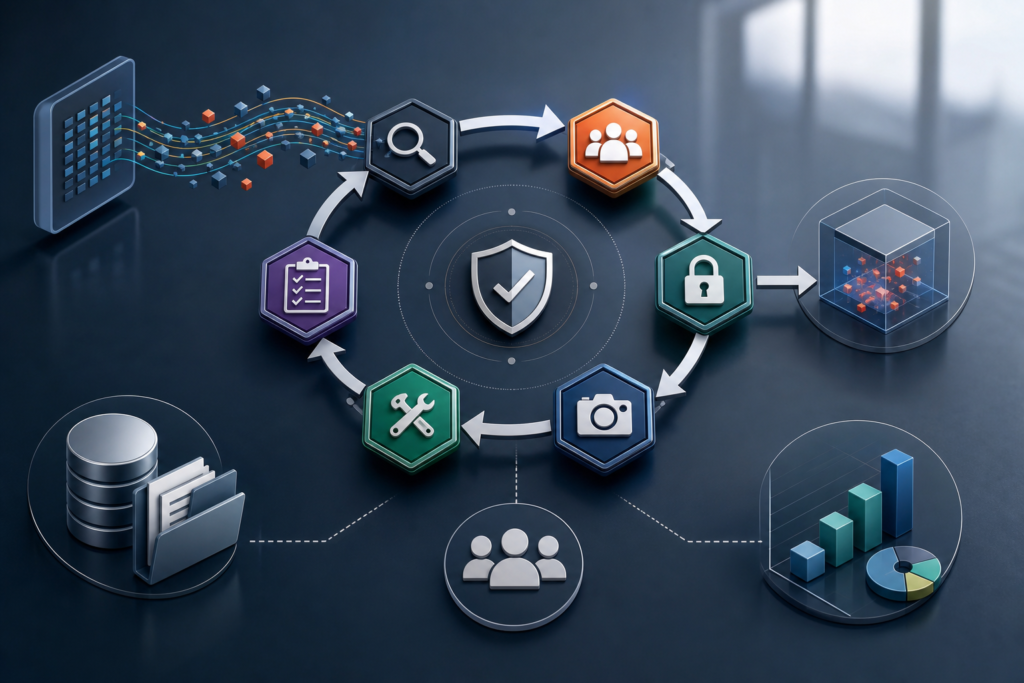
Most companies are building AI governance for approval day, but the real test is incident day. AI incident response is the operating discipline that determines whether a business can detect, classify, contain, investigate, remediate, communicate, and learn from failures involving AI systems.
The real test is incident day
AI governance often looks credible in a meeting.
There is a policy. There is a vendor review. There may be a risk register, an acceptable-use statement, a model evaluation, a procurement checklist, and a committee that approves new AI use cases.
Then an AI workflow fails in production.
A support assistant gives a customer the wrong refund answer. A retrieval system exposes internal notes in a generated response. An agent calls a tool with the wrong account identifier. A knowledge assistant cites a superseded policy. A sales workflow writes inaccurate enrichment data into the CRM. A reviewer approves a draft because the evidence trail was hidden from the review screen.
That is when governance becomes operational or gets exposed as paperwork.
AI incident response is the process for handling AI-caused or AI-assisted failures after they are detected. It covers unsafe outputs, data exposure, tool misuse, biased routing, incorrect recommendations, workflow corruption, policy violations, excessive autonomy, and near misses where harm was avoided by luck, review, or containment.
Policies, evals, guardrails, and observability matter. They reduce risk and help teams detect abnormal behavior. They do not answer the harder operational questions by themselves: Who owns the incident? How severe is it? What gets paused? What evidence must be preserved? Who tells customers, legal, security, compliance, product, or operations? What control changes before the workflow goes back to normal?
That missing loop is where many AI programs are weakest.
What AI incident response means
AI incident response is the practical operating loop for detecting, classifying, containing, investigating, remediating, communicating, and learning from failures involving AI systems.
A useful internal definition should be broad enough to cover security, safety, quality, compliance, and business operations. If the system uses AI to influence a real workflow, then failures can become business incidents.
A few terms need plain definitions:
- AI incident: An event where an AI system contributes to actual or potential harm, policy violation, operational disruption, data exposure, bad customer experience, financial error, or materially incorrect decision support.
- Near miss: A failure that could have caused harm but was caught before impact, often by human review, validation, monitoring, or chance.
- Severity level: A business classification that reflects impact, urgency, blast radius, reversibility, customer exposure, data sensitivity, regulatory context, and whether the system can continue safely.
- Containment: The immediate action that limits further harm, such as pausing a workflow, disabling a tool, narrowing permissions, routing all outputs to review, rolling back a prompt, or blocking a data source.
- Remediation: The corrective work that fixes the underlying cause, such as changing prompts, retrieval, permissions, evals, validators, UI review design, tool schemas, training, or operational procedures.
- Rollback: Returning a system, workflow, model, prompt, tool integration, or permission set to a prior known state.
- Post-incident review: A structured review that explains what happened, why controls failed or succeeded, what evidence exists, what changed, and how recurrence will be measured.
The key point for leaders is simple: an AI incident is not always a cyberattack. It may be a normal-looking workflow that produced the wrong business outcome.
That is why AI Observability Is Automation’s Critical Control Layer is so closely connected to incident response. If the organization cannot reconstruct what the AI saw, retrieved, generated, called, changed, approved, and escalated, it cannot investigate the incident with confidence.
Governance, observability, security, and incident response are different layers
Teams often blur four related disciplines. The confusion creates gaps.
| Layer | Primary job | Where it stops | What AI incident response adds |
|---|---|---|---|
| AI governance | Defines policy, ownership, risk appetite, approval rules, and accountability | It may approve systems without specifying incident-day actions | Converts governance intent into escalation, containment, remediation, and learning |
| AI observability | Records prompts, retrieval, model calls, tool calls, approvals, costs, errors, and outcomes | It can detect and explain behavior without deciding what to do next | Turns evidence into response decisions |
| Security incident response | Handles cybersecurity events such as compromise, abuse, exfiltration, and unauthorized access | It may miss business AI failures that are not attacks | Expands response to unsafe outputs, flawed recommendations, over-trusted automation, and workflow harm |
| AI incident response | Coordinates classification, containment, investigation, communication, remediation, and post-incident learning | It depends on governance, observability, and security to work well | Creates the operating loop for incident day |
NIST’s AI Risk Management Framework is useful because it frames AI risk as a lifecycle activity through govern, map, measure, and manage functions. NIST’s Cybersecurity Framework 2.0 also gives familiar language around govern, identify, protect, detect, respond, and recover. OWASP’s Top 10 for LLM Applications adds application-layer risks such as prompt injection, sensitive information disclosure, improper output handling, excessive agency, misinformation, and unbounded consumption.
Those frameworks are valuable. They still need translation into company-specific response behavior.
A mid-market company does not need a massive AI risk office to begin. It does need a clear operating loop for the AI workflows that touch customers, money, sensitive data, internal records, regulated decisions, or external communications.
Why this matters now
AI systems are moving from chat windows into workflows.
They retrieve internal knowledge. They draft customer replies. They classify tickets. They summarize calls. They update records. They recommend refunds. They review documents. They call APIs. They trigger automations. They route cases. They help engineers write code. They generate content that customers, employees, or partners may trust.
Once AI touches a workflow, failure changes shape.
Traditional monitoring may show that the service is up, latency is fine, and the API call succeeded. The business failure may still be severe. The AI retrieved the wrong document, used stale context, wrote a plausible but false answer, called the right tool with the wrong argument, or gave a human reviewer too little evidence to challenge the output.
The AI Incident Database exists because public AI failures and near harms are now numerous enough to require indexing and collective learning. The EU AI Act also contains serious incident reporting obligations for certain high-risk AI systems, which signals that incident handling is becoming part of the governance landscape for some organizations and use cases.
For most businesses, the immediate lesson is operational rather than legal. As AI becomes embedded in work, the organization needs incident muscle memory. Waiting until the first customer-facing failure is too late.
The mistake most teams make
The common failure pattern is approval without response design.
A company approves an AI use case. The team runs evaluations. A vendor passes security review. The pilot looks good. The workflow launches. The dashboard tracks usage and cost.
Then an incident occurs and everyone discovers that the operating model is vague.
Product thinks engineering owns it. Engineering thinks the business owner owns it. Security gets involved only if there is suspected abuse or data exposure. Legal asks for evidence that was never preserved. Compliance asks whether this triggers reporting obligations. Customer support wants guidance on what to tell affected users. Operations wants to know whether to pause the workflow. Leadership wants to know whether the incident is isolated or systemic.
The delay is not caused by a lack of intelligence. It is caused by missing decision rights.
AI incident response should be designed before scaling the workflow, especially when AI can write to business systems, communicate externally, use sensitive knowledge, or influence high-impact decisions.
This is the same operating principle behind AI Governance Is Infrastructure, Not Paperwork. Governance becomes real only when it changes permissions, logging, review gates, escalation paths, rollback options, and operating behavior.
The technical reality behind the business decision
AI incidents are difficult to investigate because AI behavior is often probabilistic, context-dependent, and distributed across systems.
A single bad outcome might involve:
- The user request or business event
- The system prompt and prompt version
- The model provider, model name, and deployment settings
- Retrieved documents, chunks, rankings, filters, and source freshness
- Structured output validation
- Tool schemas, arguments, responses, errors, and retries
- Permission checks and role-based access rules
- Human review, approval, rejection, override, or escalation
- Downstream writes to CRMs, helpdesks, ERPs, ticketing systems, repositories, or databases
- The final customer, employee, financial, operational, or compliance outcome
If those pieces are not logged with usable identifiers and timestamps, post-incident analysis becomes guesswork.
Technical teams should think of AI incident response as an architecture requirement, not a cleanup procedure. OpenTelemetry’s generative AI semantic conventions are one sign that AI telemetry is becoming more standardized. Anthropic’s agent evaluation guidance also emphasizes transcripts, traces, trajectories, tool calls, intermediate results, and environment outcomes when evaluating agent behavior.
For business leaders, the translation is direct: if a system cannot preserve the evidence needed to explain failure, it is not ready for high-impact automation.
There are tradeoffs. More logging helps investigations but can increase privacy, retention, and security obligations. More human approval can reduce risk but add latency and cost. More aggressive containment can protect customers but interrupt legitimate operations. More autonomy can increase throughput but expand the blast radius.
Those tradeoffs should be explicit before launch.
What should trigger an AI incident?
Every hallucination is not automatically a major incident. Every low-quality draft should not create a crisis process. If everything is an incident, nothing gets handled well.
The better approach is to define triggers by impact and control failure.
An AI-generated typo in an internal draft may be a quality issue. A hallucinated legal citation sent to a client may be an incident. A chatbot giving a vague answer may be a product issue. A chatbot exposing another customer’s information is an incident. A model producing a weak summary may be feedback data. A workflow repeatedly updating the wrong account record is an incident.
Useful triggers include:
- Customer-facing misinformation with material business, legal, financial, health, safety, or reputational impact
- Sensitive data exposure through prompts, retrieved context, logs, outputs, or tool responses
- AI tool use that creates unauthorized, duplicate, excessive, or irreversible actions
- Biased, unfair, or policy-violating recommendations in consequential workflows
- Prompt injection, jailbreak, data poisoning, or retrieval manipulation affecting system behavior
- Workflow drift after model, prompt, retrieval, policy, or integration changes
- Human reviewers approving AI outputs because the review interface hid necessary evidence
- Repeated near misses showing a pattern, even when no customer harm occurred
The point is to avoid treating AI incidents as isolated prompt defects. Many failures are system failures. The model may be part of the story, but so are retrieval, permissions, review design, tool boundaries, validation, and operating ownership.
Severity should drive response, not panic
Severity classification prevents two bad outcomes: overreaction to small issues and underreaction to serious ones.
A practical severity model can be simple.
| Severity | Typical signal | Immediate response |
|---|---|---|
| Low | Internal-only quality issue, no sensitive data, no external impact, easy correction | Log, monitor, add to evals or backlog |
| Medium | Limited business impact, contained customer exposure, reversible action, no regulated reporting likely | Triage, preserve evidence, notify owner, fix before expansion |
| High | Customer harm, sensitive data exposure, financial impact, policy violation, repeated failure, or workflow corruption | Pause affected workflow, escalate to cross-functional incident owner, investigate root cause, prepare communication |
| Critical | Broad harm, serious safety issue, major data exposure, regulated high-risk system impact, material legal or reputational exposure, uncontrolled autonomous action | Disable or isolate system, activate executive, legal, security, compliance, and communications response, preserve evidence under stricter controls |
Severity should consider blast radius, reversibility, exposure, recurrence, autonomy, and uncertainty.
A small visible failure may be less dangerous than a silent pattern. One bad draft caught by a reviewer may be a near miss. Fifty incorrect CRM updates over two weeks may be a high-severity workflow incident even if no single moment looked dramatic.
The incident-day operating loop
A useful AI incident response loop has seven steps.
- Detect: Receive signal from monitoring, human review, user report, audit sample, anomaly detection, security alert, or business metric.
- Classify: Decide whether this is a quality issue, near miss, security event, AI incident, or broader operational incident.
- Contain: Pause, route to human review, disable a tool, roll back a prompt, block a retrieval source, limit permissions, or stop downstream writes.
- Preserve evidence: Capture prompts, inputs, outputs, retrieval context, tool calls, approvals, versions, logs, timestamps, user impact, and downstream actions.
- Investigate: Determine whether the failure came from model behavior, retrieval, data quality, prompt design, tool permissions, validation, human review, integration, or policy ambiguity.
- Remediate and recover: Fix the cause, validate the fix, restore service safely, communicate to affected stakeholders where appropriate, and track cleanup.
- Learn: Update eval sets, guardrails, permissions, review screens, runbooks, training, monitoring, vendor requirements, and governance controls.
This loop should be documented in a playbook short enough to use under pressure.
What leaders should fund before scaling
AI incident response requires modest but real investment.
Leaders should fund the boring work that makes incident day manageable:
- Workflow inventory by risk tier
- Named business owners for each production AI workflow
- Severity definitions and escalation paths
- AI observability across prompts, retrieval, model calls, tool calls, approvals, and outcomes
- Evidence retention rules with privacy and security review
- Kill switches, permission narrowing, rollback paths, and fallback workflows
- Human review queues for high-risk or uncertain outputs
- Incident runbooks for customer-facing, data-sensitive, tool-using, and decision-support systems
- Post-incident reviews that update evals and controls
This connects directly to AI Evals Are the Critical Layer Between Demo and Production. Incidents should feed evaluation sets. Near misses should become test cases. Post-incident learning should change the system, not disappear into a meeting summary.
What builders should verify
Engineering and product teams need to verify that the workflow can be operated under stress.
Before expanding autonomy, builders should ask:
- Can we identify the exact prompt, model, retrieval source, tool call, approval record, and downstream action for a specific output?
- Can we disable a tool without taking down the entire product?
- Can we force all outputs through human review temporarily?
- Can we roll back a prompt, policy, retrieval index, model configuration, or integration change?
- Can we replay an incident safely in a staging or evaluation environment?
- Can we determine whether the issue affected one user, one segment, one workflow, or the whole system?
- Can we identify records changed by the AI workflow and correct them?
- Can security, legal, compliance, product, operations, and support access the evidence they need without exposing more sensitive data?
For agentic systems, AI Agent Guardrails for Safe Workflow Permissions is especially relevant. Tool permissions define blast radius. Least privilege, approval gates, idempotent actions, bounded retries, and audit trails make incidents smaller and easier to understand.
A practical example: support AI with tool access
Consider a customer support workflow.
The AI reads a ticket, retrieves policy, summarizes customer history, drafts a response, and proposes a refund action through a connected tool. A reviewer approves the action for cases under a threshold.
A weak incident response design logs only the final response. When a customer complains, the team cannot tell whether the error came from the retrieved policy, the customer history lookup, the refund calculation, the tool call, or the human approval step.
A stronger design preserves the full workflow trace. It records the policy version, retrieval source, customer account identifier, model output, proposed refund amount, tool arguments, reviewer decision, and final action. It also has a containment option: route all refund recommendations to manual review, disable the refund tool temporarily, or roll back to a previous prompt and policy index.
Now the incident can be handled as a business system failure rather than a mystery.
The team can ask: Was this one bad answer, a stale policy, a permission issue, a tool schema error, a reviewer interface problem, or a pattern across all refund cases?
That question determines the fix.
The better mental model: the incident-ready workflow
The mental model leaders should use is the incident-ready workflow.
An incident-ready AI workflow has four properties.
First, it can be seen. The organization can reconstruct what happened across prompts, retrieval, model behavior, tools, approvals, and outcomes.
Second, it can be stopped. The team can pause, narrow, or route the workflow without waiting for a full engineering project.
Third, it can be explained. The incident owner can distinguish model error from data error, permission error, review error, policy ambiguity, vendor change, or integration failure.
Fourth, it can be improved. The lesson changes evals, controls, prompts, permissions, retrieval, monitoring, review design, or operating policy.
That is the bridge between governance and operations.
The line worth defending
AI incident response is not a sign that AI adoption has failed. It is a sign that the organization is treating AI as production infrastructure.
A company that cannot respond to AI failure should be careful about expanding AI autonomy. A company that can detect, contain, explain, and learn from failure has a better chance of earning trust through evidence.
The goal is not to prevent every bad output. That is unrealistic. The goal is to prevent one bad output from becoming uncontrolled harm, silent recurrence, or institutional confusion.
Approval day tells you what the company hopes the AI system will do. Incident day tells you whether the company can operate it.
Key Takeaways
- AI incident response is the operating loop that connects AI governance to real production behavior.
- An AI incident can involve unsafe outputs, data exposure, tool misuse, biased decisions, workflow corruption, or policy violations.
- Governance, observability, security response, and AI incident response overlap, but they are not the same discipline.
- Leaders should define severity, ownership, containment options, evidence requirements, and escalation paths before scaling AI workflows.
- Builders should instrument prompts, retrieval, model calls, tool calls, approvals, versions, permissions, and downstream outcomes.
- Near misses matter because they reveal control weaknesses before larger harm occurs.
- Post-incident reviews should update evals, prompts, guardrails, retrieval, permissions, review design, and governance controls.
- The strongest AI workflows are incident-ready: visible, stoppable, explainable, and improvable.
Practical Decision Framework
Use this framework when deciding how much AI incident response discipline a workflow needs before launch or scale.
| Decision Area | Low-Risk Signal | Higher-Risk Signal | Required Response Capability |
|---|---|---|---|
| Customer exposure | Internal draft or assistant output | Customer-facing answer, decision, or action | Escalation path, communication plan, review queue |
| Data sensitivity | Public or low-sensitivity content | Customer, employee, legal, financial, regulated, or confidential data | Evidence controls, redaction, access limits, retention policy |
| Autonomy | AI recommends only | AI writes, sends, updates, approves, purchases, deletes, or triggers tools | Kill switch, approval gate, rollback, tool-level logging |
| Reversibility | Easy to undo | Difficult, costly, or impossible to undo | Strict containment, human approval, recovery plan |
| Business impact | Minor productivity issue | Financial, legal, reputational, safety, compliance, or customer trust impact | Severity model, executive escalation, post-incident review |
| Observability | Final output visible | Full trace across prompt, retrieval, tools, approvals, and outcomes needed | Trace IDs, logs, version records, incident evidence package |
| Recurrence risk | One-off low-impact defect | Repeated failures, drift, or similar near misses | Eval update, monitoring alert, root-cause remediation |
A practical rule: any AI workflow that can affect customers, money, sensitive data, systems of record, regulated decisions, or external communications needs an incident response playbook before it earns more autonomy.
FAQ
What is AI incident response?
AI incident response is the process for detecting, classifying, containing, investigating, remediating, communicating, and learning from failures involving AI systems. It applies to failures such as unsafe outputs, data exposure, tool misuse, biased recommendations, workflow errors, policy violations, and near misses.
Is every hallucination an AI incident?
No. A low-impact hallucination in an internal draft may be a quality issue. It becomes an incident when it creates or could create material harm, customer impact, data exposure, financial error, policy violation, compliance concern, or repeated workflow failure.
How is AI incident response different from cybersecurity incident response?
Cybersecurity incident response focuses on security events such as compromise, abuse, unauthorized access, and data exfiltration. AI incident response includes those risks but also covers business AI failures, including incorrect recommendations, unsafe outputs, excessive agency, flawed retrieval, over-trusted automation, biased routing, and workflow harm.
Who should own AI incident response?
Ownership should be shared but explicit. A business owner should own the workflow impact. Engineering or product should own technical investigation and remediation. Security, legal, compliance, privacy, operations, and communications should join based on severity and incident type. One named incident lead should coordinate decisions.
What evidence should teams preserve during an AI incident?
Teams should preserve the user request or business event, prompt and prompt version, retrieved context, model output, model configuration, tool calls, permissions, validation results, approval records, timestamps, downstream actions, affected users or records, and any monitoring or complaint signals.
How can a mid-market company start without creating bureaucracy?
Start with the highest-risk production AI workflows. Define severity levels, owners, escalation paths, evidence requirements, containment options, and post-incident review habits. Keep the playbook short. Expand the process only as workflows become more autonomous, customer-facing, or sensitive.
Sources
- NIST AI Risk Management Framework: https://www.nist.gov/itl/ai-risk-management-framework
- NIST Artificial Intelligence Risk Management Framework, Generative AI Profile: https://nvlpubs.nist.gov/nistpubs/ai/NIST.AI.600-1.pdf
- NIST Cybersecurity Framework 2.0: https://nvlpubs.nist.gov/nistpubs/CSWP/NIST.CSWP.29.pdf
- OWASP Top 10 for LLM Applications 2025: https://genai.owasp.org/resource/owasp-top-10-for-llm-applications-2025/
- OWASP Top 10 for Large Language Model Applications: https://owasp.org/www-project-top-10-for-large-language-model-applications
- AI Incident Database: https://incidentdatabase.ai/
- EU AI Act Article 73, Reporting of Serious Incidents: https://ai-act-service-desk.ec.europa.eu/en/ai-act/article-73
- OECD, Towards a Common Reporting Framework for AI Incidents: https://www.oecd.org/content/dam/oecd/en/publications/reports/2025/02/towards-a-common-reporting-framework-for-ai-incidents_8c488fdb/f326d4ac-en.pdf
- OpenTelemetry Semantic Conventions for Generative AI Systems: https://opentelemetry.io/docs/specs/semconv/gen-ai/
- Google SRE Incident Management Guide: https://sre.google/resources/practices-and-processes/incident-management-guide/
- Anthropic, Demystifying Evals for AI Agents: https://www.anthropic.com/engineering/demystifying-evals-for-ai-agents
Related articles from Kyle Beyke
- AI Observability Is Automation’s Critical Control Layer: https://beykeworkflows.com/ai-observability-business-automation-control-layer/
- AI Evals Are the Critical Layer Between Demo and Production: https://beykeworkflows.com/ai-evals-management-layer-demos-production/
- AI Governance Is Infrastructure, Not Paperwork: https://beykeworkflows.com/ai-governance-infrastructure-not-paperwork-business/
- Human-in-the-Loop AI Workflows: Reliable Approval Systems: https://beykeworkflows.com/human-in-the-loop-ai-workflows-approval-systems/
- AI Agent Guardrails for Safe Workflow Permissions: https://beykeworkflows.com/ai-agent-guardrails-permissions-safe-business-workflows/
- The Practical AI Operating Model for Mid-Market Companies: https://beykeworkflows.com/ai-operating-model-mid-market-companies/