Category: Editorial

Posts filed under Editorial.

Quantum-Enhanced LLMs: Real Signal, Weak Strategy

Decision map for quantum-enhanced LLMs showing a classical model, quantum adapter, evaluation gates, workflow metrics, and human review points.

A recent IBM quantum hardware experiment improved Llama 3.1 8B in a narrow research setup, but the business lesson is more disciplined than the headline suggests. Quantum-enhanced LLMs deserve attention as a compute signal, not as a procurement trigger. Leaders should watch the evidence, compare classical alternatives, and measure workflow value before funding quantum AI claims.

Read more

The Practical AI Operating Model for Mid-Market Companies

AI operating model for mid-market companies shown as a workflow map with ownership, governance, integration, evaluation, and human review points.

Mid-market companies do not need enterprise AI bureaucracy, but scattered pilots are not a strategy. This article argues for a lean AI operating model that defines ownership, prioritization, governance, workflow integration, evaluation, and measurement before AI tools scale across the business.

Read more

AI World Models: The Strategic Shift from Next Token to Next State

AI world models workflow map showing current state, actions, predicted next states, feedback loops, and human review points.

AI world models are becoming a serious strategy topic because many valuable AI problems are not language problems. They are state problems. This article explains the shift from next-token prediction to next-state prediction, where world-model thinking matters, where the hype outruns production reality, and what leaders and builders should evaluate before funding state-aware AI systems.

Read more

Model Context Protocol: The Critical Connector Shift

Model Context Protocol connector architecture showing AI systems linked to business workflows, approval gates, data sources, and audit logs.

Model Context Protocol is not just another developer convenience. It is a sign that AI value is moving from isolated chatbot experiences toward governed connector infrastructure. The real question for businesses is no longer whether a model can respond well, but whether it can safely reach the right systems, follow the right rules, and leave an auditable trail.

Read more

AI Procurement Is Broken: Demand Real Evidence

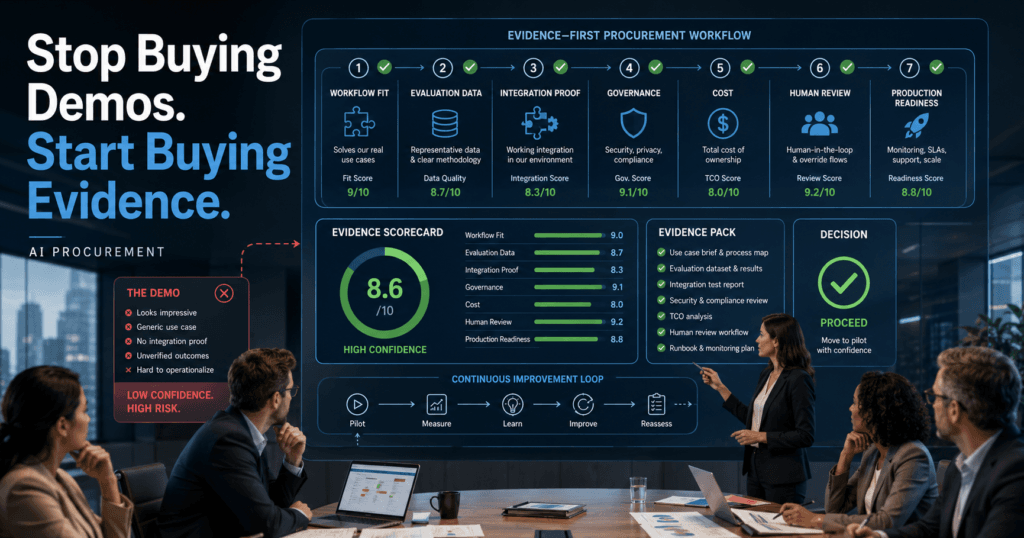
AI procurement evidence review board comparing vendor demos against workflow tests, governance checks, cost metrics, and integration proof

AI procurement often rewards the most impressive demo instead of the strongest operational proof. That is how companies buy tools that look useful in a sales call but fail inside real workflows. This article argues for an evidence-first buying model built around representative tests, integration reality, governance, cost, reliability, and clear ownership before scale.

Read more

The AI Pilot Trap: Why Strong Demos Still Fail

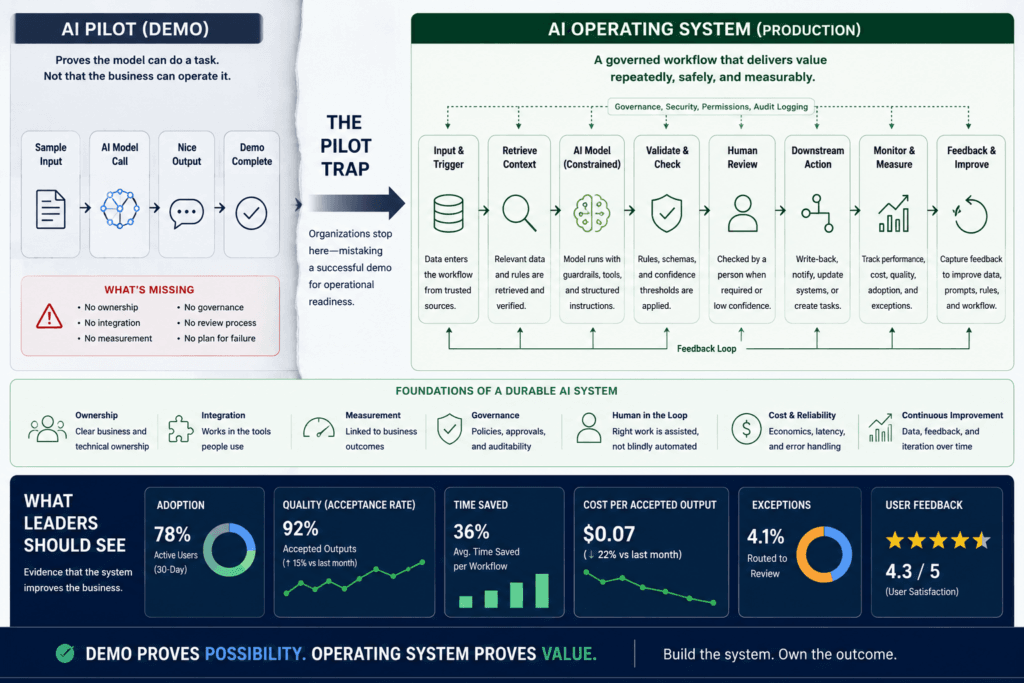
AI pilot trap visual showing a business workflow map moving from demo to governed operating system with review, metrics, and integration points

The AI pilot trap starts when companies treat a successful demo as evidence of operational readiness. A pilot can prove that a model can perform a task, but production value requires ownership, workflow integration, measurement, governance, review paths, cost discipline, and trust. This article explains why AI pilots stall and what separates experiments from durable business systems.

Read more

AI Governance Is Infrastructure, Not Paperwork

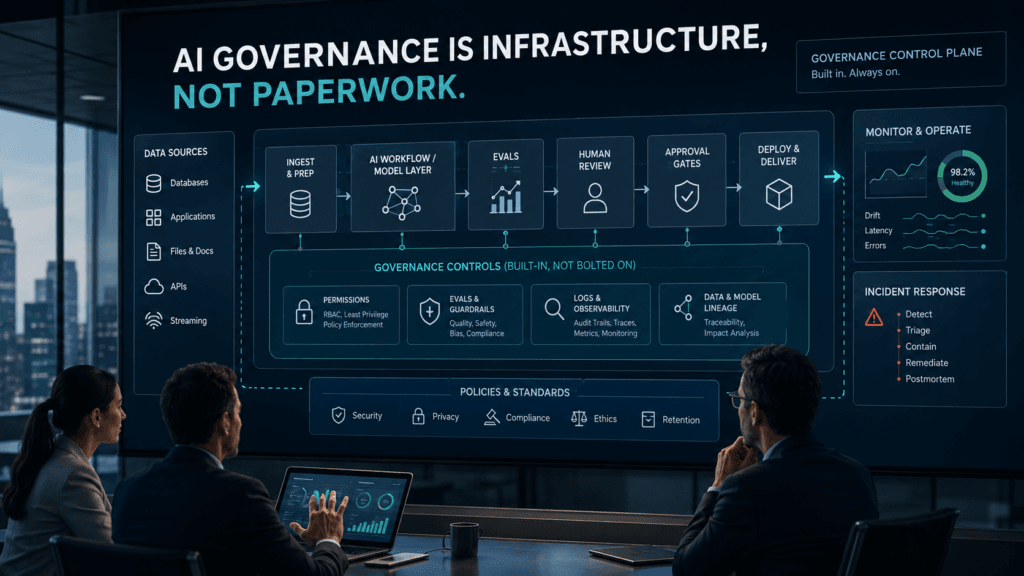
AI governance control plane showing workflow permissions, evaluation, logging, human review, and incident response across a business system

A company can have an AI policy and still have weak AI governance. The real test is whether governance changes how AI systems access data, use tools, route decisions, log behavior, involve humans, and recover from failure. As AI moves into production workflows, governance has to become part of the operating infrastructure.

Read more

Natural Language Autoencoders: A Critical Trust Lesson

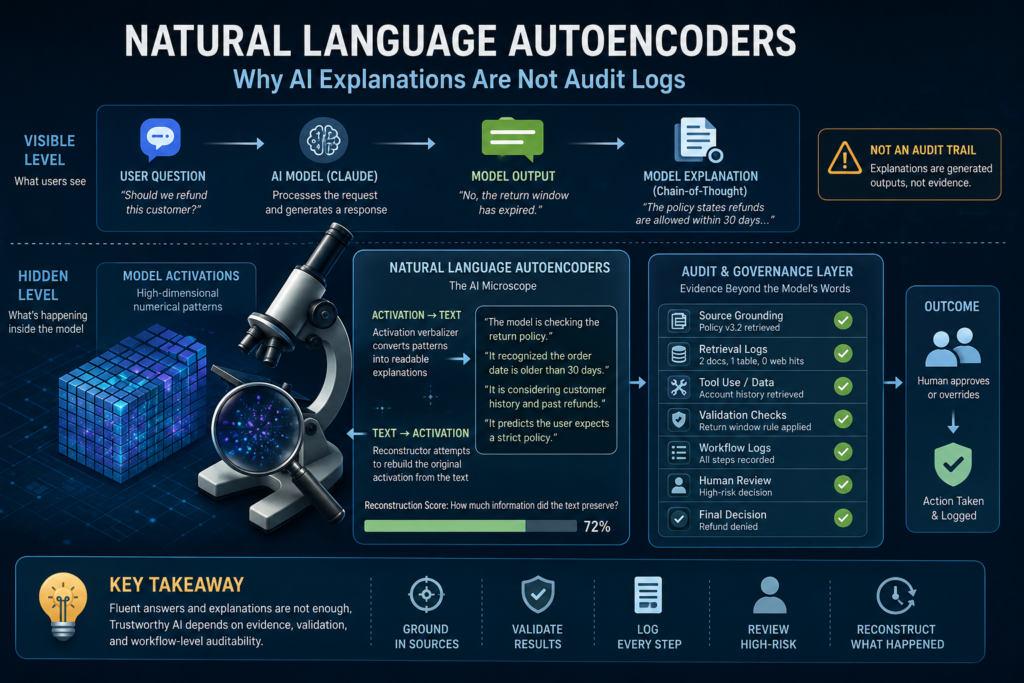
Natural language autoencoders shown as an AI audit workflow with hidden activations, readable explanations, validation checks, and human review.

Natural language autoencoders are being described as an AI microscope, but the business lesson is not that Claude thinks like a person. The real lesson is harder: fluent answers, polished explanations, and strong benchmarks are not enough evidence of reliable AI behavior. Leaders and builders need workflow-level evaluation, observability, grounding, and audit controls.

Read more

Agent Washing: Real AI Agents vs. Rebranded Automation

Agent washing illustrated as a business workflow diagram comparing real AI agents with rebranded automation.

Agent washing happens when chatbots, scripts, copilots, and workflow automation are relabeled as AI agents without meaningful autonomy or accountability. The distinction matters because leaders may fund the wrong systems, underestimate risk, and mistake demos for production capability. Real agents need tools, context, controls, evaluation, and clear ownership.

Read more

Shadow AI Is a Leadership Problem, Not Just IT

A business workflow map showing shadow AI risk paths, approved AI tools, data boundaries, and human review checkpoints.

Shadow AI is not mainly a sign that employees want to create risk. It is a signal that the approved path is too slow, unclear, or weak for the work people need to do. Leaders need visibility, data boundaries, usable approved tools, workflow-based governance, and training that employees can actually follow.

Read more