
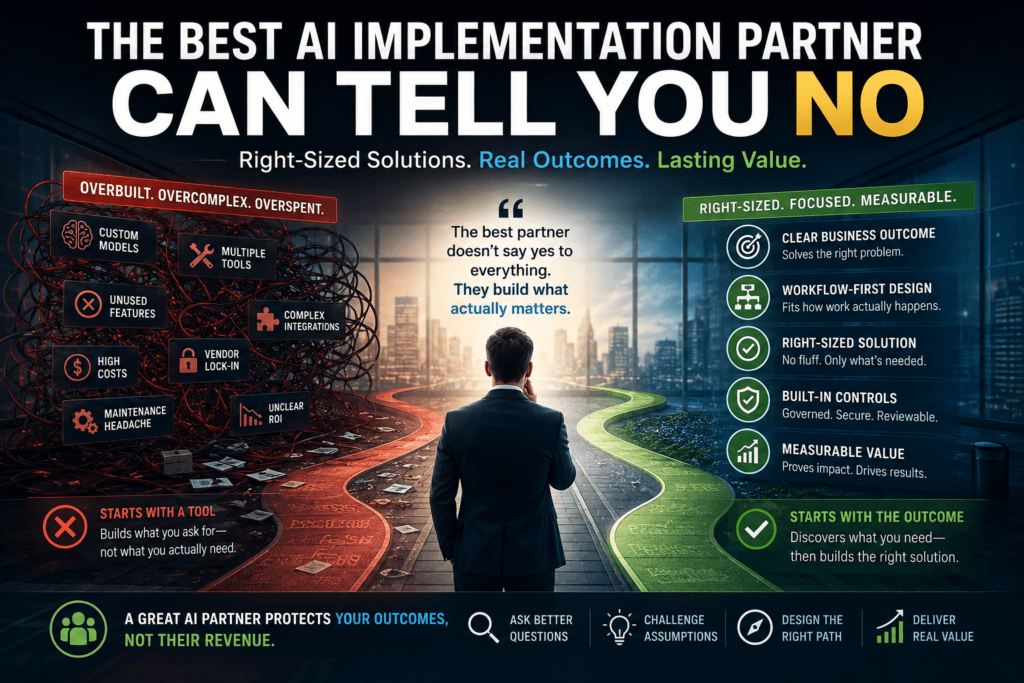
The best AI implementation partner is not the one who says yes to every request; it is the one who understands the business well enough to say no, then designs the smallest responsible path to yes.
The AI Implementation Partner Who Can Tell You No
A bad AI partner builds exactly what you ask for.
A good AI partner figures out what you actually need.
That distinction matters because most businesses do not ask for AI in the language of systems. They ask in the language of whatever they have heard about recently: a chatbot, an agent, a dashboard, a custom model, a private AI system, an automation platform, or an “AI workflow” that somehow fixes a slow process.
Sometimes the request is right. Often, it is only the first clue.
A business might ask for an AI chatbot when the real problem is inconsistent intake. It might ask for a custom model when the real need is structured extraction from documents. It might ask for a full automation when the workflow still needs human review. It might ask for a dashboard when the useful solution is a weekly exception report. It might ask for enterprise AI infrastructure when the right first move is a small pilot with clear measurement.
This is why choosing an AI implementation partner is not just a procurement decision. It is a judgment decision.
The wrong partner will happily sell everything the business asks for, including the model, the interface, the integrations, the dashboards, the training, the platform, and the kitchen sink. The right partner will slow the conversation down. They will ask what outcome matters, what workflow changes, what data exists, what should remain human-reviewed, what happens when the system is wrong, and what the cheapest safe version of the solution looks like.
That may sound less exciting than a cutting-edge demo. It is also how useful systems get built.
The “Yes” Problem in AI Consulting
AI creates a dangerous sales incentive: the impressive solution is often easier to sell than the right-sized one.
A complex proposal looks serious. It can include agents, retrieval, vector databases, custom dashboards, private models, workflow automation, CRM integrations, reporting layers, monitoring tools, and training packages. Some businesses assume that a larger proposal means the partner is more capable.
Not necessarily.
Complexity can be necessary, but it should have to earn its place. Every additional component becomes something the business has to pay for, secure, monitor, maintain, explain, and eventually update. A custom workflow that sounds impressive in a proposal can become a liability if no one owns it after launch.
This is where a reliable partner should be willing to say no.
Not “no” as a dead end. Not “no” because the work is too hard. Not “no” to protect their own convenience.
The useful kind of “no” sounds more like this:
“No, you do not need a custom model yet. Let’s test existing models against real examples first.”
“No, full automation is not safe for this workflow. Let’s build a review queue and measure correction rates.”
“No, that dashboard will not change behavior. Let’s identify the decision it is supposed to support.”
“No, the data is not ready. The first project is cleanup, structure, and access.”
“No, an agent should not be allowed to update production systems until permissions, logging, and rollback are defined.”
That kind of refusal is not negativity. It is implementation discipline.
Requirements Are Not the Same as Requests
Project failure often starts before anyone writes code. It starts when the wrong thing gets defined as the requirement.
The Project Management Institute has reported that inaccurate requirements management contributes heavily to unsuccessful projects, including scope creep, poor communication, weak stakeholder involvement, and inadequate sponsor support. That matters for AI because many AI projects begin with especially vague requirements.
“We need AI.”
“We need an agent.”
“We need to automate support.”
“We need a chatbot for our website.”
“We need an internal knowledge assistant.”
Those statements are not requirements. They are openings.
A good AI implementation partner treats the initial request as evidence to investigate. They do not assume the requested artifact is the correct solution. They ask what the business is trying to improve.
Is the goal speed? Cost reduction? Better customer response? Less manual data entry? Fewer errors? Better documentation? More consistent decisions? Better use of existing information? Reduced backlog? More reliable handoffs?
Until that is clear, the solution is premature.
The client asks for AI. The real job is to discover the workflow.
AI Value Comes From Workflow Fit
The strongest AI work usually does not begin with model choice. It begins with workflow fit.
McKinsey’s 2025 AI survey emphasizes that organizations seeing value from generative AI are not merely buying tools. They are redesigning workflows, elevating governance, and managing risk as part of deployment. MIT NANDA’s preliminary 2025 State of AI in Business report makes a similar point from another angle: many enterprise AI efforts stall because systems are brittle, poorly integrated into workflows, or misaligned with day-to-day operations.
That does not mean every AI project should become a major transformation program. It means the AI has to live somewhere real.
Where does the input come from? Who uses the output? What system does it update? What happens when the model is unsure? Who reviews the result? What is logged? What metric proves the process improved? What happens after the first version ships?
If a partner cannot answer those questions, they are not designing an implementation. They are selling a feature.
A chatbot is not a workflow. A model call is not a workflow. A dashboard is not a workflow. A workflow has triggers, users, data, decisions, exceptions, review points, downstream actions, and accountability.
That is where business AI succeeds or fails.
Common Belief vs. Production Reality
| Common Belief | Production Reality | Better Question |
|---|---|---|
| A good AI partner can build whatever we ask for. | A good partner first checks whether the ask is actually the right solution. | What business outcome are we trying to achieve? |
| More AI features mean more value. | More features often mean more cost, complexity, governance, and maintenance. | Which feature directly improves the workflow? |
| A custom AI system proves we are serious. | A custom system may be wasteful if existing tools or simpler workflows solve the problem. | What is the cheapest safe way to prove value? |
| Full automation should be the goal. | Many valuable AI workflows should remain assistive or human-reviewed. | What happens if the model is wrong? |
| Governance slows AI down. | Governance prevents unsafe shortcuts and helps systems scale responsibly. | What controls are required for this risk level? |
Right-Sized Does Not Always Mean Smaller
There is an important correction here: right-sized does not always mean cheap, small, or simple.
Sometimes the business asks for something that sounds small, but the responsible implementation is larger than expected.
A team may ask for “a quick AI assistant” that answers questions from internal documents. That sounds simple until the partner discovers that the documents are outdated, access rules are unclear, answers need citations, confidential content must be excluded, and employees need a way to report bad responses.
A company may ask for an agent that updates CRM records automatically. That sounds efficient until the partner asks who approves changes, how bad updates are reversed, whether the source data is reliable, and how the system prevents unauthorized actions.
A department may ask for a document automation workflow. That may require classification, extraction, structured outputs, validation rules, human review, exception routing, audit logs, and system write-back controls.
In those cases, the honest answer is not “let’s do the smallest possible thing.” The honest answer is “let’s do the smallest responsible thing.”
That distinction matters.
The best solution is not the smallest possible system. It is the smallest system that is safe, useful, maintainable, and capable of producing the intended business outcome.
The Technical Reality Behind the Business Decision
For technical teams, this is familiar: every new system boundary creates obligations.
A model that only drafts text for a human to edit is one level of risk. A model that reads internal documents and produces source-grounded recommendations is another. A model that updates records, triggers emails, changes account status, or takes action in a production system is another level entirely.
As the system gains access and autonomy, the design has to account for more than prompt quality.
The implementation needs data access rules. It needs permission boundaries. It needs structured outputs where downstream systems require predictable fields. It needs validation before write-back. It needs logs. It needs a human review path for uncertain or high-impact outputs. It needs monitoring. It needs a rollback plan. It needs someone responsible for maintaining it.
That is why “we need an AI agent” is not a complete requirement. Agent behavior depends on tools, permissions, memory, context, policies, review points, and failure handling. Without those boundaries, the agent is not a solution. It is an unmanaged risk.
A strong AI implementation partner should be able to explain this in business terms without hiding behind jargon. The issue is not that technical teams are trying to make things complicated. The issue is that business risk increases when AI moves from suggesting to acting.
The Best AI Implementation Partner Translates, Then Builds
A useful partner is not just a builder. They are a translator.
They translate vague ambition into operational requirements. They translate business goals into workflow design. They translate risk into controls. They translate technical tradeoffs into business consequences. They translate “we want AI” into “here is the workflow that should change, here is the first version, here is what we will measure, and here is what we will not automate yet.”
| Client Ask | Better Discovery Question | Possible Right-Sized Solution |
|---|---|---|
| “We need an AI agent.” | What decision or task should it improve? | Workflow assistant with approval steps |
| “We need a custom model.” | Have we tested existing models on real examples? | Prompting, retrieval, or structured extraction first |
| “We need full automation.” | What happens when the output is wrong? | Human-in-the-loop workflow |
| “We need a dashboard.” | What decision will the dashboard change? | Weekly exception report or alert |
| “We need enterprise AI.” | What data, risk, and scale justify enterprise architecture? | Phased pilot with governance gates |
This is where a partner’s integrity shows up.
It is easy to say yes to a client with a budget. It is harder to say, “That is not the best first move.” It is harder to recommend a smaller project when a larger one could be sold. It is harder to tell a business that the data is not ready, the workflow is unclear, or the automation should remain assistive for now.
But that is exactly what a good partner should do.
How the Right Answer Changes by Business Size
The same AI request means different things at different scales.
A small business may need practical workflow help, low-cost automation, and clear boundaries. It probably does not need a custom model, a private deployment, or an elaborate multi-system architecture unless the use case is unusually sensitive or valuable.
A growing business may need repeatability, better data structure, system integration, documentation, and clearer ownership. Its risk is often tool sprawl: too many disconnected AI subscriptions, experiments, and automations with no shared operating model.
A mid-market company may need department-level AI workflows, security review, reporting, adoption planning, and a path from pilot to production. Its risk is launching big transformation programs before requirements are mature.
An enterprise may need governance, auditability, integration, risk management, procurement discipline, and change management. Its risk is fragmented pilots, duplicated platforms, and internal science projects that never become operating systems.
| Business Size | What They Usually Need | What They Often Overbuy | What a Good Partner Should Do |
|---|---|---|---|
| Small business | Practical workflow help, low-cost automation, clear boundaries | Custom platforms, unnecessary model hosting, complex stacks | Start with simple tools, documented workflows, and measurable wins |
| Growing business | Integration, repeatability, data cleanup, governance | Too many disconnected AI tools | Standardize workflows and choose tools based on value |
| Mid-market | Department-level automation, security, reporting, adoption plans | Big transformation programs before requirements are mature | Build pilots that can scale if metrics justify it |
| Enterprise | Governance, risk controls, integration, auditability, change management | Fragmented pilots, duplicated platforms, internal science projects | Create architecture and governance around prioritized workflows |
The principle is the same at every size: the solution should fit the business outcome, risk level, operating capacity, and expected return.
Warning Signs of an AI Partner Who May Oversell You
Not every oversized proposal comes from bad intent. Sometimes it comes from enthusiasm, template-based consulting, vendor incentives, or misunderstanding the actual workflow. Still, businesses should watch for warning signs.
Be careful when a partner recommends a platform before understanding the process.
Be careful when they sell agents before discussing permissions, review points, and failure modes.
Be careful when they propose custom models before testing existing tools, retrieval, prompting, or structured extraction.
Be careful when they avoid maintenance.
Be careful when success is described as “AI adoption” instead of a measurable workflow improvement.
Be careful when they cannot explain what should remain human-reviewed.
Be careful when they never say no.
A good partner should be able to explain what not to build yet. That is part of the job.
What Businesses Should Ask Before Hiring an AI Partner
The selection conversation should be practical.
Ask what business outcome the partner thinks the project should target. Ask which workflow would change. Ask what data is needed. Ask which parts can be solved without AI. Ask what should remain human-reviewed. Ask what the cheapest safe pilot looks like. Ask what metric would prove value. Ask what breaks if the AI is wrong. Ask what maintenance will be required after launch. Ask what would justify scaling.
The answers matter more than the sales deck.
A partner who starts with discovery is not slowing the project down. They are preventing the business from moving quickly in the wrong direction.
A partner who challenges scope is not being difficult. They are reducing the chance that the project becomes expensive theater.
A partner who adds governance where needed is not overcomplicating the project. They are protecting the system from becoming unsafe, untrusted, or impossible to scale.
The Better Operating Model
The practical operating model is simple:
Translate the ask. Right-size the solution. Prove the value. Scale only what earns it.
That model keeps AI grounded.
Translation prevents the business from confusing the requested tool with the real requirement. Right-sizing prevents unnecessary complexity. Proof prevents enthusiasm from substituting for results. Scaling only what earns it prevents the organization from turning pilots into permanent cost centers.
This approach also respects both business and technical teams.
Business leaders get cost discipline and clearer outcomes. Technical teams get better requirements and fewer vague mandates. Operators get workflows that fit how work actually happens. Users get tools that support their tasks instead of adding another place to check. Governance teams get clearer controls. Finance gets a better way to compare spend against value.
That is the standard businesses should expect.
The Partner Who Says No Is Protecting the Outcome
A reliable AI implementation partner is not defined by how much they can build. They are defined by how well they can judge what should be built.
Sometimes the right answer is smaller than the business expected: a form, a rules-based workflow, a structured output, a human-reviewed assistant, a search improvement, or a reporting process.
Sometimes the right answer is larger than the business expected: permissions, logging, review queues, evaluation, governance, data cleanup, or integration work that has to exist before AI can be trusted.
The point is not minimalism for its own sake. The point is fit.
AI implementation should not be scoped around vendor excitement, executive pressure, or the newest technical trend. It should be scoped around the business outcome, the workflow, the data, the risk, the users, and the operating model.
The best AI implementation partner is the one with enough honesty and technical discipline to say no to the wrong thing, then help the business build the right thing.
Key Takeaways
- A good AI implementation partner should challenge the initial request, not blindly fulfill it.
- The first business ask is often a clue, not the final requirement.
- Right-sized AI does not always mean smaller; it means appropriate for the workflow, risk, data, users, and outcome.
- More AI features can create more cost, complexity, governance burden, and maintenance.
- Strong AI implementation starts with workflow discovery, requirements clarity, and measurable success criteria.
- Full automation is not always the goal; assistive AI with human review is often the safer and more useful starting point.
- Businesses should evaluate partners by judgment, integrity, and implementation discipline, not just technical capability.
- A partner who never says no may be protecting the sale more than the outcome.
Practical Decision Framework
Use this framework before hiring or approving an AI implementation partner.
- Define the business outcome.
Ask what decision, workflow, bottleneck, or customer experience the project is supposed to improve. - Separate the ask from the requirement.
Treat requests like “chatbot,” “agent,” “dashboard,” or “custom model” as starting points, not final answers. - Identify the smallest responsible solution.
Look for the simplest architecture that can safely produce measurable value. Avoid custom systems when existing tools, structured workflows, or process improvements are enough. - Classify the risk.
Decide what happens if the AI is wrong. High-impact, customer-facing, financial, legal, compliance, hiring, or irreversible decisions need stronger controls and human review. - Check data readiness.
Confirm whether the documents, examples, systems, permissions, and data definitions are ready. If not, the first project may be data cleanup or workflow design. - Measure before scaling.
Define success with practical metrics: time saved, accepted output rate, correction rate, exception rate, adoption, cost per useful result, or error reduction. - Ask what should not be built yet.
A trustworthy partner should be able to name the parts of the project that are premature, unnecessary, unsafe, or not yet justified. - Scale only what earns it.
Expand the workflow only after the pilot proves value, adoption, maintainability, and risk control.
FAQ
What makes a good AI implementation partner?
A good AI implementation partner clarifies the real business problem, challenges unnecessary complexity, designs the smallest responsible solution, defines measurable success, and builds only what the workflow, risk, data, and business outcome justify.
Should an AI partner ever tell a client no?
Yes. A responsible partner should say no when the request is unsafe, premature, unnecessarily expensive, poorly defined, or unlikely to solve the real business problem. The important part is turning that no into a practical alternative.
How can a business avoid being oversold on AI?
Ask the partner to explain the workflow, success metric, data requirements, human review points, failure modes, maintenance burden, and cheapest safe pilot. Be cautious if the partner recommends a platform or custom system before understanding the process.
Is the simplest AI solution always the best one?
No. The best solution is not always the smallest possible system. It is the smallest responsible system that is safe, useful, maintainable, and capable of achieving the business outcome.
When should AI remain human-reviewed?
AI should remain human-reviewed when outputs affect customers, finances, compliance, legal decisions, hiring, safety, access rights, production systems, or any workflow where a wrong answer creates meaningful harm.
What should businesses measure in an AI pilot?
Useful measures include time saved, accepted output rate, correction rate, exception rate, user adoption, cost per useful result, error reduction, customer experience impact, and whether the workflow actually improved.
Sources
- Project Management Institute: https://www.pmi.org/learning/thought-leadership/pulse/core-competency-project-program-success
- McKinsey & Company: https://www.mckinsey.com/capabilities/quantumblack/our-insights/the-state-of-ai-how-organizations-are-rewiring-to-capture-value
- MIT NANDA State of AI in Business 2025: https://mlq.ai/media/quarterly_decks/v0.1_State_of_AI_in_Business_2025_Report.pdf
- IMC USA Code of Ethics: https://www.imcusa.org/about/ethics/code-of-ethics/
- Agile Manifesto Principles: https://agilemanifesto.org/principles.html
- NIST AI Risk Management Framework: https://www.nist.gov/itl/ai-risk-management-framework
- NIST Generative AI Profile: https://www.nist.gov/publications/artificial-intelligence-risk-management-framework-generative-artificial-intelligence
- ISO/IEC 42001:2023: https://www.iso.org/standard/81230.html
- OECD AI Principles: https://oecd.ai/en/ai-principles
- Zylo 2025 SaaS Management Index Announcement: https://zylo.com/news/2025-saas-management-index/
Related articles from Kyle Beyke
- AI Use Cases: 7 Smart Rules for Business: https://beykeworkflows.com/ai-use-cases-rules-business/
- AI Workflow Anatomy: Essential Guide for Business: https://beykeworkflows.com/ai-workflow-anatomy-business-guide/
- AI Cost Control: Smart Guide for Efficient Systems: https://beykeworkflows.com/ai-cost-control-systems-tokens-latency-routing/
- AI Model Selection: Powerful Guide for Smart Business AI: https://beykeworkflows.com/ai-model-selection-business-ai-guide/