
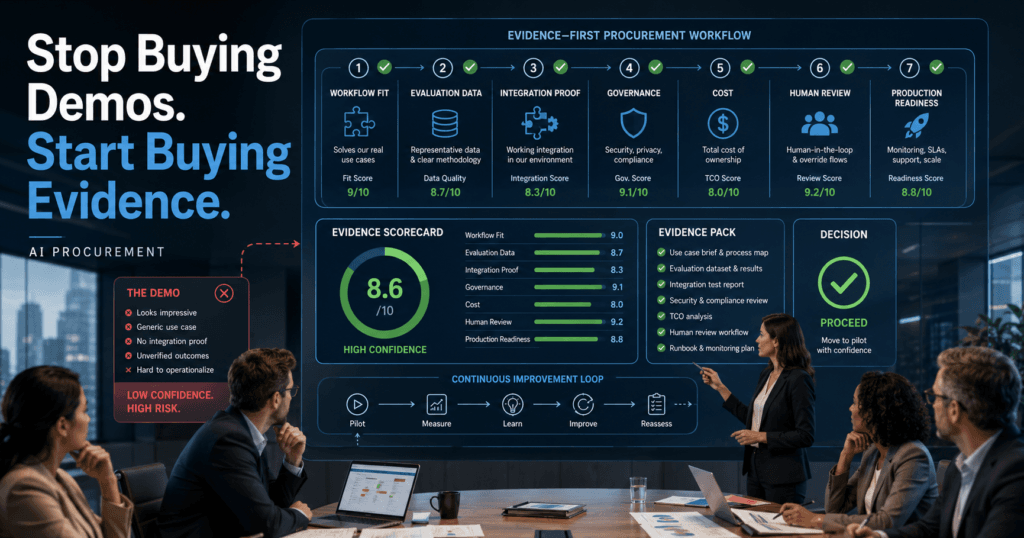
AI procurement fails when buyers confuse a convincing demo with evidence that a system can survive production.
A great AI demo can make a room go quiet. The tool answers quickly. The interface looks clean. The workflow appears obvious. The vendor shows a few examples that match the buyer’s pain points. Someone says, “This could save us hundreds of hours.”
That may be true. It may also be theater.
AI procurement has a demo problem. Not because demos are useless, but because too many buying processes treat them as proof. A demo proves that a vendor can make AI look useful under controlled conditions. It does not prove the system can handle your messy data, your permissions model, your edge cases, your exception queues, your latency requirements, your cost constraints, your compliance posture, or your actual users.
That gap is where AI budgets go to die.
The companies that get value from AI will not be the ones that buy the flashiest tools first. They will be the ones that demand evidence before scale. Evidence that the workflow is real. Evidence that the outputs are measurable. Evidence that the system can be integrated, governed, reviewed, monitored, and improved after the sales team leaves.
A demo shows possibility. AI procurement needs proof.
Why AI procurement keeps rewarding theater
Most software buying processes were already vulnerable to polished selling. AI makes the problem worse because the product can produce moments that feel almost magical.
A traditional software demo usually shows screens, permissions, dashboards, automations, and reports. Buyers can still be misled, but they are often evaluating visible functionality. With generative AI, the most persuasive part of the demo is often the model’s output. It summarizes a document, drafts an email, classifies a ticket, writes a policy answer, or extracts fields from a file.
The output feels like the value.
That is the trap.
In production, the value is not the isolated answer. The value is whether the answer is useful inside a business process. Does it come from the right source material? Can it handle missing context? Does it know when not to answer? Can the output be validated? Can a human review it efficiently? Can it write to the right system without creating downstream cleanup? Can the organization measure whether it improved the workflow?
AI procurement often skips those questions because the demo creates the illusion that the hard part is already solved.
It is not.
The hard part is not getting an AI system to produce a plausible response. The hard part is making that response reliable enough, constrained enough, integrated enough, and accountable enough to be worth operating.
The broken buying pattern
The common failure pattern is easy to recognize.
A team sees a vendor demo. The demo is tailored to a broad use case: customer support, sales enablement, document processing, internal knowledge search, finance operations, contract review, recruiting, engineering productivity, or executive analysis. The vendor uses clean examples. The workflow is narrow. The exceptions are invisible. The cost model is discussed at a high level. Security and governance are “supported.” Integration is described as straightforward.
Then the company buys.
Only after purchase does the real evaluation begin. The tool struggles with internal documents. The permissions model is more complicated than expected. Users do not trust the output. The best use case is narrower than the sales process implied. The system needs more human review than planned. API integration requires engineering work no one budgeted. Cost at real volume looks different from cost in a pilot. The business owner thought IT owned it. IT thought the vendor owned it. The vendor thought the customer had defined success criteria.
That is not an AI failure. It is a procurement failure.
The buying process selected for demo performance instead of operational evidence.
What demos hide
A demo is usually designed to reduce friction. Production exposes friction.
That difference matters because AI tools are sensitive to context. They depend on inputs, instructions, retrieval, model behavior, validation, human review, downstream systems, security boundaries, and user expectations. A small change in any part of that system can change the result.
Here is what a polished demo can hide:
| Common Belief | Production Reality | Better Question |
|---|---|---|
| The demo worked, so the tool is ready. | The demo likely used curated examples, controlled context, and limited failure exposure. | Has the vendor proven the tool on our actual workflow conditions? |
| The best model will solve the problem. | Model capability is only one part of the system; integration, data, validation, and review determine value. | What system around the model is required for reliable operation? |
| A pilot is successful if users like it. | User enthusiasm is useful, but procurement needs measurable quality, cost, adoption, and failure data. | What evidence would justify scaling this tool? |
| Vendor benchmarks prove quality. | Benchmarks may not reflect your tasks, data, policies, risk tolerance, or users. | How does the tool perform on representative examples from our business? |
| Automation means labor savings. | Automation without exception handling often shifts work into review, cleanup, and support. | Which work disappears, and which work moves somewhere else? |
This is why AI vendor evaluation needs to move from “show us what it can do” to “prove how it behaves under our constraints.”
AI procurement is a systems decision, not a tool decision
A common executive mistake is treating AI procurement like ordinary software procurement with an AI label attached.
That is too narrow.
Buying AI is often a decision about a system of work. The vendor may provide the model, interface, retrieval layer, automation engine, monitoring tools, integrations, or administrative controls. But the buyer still owns the business process. The buyer owns the definition of success. The buyer owns the consequences of a bad output reaching a customer, employee, regulator, database, or executive decision.
That means procurement has to evaluate the whole operating model.
For a customer support assistant, the question is not “Can it draft a good reply?” The question is “Can it draft replies that support agents accept, correct less often, keep within policy, escalate correctly, protect customer data, and reduce handling time without damaging customer experience?”
For an invoice extraction tool, the question is not “Can it read this sample PDF?” The question is “Can it extract the right fields from real invoices, preserve evidence, handle exceptions, validate against purchase orders, flag duplicates, and write into the finance system only when safe?”
For a sales-call summary tool, the question is not “Can it summarize a transcript?” The question is “Can it produce CRM-ready notes that reps trust, managers can inspect, security can approve, legal can tolerate, and finance can justify at real usage volume?”
Those are procurement questions. They are also technical questions. AI procurement sits at the intersection of both.
What evidence should replace demo excitement
The alternative to demo-led buying is not bureaucracy. It is evidence.
Evidence-based AI procurement means evaluating an AI product against real workflows, representative data, measurable quality bars, integration requirements, cost expectations, risk controls, and operational ownership before making a purchase decision.
That starts with a blunt requirement: no AI tool should be approved for scale until the buying team can describe what would prove it works.
Not what would make it look impressive. What would prove it works.
A credible AI proof of concept should include representative examples. Not just ideal examples. Normal cases, edge cases, missing data, ambiguous inputs, policy exceptions, angry customers, duplicate records, formatting problems, low-quality documents, high-risk scenarios, and cases where the system should refuse, escalate, or ask for review.
It should include measurable criteria. Human acceptance rate. Correction rate. Field-level accuracy. Escalation accuracy. Invalid output rate. Latency. Cost per successful outcome. Review time. Downstream error rate. User adoption. Audit completeness. Support burden.
It should include integration review. Where does the tool sit? What systems does it read from? What systems does it write to? What permissions does it need? What logs are available? Can outputs be exported? Can the organization monitor performance over time? What happens if the vendor changes a model, endpoint, workflow, or pricing structure?
It should include governance review. What data is processed? Where is it stored? How long is it retained? Who can access it? What administrative controls exist? What audit trails are available? What human approvals are required? What risks are unacceptable?
This does not make AI procurement slower in the ways that matter. It makes expensive mistakes less likely.
The technical reality buyers cannot ignore
Technical teams often inherit the consequences of weak procurement.
If procurement never defines an evaluation set, engineers inherit subjective complaints. If procurement never defines acceptance criteria, product teams inherit vague dissatisfaction. If procurement never tests real examples, operators inherit exception queues. If procurement never checks integration depth, IT inherits brittle workarounds. If procurement never models cost at volume, finance inherits surprise.
AI systems require more than a vendor promise because model behavior is variable. Evaluation matters because a system can produce different output from similar inputs, and traditional pass/fail software testing is often insufficient on its own. Buyers do not need to become machine learning researchers, but they do need to understand that production AI requires task-specific measurement.
This is especially important when an AI tool is connected to internal knowledge, documents, customer data, business systems, or workflow actions. Retrieval quality affects answer quality. Permissions affect data exposure. Output structure affects whether software can consume the response. Validation affects whether errors are caught before they spread. Logging affects whether teams can diagnose problems. Human review affects whether the organization can safely use the tool before it is mature enough for greater automation.
The model is not the product. The workflow is the product.
What each stakeholder needs to understand
AI procurement fails when each group assumes another group has handled the hard part.
| Audience | What They Often Assume | What They Need to Understand |
|---|---|---|
| Business leaders | A polished demo reduces buying risk. | A demo only shows possibility; evidence reduces buying risk. |
| Decision makers | Vendor claims and benchmarks are enough to compare tools. | Procurement should compare tools against workflow-specific requirements and measurable outcomes. |
| Engineers and developers | Procurement happens before implementation. | Procurement choices define the constraints, risks, and technical debt engineering inherits. |
| Product leaders | User enthusiasm is enough to validate the tool. | Adoption matters, but success needs workflow metrics and failure analysis. |
| Operators | Automation will remove work. | Poor automation often moves work into review, cleanup, exception handling, and support. |
The point is not to make everyone technical. The point is to make the buying decision honest.
Executives should not need to inspect every API detail. Engineers should not need to own every business outcome. Procurement should not need to design the workflow alone. But the process needs all three kinds of thinking: commercial judgment, operational clarity, and technical verification.
An evidence-first AI procurement framework
A better AI procurement framework has seven parts.
1. Define the workflow before evaluating the vendor
Start with the work, not the tool.
Write down the exact process the AI system is expected to improve. Identify the inputs, outputs, users, business owner, systems involved, human review points, downstream actions, and measurable outcome.
Bad framing: “We need an AI assistant for support.”
Better framing: “We need a system that drafts policy-compliant support replies for refund and account-access tickets, routes uncertain cases to senior agents, and reduces average handling time without increasing customer escalations.”
That difference changes the buying process.
2. Define the evidence standard
Before the demo, decide what proof matters.
The evidence standard should include quality, cost, latency, integration, governance, and ownership. It should define what the vendor must show before the company treats the tool as ready for a broader pilot or purchase.
This protects the buyer from being impressed into ambiguity.
3. Test real operating conditions
A vendor should be able to prove performance on representative examples. That does not mean giving away sensitive data carelessly. It may require sanitized data, synthetic-but-realistic examples, controlled test sets, secure trial environments, or a limited proof of concept.
But the principle matters: the tool must be tested against the shape of the real work.
For document processing, include bad scans, inconsistent layouts, missing fields, duplicate documents, and policy exceptions. For internal knowledge search, include outdated documents, conflicting policies, permission-restricted materials, and questions that should not be answered. For customer communication, include angry messages, ambiguous requests, regulated topics, and cases that require escalation.
4. Measure behavior, not vibes
The buying team should not leave the pilot with only anecdotes.
Useful metrics depend on the workflow, but common measures include acceptance rate, correction rate, invalid output rate, escalation accuracy, field-level accuracy, policy compliance, latency, cost per completed task, user adoption, and downstream error rate.
A tool that users like but constantly correct may not be a productivity gain. A tool that performs well on easy examples but fails on high-risk cases may not be safe to scale. A tool that saves time in one department but creates cleanup work in another may not improve the business.
5. Verify integration and observability
Many AI tools look complete until they have to fit inside existing systems.
Procurement should verify how the product integrates with identity systems, CRMs, ERPs, help desks, document repositories, data warehouses, collaboration tools, workflow engines, and reporting systems. It should also verify what logs, audit trails, exports, APIs, administrative controls, and monitoring capabilities are available.
If a system cannot be observed, it cannot be managed. If it cannot be managed, it should not be trusted with important workflow decisions.
6. Keep high-risk work human-reviewed
Evidence-first procurement does not assume every AI workflow should be fully automated.
Some outputs should remain reviewed by people, especially when they are customer-visible, financial, legal, compliance-sensitive, irreversible, or based on uncertain context. Human review is not a failure of AI. It is often the control that allows AI to be useful without being reckless.
The procurement question should be: where does AI assist, where does it recommend, where does it draft, where does it decide, and where must a human approve?
7. Scale only after the pilot survives evidence
A pilot should not prove that people are excited. It should prove that the system improves a measurable workflow under realistic constraints.
That means the pilot needs a clear start, clear scope, clear owner, clear measurement plan, and clear decision rule. At the end, the buying team should be able to say one of three things: scale it, revise it, or stop.
Anything else is drift.
The procurement questions that matter
AI buying criteria should be practical enough to use in a real meeting. Leaders do not need a hundred-point checklist. They need sharper questions.
| Decision Area | Why It Matters | What Can Go Wrong |
|---|---|---|
| Workflow fit | AI value depends on the work it improves. | The company buys a tool with no clear operational owner or measurable outcome. |
| Evaluation quality | Representative testing exposes real failure modes. | The system passes curated demos but fails on messy business inputs. |
| Integration depth | Useful AI must fit where work actually happens. | Teams rely on copy-paste workflows, manual exports, or brittle workarounds. |
| Governance | AI tools may process sensitive data or influence important decisions. | Permissions, auditability, retention, review, or accountability gaps appear after purchase. |
| Cost at volume | AI cost depends on usage, context, retries, review, and support. | The pilot looks cheap, but production usage changes the economics. |
| Ownership | AI systems require ongoing monitoring and improvement. | No one owns performance once the contract is signed. |
These questions change the buying conversation. They move the organization away from “Which vendor impressed us most?” and toward “Which vendor can prove fit under our operating conditions?”
What leaders should fund
Leaders should fund evidence.
That may sound obvious, but many organizations fund licenses before they fund evaluation. They allocate budget for the tool, then underfund the work required to determine whether the tool is any good.
A serious AI initiative needs time and capacity for workflow analysis, sample creation, data review, evaluation design, security review, integration testing, user feedback, measurement, and post-launch monitoring. Those activities are not overhead. They are the work that turns AI from a demo into a business capability.
If the organization cannot fund evaluation, it is not ready to fund scale.
What product and technical teams should push for
Product teams should push for workflow clarity. Who is the user? What job is being improved? What output is required? What does success look like? What does failure look like? Where does the experience break?
Technical teams should push for testable requirements. What are the representative examples? What data does the system need? How are outputs validated? What happens when confidence is low? How are errors logged? What systems are touched? What permissions are required? What is the fallback path?
Security, legal, finance, and operations should not be brought in only after enthusiasm has built political momentum. They should shape the evidence standard before the purchase decision hardens.
This is how teams avoid buying a tool that everyone likes in theory and no one can responsibly operate.
Better AI procurement is not anti-innovation
There is a predictable objection to evidence-first buying: it sounds slow.
Sometimes it will slow down a bad purchase. That is a feature.
But done well, evidence-first AI procurement can speed up real adoption because it reduces rework. It clarifies ownership early. It narrows the use case. It exposes integration issues before contract commitment. It gives technical teams concrete requirements. It gives leaders a defensible basis for investment. It gives users a workflow that has actually been designed around their work.
The alternative is not speed. The alternative is unmanaged optimism.
Companies do not lose time because they ask hard questions. They lose time when they skip those questions, buy the wrong tool, spend months trying to make it fit, and then quietly move on to the next demo.
Buy the proof, not the performance
AI procurement needs a different standard.
Do not reject demos. Use them for what they are: a first look at possibility. Then demand the evidence that matters. Representative tests. Measurable outcomes. Integration proof. Governance clarity. Cost realism. Human review design. Operational ownership.
A vendor that can provide that evidence is not just selling a better product. They are reducing your risk.
A buyer that demands that evidence is not being difficult. They are doing their job.
The future of business AI will not be decided by the tools that looked most impressive in conference rooms. It will be decided by the systems that survived contact with real work.
A demo proves that AI can look useful. Evidence proves that it can become useful.
Key Takeaways
- AI procurement should not treat vendor demos as proof of production readiness.
- A demo shows possibility under controlled conditions; evidence shows whether the tool can work inside real business constraints.
- Buyers should evaluate AI vendors against representative workflows, realistic inputs, measurable quality bars, integration needs, governance requirements, and cost at volume.
- Technical teams inherit the consequences of weak procurement, including unclear acceptance criteria, brittle integrations, insufficient observability, and unmanaged failure modes.
- Human review is often the control that lets AI create value safely before deeper automation is justified.
- A credible AI proof of concept should produce a decision: scale, revise, or stop.
- The best AI procurement process funds evaluation before it funds broad deployment.
Practical Decision Framework
Use the Evidence-First AI Procurement Framework before approving an AI vendor for scale.
- Define the workflow.
Identify the exact business process, users, inputs, outputs, systems, review points, and owner. - Define the evidence standard.
Decide what the vendor must prove before purchase: quality, cost, latency, integration, governance, security, and operational ownership. - Build a representative test set.
Include normal cases, edge cases, messy data, missing context, high-risk scenarios, and cases where the system should escalate or refuse. - Measure business and technical performance.
Track acceptance rate, correction rate, error rate, escalation accuracy, latency, cost per completed task, adoption, and downstream impact. - Verify integration and controls.
Confirm APIs, identity and permissions, logging, audit trails, exportability, monitoring, data handling, retention, and fallback paths. - Decide what remains human-reviewed.
Keep customer-visible, financial, legal, compliance-sensitive, irreversible, or uncertain outputs under human approval until evidence supports more automation. - Scale only when the evidence supports it.
Do not scale because the demo was impressive. Scale because the pilot proved measurable improvement under realistic operating conditions.
FAQ
What is AI procurement?
AI procurement is the process of evaluating, selecting, approving, and governing AI tools or vendors for business use. Strong AI procurement considers workflow fit, measurable performance, integration, cost, risk, governance, security, and ownership rather than relying only on demos or vendor claims.
Why are AI vendor demos not enough?
AI vendor demos usually show a controlled version of the product with curated examples and limited exposure to edge cases. They can show what is possible, but they do not prove that the tool will work reliably with a company’s real data, users, systems, policies, and constraints.
What should an AI proof of concept include?
A credible AI proof of concept should include representative examples, measurable success criteria, failure analysis, integration review, cost estimates, governance checks, user feedback, and a clear decision rule for whether to scale, revise, or stop.
How should business leaders evaluate AI vendors?
Business leaders should ask what workflow the tool improves, what evidence proves success, what risks require human review, what systems the tool must integrate with, what the real operating cost will be, and who owns performance after launch.
What should engineers verify during AI procurement?
Engineers should verify data access, APIs, output structure, validation options, logging, monitoring, authentication, permissions, rate limits, latency, model or system versioning, fallback behavior, and the practical effort required to integrate the tool into existing systems.
When should AI tools remain human-reviewed?
AI tools should remain human-reviewed when outputs are customer-facing, financial, legal, compliance-sensitive, irreversible, high-impact, or based on uncertain information. Human review can be reduced only when evidence shows the system is reliable enough for the specific workflow and risk level.
Sources
- NIST AI Risk Management Framework: https://www.nist.gov/itl/ai-risk-management-framework
- NIST AI Risk Management Framework: Generative Artificial Intelligence Profile: https://www.nist.gov/publications/artificial-intelligence-risk-management-framework-generative-artificial-intelligence
- ISO/IEC 42001:2023 Artificial Intelligence Management System: https://www.iso.org/standard/42001
- OWASP Top 10 for Large Language Model Applications: https://owasp.org/www-project-top-10-for-large-language-model-applications/
- OpenAI Evaluation Best Practices: https://developers.openai.com/api/docs/guides/evaluation-best-practices
- Google Cloud Vertex AI Gen AI Evaluation Service Overview: https://docs.cloud.google.com/vertex-ai/generative-ai/docs/models/evaluation-overview
- Microsoft Responsible AI Practices for Azure OpenAI: https://learn.microsoft.com/en-us/azure/foundry/responsible-ai/openai/overview
Related articles from Kyle Beyke
- AI Model Selection: Powerful Guide for Smart Business AI: https://beykeworkflows.com/ai-model-selection-business-ai-guide/
- AI Use Cases: 7 Smart Rules for Business: https://beykeworkflows.com/ai-use-cases-rules-business/
- AI Workflow Anatomy: Essential Guide for Business: https://beykeworkflows.com/ai-workflow-anatomy-business-guide/