
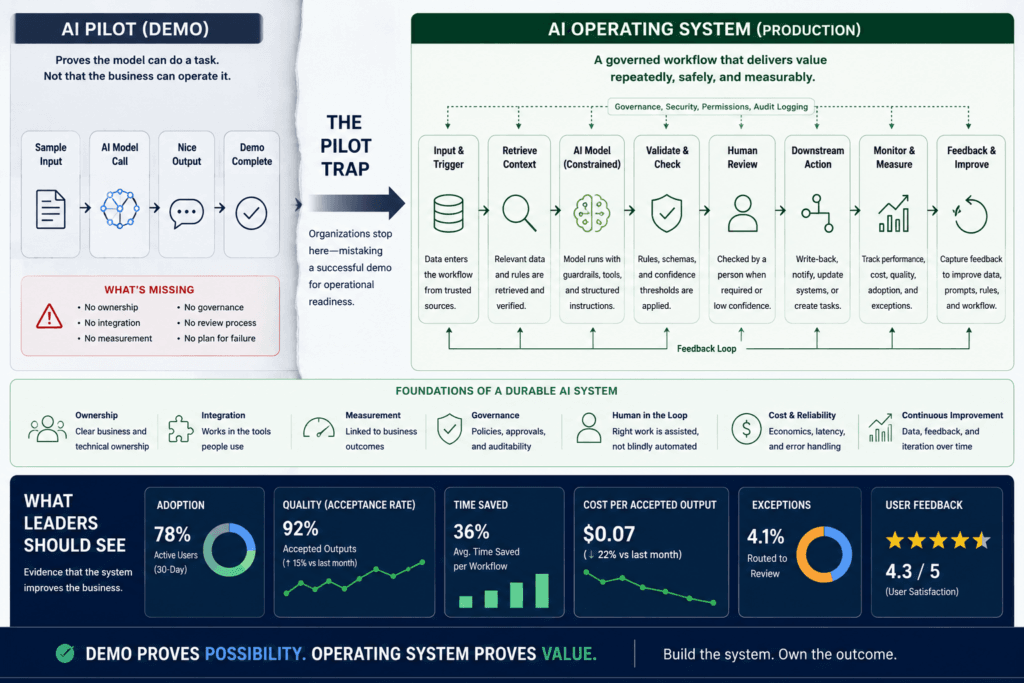
An AI pilot does not become an operating system until the business defines ownership, workflow integration, measurement, governance, and the conditions under which the system is trusted to act.
The demo worked. The room liked it. The prototype summarized documents, drafted responses, extracted fields, generated recommendations, or filled in CRM notes with enough polish to feel useful.
Then nothing changed.
The project did not fail loudly. It did not collapse in a dramatic technical incident. It simply stopped moving. The innovation team moved on. The business team went back to the old process. Engineering could not justify production work without clearer requirements. Finance could not see the return. Compliance had questions nobody had budgeted time to answer. Users liked the idea, but not enough to change how work actually moved.
That is the AI pilot trap.
The AI pilot trap is the pattern where an organization proves that AI can perform a task in a controlled experiment but fails to convert that experiment into a governed, measured, integrated business workflow.
The mistake is not experimentation. Pilots are useful. They help teams learn what models can do, where data is messy, where users hesitate, and where risk lives. The mistake is treating pilot activity as implementation maturity. A company can run dozens of impressive AI pilots and still have no AI operating capability if none of those pilots has an owner, a production path, a metric, a review process, a data contract, an integration plan, and a budget to operate after launch.
A demo proves possibility. An operating system proves value.
Why the AI Pilot Trap Matters Now
The first phase of generative AI adoption was fueled by curiosity. Leaders wanted to see what the tools could do. Teams built chatbots, summarizers, extraction demos, knowledge assistants, copilots, and internal prototypes. That phase was reasonable. Nobody learns a new technical capability by reading strategy slides.
The next phase is different.
Budgets are now being questioned. Executives want to know which AI investments are changing throughput, quality, cost, customer experience, revenue, or decision speed. Business teams are becoming tired of proofs of concept that create more meetings than outcomes. Technical teams are being asked to productionize experiments that were never designed with production constraints in mind.
This is where the gap appears.
A pilot is usually judged by whether the model appears useful. A production system is judged by whether the business can operate it repeatedly. Those are different standards.
A support-response demo may look excellent when tested on ten clean tickets. A production support workflow has to deal with policy exceptions, missing customer history, angry customers, regulated language, escalation rules, brand tone, ticket-system write-back, quality review, and auditability.
A sales-call summary pilot may produce readable notes. A real CRM workflow has to map fields correctly, avoid unsupported claims, handle confidential information, track edit rates, preserve account-owner accountability, and prove that follow-up speed or quality improved.
An invoice-extraction prototype may identify vendor names and totals in sample PDFs. A finance operating system has to classify document types, manage confidence thresholds, route exceptions, validate against vendor master data, write to ERP only when allowed, and preserve evidence for audit.
The pilot is the easiest part of that chain.
The Mistake Most Teams Make
Most stalled AI pilots are not designed to answer the question that matters.
They answer: “Can AI do this task?”
They do not answer: “Can this AI capability be operated safely, repeatedly, economically, and measurably inside the business?”
That difference matters.
A model can summarize a document, but that does not mean the summary is trusted enough to drive a decision. A model can draft a customer response, but that does not mean the draft should be sent without review. A model can extract invoice fields, but that does not mean the system can write to the ERP. A model can suggest a next action, but that does not mean the organization knows who is accountable if the suggestion is wrong.
The common failure pattern looks like this:
| Common Belief | Production Reality | Better Question |
|---|---|---|
| If the pilot works, we can scale it. | A pilot only proves limited feasibility unless it tests integration, ownership, risk, cost, and adoption. | What has this pilot proven about production readiness? |
| The model is the main system. | The model is one component inside a workflow with inputs, controls, actions, and feedback. | What system surrounds the model? |
| Productivity gains automatically create ROI. | Productivity only matters if the business captures it as throughput, margin, quality, revenue, or resilience. | How will the gain show up in a business metric? |
| Users liked the demo, so adoption will follow. | Users adopt systems that fit real work, incentives, trust, and accountability. | What behavior must change after launch? |
| We can add governance later. | Governance added late often blocks scale or forces expensive redesign. | What needs review before production? |
The pilot trap is usually an operating-model failure disguised as a technical delay.
The Technical Reality Behind the Business Decision
Production AI is not a model call. It is a system.
A useful AI workflow usually has an input source, a trigger, context retrieval, a model call, structured output, validation, human review, downstream action, logging, feedback, cost tracking, escalation, and a rollback path.
That does not mean every AI system needs heavy enterprise architecture. It means the system has to match the consequence of the work.
For low-risk drafting, the workflow may be simple: retrieve approved context, draft text, show it to a human, track edits, and measure time saved.
For customer-facing recommendations, the workflow needs more control: policy grounding, prohibited claims, approval thresholds, escalation paths, and output review.
For finance, legal, healthcare, insurance, HR, or regulated operations, the system may need stricter permissions, audit logs, confidence scoring, exception queues, and formal review.
The hard part is not making the model respond. The hard part is deciding what happens before and after the response.
Technical teams know this from production software. A prototype can ignore edge cases. A production system cannot. Production systems need versioning, monitoring, access control, error handling, cost limits, test coverage, and operational ownership. AI systems add another layer because model behavior can vary, outputs can sound plausible while being wrong, and changes to prompts, context, models, or retrieval can alter behavior in ways that traditional software tests may not catch.
That is why evals matter. That is why structured outputs matter. That is why logs matter. That is why review queues matter. That is why the business owner matters as much as the technical owner.
The model call is not the product. The workflow, validation, logging, permissions, and feedback loop are the product.
What Business Leaders Need to Understand
Business leaders should stop asking only whether an AI pilot worked.
A better question is: “What would have to be true for this to become part of how the business runs?”
That question changes the discussion. It moves the project from demo quality to operating-system readiness.
| Audience | What They Often Assume | What They Need to Understand |
|---|---|---|
| Business leaders | A successful demo proves the idea is worth scaling. | Scaling requires ownership, budget, metrics, governance, and process redesign. |
| Decision makers | AI pilots are low-risk experiments. | Poorly framed pilots consume attention, create false confidence, and delay better investments. |
| Engineers and developers | The production challenge is mainly prompt or model improvement. | Production requires integration, validation, observability, failure handling, and maintainable workflows. |
| AI enthusiasts | Better models will solve most pilot failures. | Many failures come from weak operating models, not weak model capability. |
The business decision is not whether AI is impressive. It often is. The decision is whether a specific AI workflow can change a specific business outcome under real conditions.
That requires several uncomfortable questions.
Who owns the workflow after launch?
What metric will change?
What is the acceptable error rate?
What happens when the system is wrong?
Who reviews low-confidence outputs?
What data is the system allowed to use?
What systems must it read from or write to?
What does it cost per accepted outcome, not per demo?
What behavior must users change?
What would cause the system to be paused, rolled back, or redesigned?
If those questions feel premature, the project is probably still an experiment. That is fine. Experiments have value. But they should not be presented as production strategy.
What Engineers and Developers Need to Build Around
Technical teams often inherit AI pilots after the interesting demo work is done. That is when the real engineering begins.
A production AI system usually needs evidence across several areas:
| Decision Area | Why It Matters | What Can Go Wrong |
|---|---|---|
| Evaluation | The team needs to know whether outputs are improving or degrading. | The system feels good in demos but fails on edge cases and real data. |
| Retrieval and context | Model quality depends on the right information being available at the right time. | The model answers from stale, incomplete, or unauthorized context. |
| Structured outputs | Downstream systems need predictable formats. | Free-form responses break automation or require manual cleanup. |
| Permissions | AI systems often touch sensitive operational data. | Users see information they should not see, or the model acts outside its role. |
| Observability | Teams need to monitor cost, latency, errors, drift, and user behavior. | Problems stay invisible until users lose trust. |
| Human review | Some work should be assisted, not automated. | The organization over-automates and creates avoidable risk. |
| Rollback | Production systems need a safe way to stop or revert. | A bad prompt, model change, or retrieval issue keeps affecting live work. |
A useful AI workflow might look simple in concept:
ai_workflow(input):
    validate_business_context(input)
    retrieve_required_context(input)
    run_model_with_constraints(input)
    verify_output_against_rules()
    route_to_human_or_system_action()
    log_result_and_feedback()
The pseudocode is not the hard part. The hard part is making each line real.
What counts as valid business context? Which sources are authoritative? What schema is required? Which rules are deterministic? What confidence threshold routes to review? What gets logged? Who sees the logs? How are failures labeled? Which feedback actually improves the system?
Those are product, engineering, operations, risk, and business questions at the same time.
The Better Operating Model
The better model is not “run more pilots.” It is “advance fewer pilots through clearer gates.”
Call it the Pilot-to-Operating-System Test.
A pilot should not move forward because it impressed people. It should move forward because it produced evidence that the workflow can become a controlled operating capability.
The path has three stages.
First, pilot to workflow candidate. The pilot proves that the task is real, frequent enough, valuable enough, and technically plausible. The output is not a production plan. It is a decision about whether the workflow deserves deeper investment.
Second, workflow candidate to controlled production. The team defines ownership, metrics, integration points, evals, permissions, review paths, cost assumptions, and failure handling. The system may start with human approval and limited scope. That is not weakness. It is how trust is earned.
Third, controlled production to operating system. The workflow becomes part of normal business operations. It has a budget, a service owner, technical maintenance, governance review, monitoring, training, and a way to improve over time.
The Pilot-to-Operating-System Test asks eight questions:
| Gate | Question |
|---|---|
| Workflow Gate | Is there a real workflow with enough frequency, friction, and business value? |
| Ownership Gate | Is there a named business owner and a named technical owner after launch? |
| Measurement Gate | Is there a metric that will prove whether the system improves the business? |
| Control Gate | Are validation, review, permissions, escalation, and rollback paths defined? |
| Integration Gate | Can the system operate inside the tools and processes people already use? |
| Economics Gate | Does the value survive realistic production costs, latency, review time, and maintenance? |
| Trust Gate | Do users know when to rely on the system, when to review it, and when to override it? |
| Scale Gate | Has the pilot produced evidence that the system can be operated repeatedly, not just demonstrated once? |
A pilot that fails this test may still be useful. It may teach the team that the data is not ready, the workflow is not valuable enough, the risk is too high, or the process is too immature. That is not failure. That is information.
The real failure is scaling anyway.
Practical Examples: Where Pilots Stall
A customer support team runs a pilot where AI drafts responses from help-center articles. The demo looks strong. Leaders see faster response drafting. Agents like the first version.
Then production questions arrive. Which help-center articles are approved? What happens when policies conflict? Who checks tone? Which tickets require escalation? How are low-confidence answers flagged? Does the system update the ticket, draft inside the ticket, or send directly? What metric matters: handle time, first-contact resolution, customer satisfaction, quality score, or cost per resolved ticket?
The better version treats the project as a support workflow redesign, not a writing assistant demo.
A sales team tests AI summaries for call transcripts. The prototype produces readable summaries. It feels useful immediately.
But production requires CRM integration, field mapping, allowed-value validation, account-owner review, edit-rate logging, and measurement of whether follow-up quality or speed improves. Without that, the pilot creates nicer notes but not necessarily better sales execution.
A finance operations team pilots invoice extraction. The model identifies fields in sample PDFs.
The operating system requires document classification, confidence thresholds, exception queues, vendor master validation, ERP write-back rules, audit logs, and finance ownership of the approval process. The technical extraction task is only one piece of the control environment.
In each case, the pilot does not fail because AI cannot help. It fails because the organization never designed the operating system around the capability.
What to Do Next
Leaders should fund fewer pilots with clearer conditions.
A pilot should have a business owner before it starts. That owner does not need to understand every technical detail, but they must own the workflow outcome. If nobody owns the business result, the pilot is probably theater.
Product and operations teams should map the workflow before choosing the tool. Where does work enter? Who touches it? What data is needed? What decisions are made? What systems are updated? Where do errors cause harm? Where does human judgment remain essential?
Technical teams should instrument early. Track acceptance rates, edit rates, escalation rates, latency, cost, validation failures, user overrides, and failure categories. Do not wait until production to learn whether the system is trusted.
Compliance, security, finance, and risk teams should be included before scale, not after. Late review creates rework and distrust. Early review creates boundaries the team can design within.
Decision makers should be willing to stop pilots that cannot pass the operating-system test. Ending a weak pilot is not anti-AI. It is good capital allocation.
The goal is not to automate everything. The goal is to build workflows where AI improves speed, quality, consistency, or decision support while accountability remains clear.
AI Maturity Is Not Pilot Volume
The companies that win with AI will not be the ones with the most pilots. They will be the ones that turn fewer, better pilots into owned, measured, governed workflows.
That is less glamorous than a spectacular demo. It also matters more.
A pilot can show that AI is capable. An operating system shows that the business is capable of using AI responsibly and repeatedly.
That is the real maturity test.
Not how many experiments were launched.
Not how many people were impressed.
Not how many tools were evaluated.
The test is whether AI changes the way work moves through the business, under real constraints, with real ownership, real measurement, and real trust.
Key Takeaways
- The AI pilot trap happens when a company proves technical possibility but fails to build an operating capability.
- A successful demo is not evidence of production readiness unless it tests workflow fit, ownership, risk, integration, economics, and adoption.
- The model is only one component of a production AI system; the surrounding workflow determines whether value is captured.
- Business leaders should judge AI pilots by operating-system readiness, not presentation quality.
- Engineers need evals, schemas, logs, permissions, review queues, cost controls, rollback paths, and integration contracts.
- Many AI failures are operating-model failures, not model-capability failures.
- The best pilots produce evidence that a workflow can be owned, measured, governed, and improved over time.
Practical Decision Framework
Use the Pilot-to-Operating-System Test before funding, scaling, or killing an AI pilot.
| Gate | What to Ask | What to Measure |
|---|---|---|
| Workflow Gate | Is this workflow repetitive, valuable, measurable, and reviewable? | Frequency, cycle time, error rate, backlog, value per completed workflow. |
| Ownership Gate | Who owns the business outcome and who owns the technical system after launch? | Named owners, support model, operating budget, review cadence. |
| Measurement Gate | What metric proves the system improves the business? | Time saved, throughput gain, quality improvement, risk reduction, revenue impact. |
| Control Gate | What happens when the AI is wrong, uncertain, or outside policy? | Validation pass rate, approval rate, escalation rate, exception rate. |
| Integration Gate | Can the system work inside the tools people already use? | CRM, help desk, ERP, document system, analytics, or workflow-system adoption. |
| Economics Gate | Does value survive production cost? | Cost per accepted output, latency, review time, retry rate, maintenance effort. |
| Trust Gate | Do users know when to rely on the system and when to override it? | Edit rate, override rate, user feedback, quality review results. |
| Scale Gate | Has the pilot shown repeatable operation, not just a good demo? | Stable performance across real users, real data, real controls, and real edge cases. |
A pilot that cannot pass these gates should either remain experimental, be redesigned, or be stopped. A pilot that can pass them deserves a production path.
FAQ
Why do AI pilots fail to become production systems?
AI pilots often fail because they are designed to prove that a model can perform a task, not that the business can operate the workflow. Production requires ownership, integration, measurement, governance, security, review paths, cost controls, and user adoption.
What is the difference between an AI pilot and an AI operating system?
An AI pilot tests feasibility in a limited setting. An AI operating system embeds AI into a repeatable business workflow with inputs, context, permissions, validation, human review, downstream actions, monitoring, feedback, and measurable outcomes.
How should leaders evaluate whether an AI pilot is worth scaling?
Leaders should ask whether the pilot has a clear workflow owner, business metric, data path, control model, integration plan, production budget, review process, and evidence that users will adopt it under real conditions.
What technical work is required after an AI demo succeeds?
Technical teams usually need to build evals, retrieval controls, structured outputs, validation rules, logging, permissions, human review queues, observability, cost tracking, fallback behavior, and integration with business systems.
Should AI pilots aim for full automation?
Not always. Many valuable AI workflows should begin as assistive systems with human review. Full automation is only appropriate when the work is low-risk enough, measurable enough, and controlled enough to justify it.
Who should own an AI workflow after a pilot?
Ownership should usually be shared. A business owner should own the workflow outcome, while a technical owner should own system reliability, integration, monitoring, and maintenance. Compliance, security, finance, and operations may also need defined roles depending on risk.
Sources
- NIST AI Risk Management Framework Core: https://airc.nist.gov/airmf-resources/airmf/5-sec-core/
- NIST Artificial Intelligence Risk Management Framework: Generative Artificial Intelligence Profile: https://www.nist.gov/publications/artificial-intelligence-risk-management-framework-generative-artificial-intelligence
- OpenAI Production Best Practices: https://developers.openai.com/api/docs/guides/production-best-practices
- OpenAI Evaluation Best Practices: https://developers.openai.com/api/docs/guides/evaluation-best-practices
- OpenAI Structured Outputs Documentation: https://developers.openai.com/api/docs/guides/structured-outputs
- Anthropic Claude Tool Use Documentation: https://platform.claude.com/docs/en/agents-and-tools/tool-use/overview
- Google Cloud AI and ML Reliability Perspective: https://docs.cloud.google.com/architecture/framework/perspectives/ai-ml/reliability
- Google Cloud Vertex AI Model Observability: https://docs.cloud.google.com/vertex-ai/generative-ai/docs/learn/model-observability
- Google Cloud Gen AI Evaluation Service Overview: https://docs.cloud.google.com/vertex-ai/generative-ai/docs/models/evaluation-overview
- McKinsey The State of AI: Global Survey 2025: https://www.mckinsey.com/capabilities/quantumblack/our-insights/the-state-of-ai
- IBM 2025 CEO Study Press Release: https://newsroom.ibm.com/2025-05-06-ibm-study-ceos-double-down-on-ai-while-navigating-enterprise-hurdles
Related articles from Kyle Beyke
- AI Workflow Anatomy: Essential Guide for Business: https://beykeworkflows.com/ai-workflow-anatomy-business-guide/
- AI Use Cases: 7 Smart Rules for Business: https://beykeworkflows.com/ai-use-cases-rules-business/
- AI Cost Control: Smart Guide for Efficient Systems: https://beykeworkflows.com/ai-cost-control-systems-tokens-latency-routing/
- AI Model Selection: Powerful Guide for Smart Business AI: https://beykeworkflows.com/ai-model-selection-business-ai-guide/
- Structured Outputs for AI Workflows: Reliable Guide: https://beykeworkflows.com/structured-outputs-for-ai-workflows-guide/
- Production Prompting: Essential Business AI Guide: https://beykeworkflows.com/production-prompting-business-ai-guide/
- 7 Best AI ROI Lessons: https://beykeworkflows.com/7-best-ai-roi-lessons/
- Building Brilliant Modern Agentic AI Systems for Business: https://beykeworkflows.com/how-modern-agentic-ai-systems-are-built-for-business/