
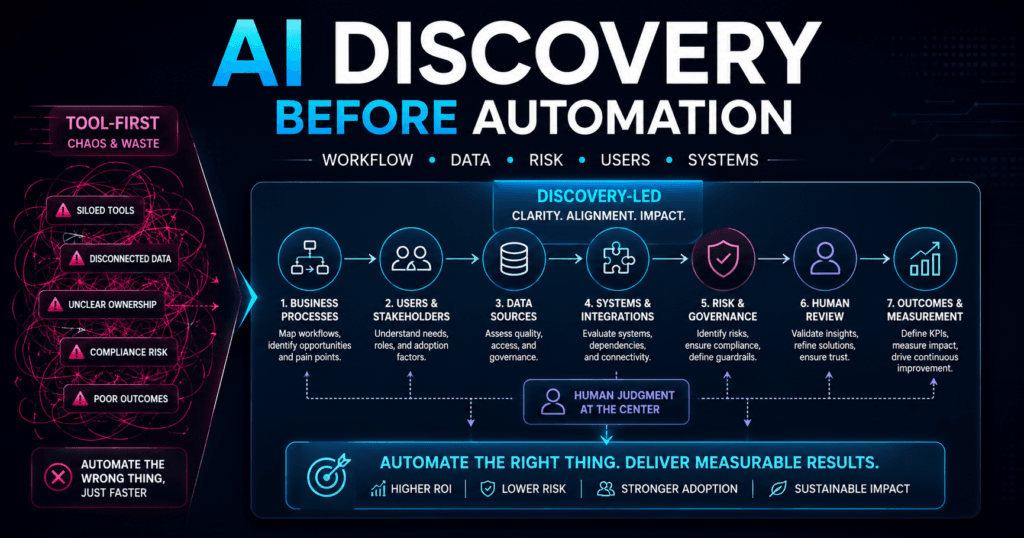
AI discovery is not about finding where AI can fit; it is about finding which workflow is worth changing.
AI Discovery Is Where Automation Succeeds or Fails
Bad AI projects do not usually fail when the model answers.
They fail earlier, when the business skips the work of discovering what actually needs to change.
A company says it needs an AI agent. Another says it needs workflow automation. Another wants a chatbot, document processing system, dashboard, internal search tool, customer support assistant, or custom AI platform. Those may be reasonable requests. They may also be symptoms of a deeper problem the business has not named yet.
The real issue might be inconsistent intake. Poor data. Too many handoffs. Slow approvals. Unclear ownership. Missing review steps. A broken process. A reporting gap. A customer experience problem. Or a workflow that should not be automated yet.
That is why AI discovery matters.
AI discovery is not a feature intake call. It is not a vendor demo. It is not a short meeting where a consultant collects the requested tool and turns it into a quote. Serious discovery is a disciplined investigation into how the business actually works: the workflow, users, data, decisions, systems, exceptions, risks, metrics, and ownership model behind the request.
The goal is not to find every place AI could be used. That is too easy. The goal is to find where AI, automation, process redesign, or better systems would actually improve the business.
The Mistake: Starting With the Tool
Many teams start with the artifact instead of the problem.
They ask for “an AI agent” before defining the task. They ask for “automation” before mapping the current process. They ask for “a dashboard” before naming the decision the dashboard should improve. They ask for “a chatbot” before understanding whether the real issue is customer support volume, documentation quality, response inconsistency, or unclear routing.
That is how weak AI discovery begins: with a desired object.
A better process starts with questions:
What business result should change?
Who does the work today?
Where does the work slow down?
What information is missing?
What gets reworked?
What should never be automated without review?
What data can be trusted?
What happens if the AI output is wrong?
What metric would prove the workflow improved?
Project management research has long pointed to the cost of poor requirements. AI makes that problem sharper because a vague requirement can still produce an impressive demo. A chatbot can answer. An agent can take actions. A dashboard can display charts. A model can summarize documents.
But none of that proves the business improved.
Deployment is not the goal. Better work is the goal.
What AI Discovery Should Actually Include
AI discovery should identify the operating reality underneath the requested solution.
That means understanding the business outcome first. A support team may want faster responses. A finance team may want fewer invoice exceptions. A sales team may want better CRM updates. A legal team may want contract risk surfaced earlier. An operations team may want fewer manual status checks. Each of those outcomes implies a different workflow, risk level, data need, and implementation pattern.
Discovery should also include the people who do the work. Executives understand strategy, but operators know the exceptions. They know the spreadsheet that exists because the main system does not capture the needed field. They know which approval step gets skipped under pressure. They know which customer requests are easy, which are ambiguous, and which should never be routed to automation.
A discovery process that only interviews leadership will miss how the business actually runs.
Good discovery should examine the current workflow, the systems involved, the data available, the quality of that data, the handoffs, the exceptions, the failure modes, and the human review points. It should also define what success means before anyone builds.
If success is “we deployed AI,” the project is already drifting.
Success should be measurable: reduced response time, fewer manual steps, lower rework, faster triage, better field completion, improved acceptance rate, fewer exceptions, shorter cycle time, lower cost per processed item, or better customer experience.
AI discovery should connect implementation to those outcomes.
Common Belief vs. Production Reality
| Common Belief | Production Reality | Better Question |
|---|---|---|
| We need an AI tool. | The tool may not match the actual workflow problem. | What business result should change? |
| The discovery call is just intake. | Discovery should uncover workflows, data, users, risk, systems, and metrics. | What do we need to understand before designing? |
| If AI can do the task, we should automate it. | Capability is not the same as operational readiness. | What happens if the output is wrong? |
| Executives can define the workflow. | Operators usually know the exceptions, workarounds, and failure points. | Who actually does the work today? |
| Deployment proves success. | Success requires measurable workflow improvement. | What metric proves the business improved? |
Why Tool-First AI Discovery Fails
Tool-first discovery fails because tools hide assumptions.
A chatbot assumes there is reliable knowledge to answer from. A document-processing workflow assumes documents are consistent enough to classify and extract from. A dashboard assumes the data definitions are trusted. An AI agent assumes permissions, tools, actions, and rollback paths are clear. A workflow automation assumes the current process is stable enough to automate.
Those assumptions are often wrong.
A company may want AI to answer customer questions, but its documentation may be outdated. It may want automated CRM updates, but its fields may be inconsistent. It may want document extraction, but the source files may vary by vendor, department, or region. It may want internal search, but access permissions may be poorly maintained. It may want autonomous action, but no one has defined what happens when the system makes a bad call.
AI does not remove those problems. It exposes them.
This is why discovery has to look across domains. A useful AI or automation system may touch operations, customer experience, IT, legal, finance, sales, compliance, data governance, security, and frontline work. A narrow technical conversation will miss business risk. A narrow executive conversation will miss implementation reality. A narrow vendor conversation will usually start too close to the solution.
Good discovery connects the domains before choosing the architecture.
The Technical Reality Behind the Business Decision
From a technical perspective, discovery is system design before system design.
Before choosing a model, platform, database, workflow tool, or automation layer, the team needs to know the shape of the work.
What triggers the workflow? Is it an email, ticket, uploaded file, CRM update, scheduled report, form submission, or user action? What data is available at that moment? What context does the AI need? Where is that context stored? Who has permission to access it? What output is expected? Should the output be prose, a classification label, a structured JSON object, a draft response, a recommendation, or a system action?
Then come the control questions.
What should be validated? Which values require deterministic rules? What should route to a human? What should never be sent to a customer without approval? What should be logged? What should be measured? What happens when the model is uncertain? What happens when the upstream data is missing? What happens when the downstream system is unavailable?
These are not minor details. They determine whether AI becomes a useful business workflow or a fragile demo.
A production AI workflow is rarely just “prompt in, answer out.” It often includes inputs, triggers, retrieval, model calls, structured outputs, validation, human review, downstream actions, logging, monitoring, exception handling, and ongoing ownership.
If discovery does not identify those pieces, the build is operating on assumptions.
Tell-Tale Signs the Project Is Already Drifting
There are warning signs that an AI project is heading away from the optimal outcome before implementation begins.
The first sign is that the project starts with a tool instead of a workflow. “We need an AI agent” is not a requirement. It is a possible solution.
The second sign is that no one can name the business result that should change. If the team cannot define the bottleneck, decision, cost, risk, or customer experience problem, it cannot evaluate whether AI helped.
The third sign is executive-only discovery. Leaders are essential, but they rarely know every exception, workaround, duplicate entry, manual approval, and unofficial process that makes the workflow function.
The fourth sign is unmapped process automation. Automating an unclear process does not create clarity. It usually makes confusion faster.
The fifth sign is assumed data readiness. If documents, fields, records, permissions, labels, and definitions are messy, the AI workflow will inherit that mess.
The sixth sign is late risk review. Risk should shape the design from the beginning. If governance appears only after the solution is designed, the project may need to be rebuilt around controls that should have been included earlier.
The seventh sign is success defined as deployment. A live AI system that does not improve a workflow is not a successful implementation.
The eighth sign is missing human review design. For consequential workflows, the question is not only whether AI can generate an output. It is who reviews it, when they review it, and what happens when the output is wrong.
The ninth sign is a partner who never challenges the request. If every answer is yes, the business may be buying implementation without diagnosis.
The tenth sign is no post-launch owner. AI systems need monitoring, updates, feedback loops, exception handling, and maintenance. If no one owns the workflow after launch, the system will decay.
AI Discovery Should Scale With the Business
Discovery should not become endless analysis. That is the opposite failure.
The right amount of discovery depends on the risk, cost, complexity, and importance of the workflow.
For a small business automating basic intake emails, discovery may be lightweight: a few conversations, current-process mapping, sample messages, tool review, data check, risk screen, and a small pilot. The goal is not to create a binder. The goal is to avoid building the wrong thing.
For a growing business, discovery should go deeper into repeatability, system fit, and ownership. The team may need to understand how customer data, CRM fields, document storage, email workflows, and reporting habits connect. At this size, the risk is usually disconnected automation: too many tools, too many one-off workflows, and no shared operating model.
For a mid-market company, discovery should include integration boundaries, security review, user roles, exception handling, metrics, and governance. The organization may have enough complexity that a quick automation can create more problems than it solves.
For an enterprise or regulated organization, discovery has to include lifecycle ownership, auditability, legal and compliance review, access control, monitoring, model risk, change management, and policy alignment. In that environment, “move fast” without discovery can create unacceptable risk.
The rule is simple: discovery should be proportional. Not too shallow for the risk. Not too heavy for the use case.
A Practical AI Discovery Framework
| Discovery Area | What to Ask | What to Measure |
|---|---|---|
| Outcome | What business result should change? | Time saved, error reduction, backlog reduction, response time, cost change |
| Workflow | How does the work happen today? | Handoffs, delays, rework, exception volume, duplicate work |
| Users | Who does the work and who relies on the result? | Adoption, satisfaction, review effort, training burden |
| Data | What data exists, where is it, and can it be trusted? | Completeness, freshness, consistency, access gaps, source quality |
| Risk | What happens if the system is wrong? | Error severity, review rate, escalation rate, audit need |
| Systems | What tools must AI read from or write to? | Integration complexity, permission scope, failure points |
| Review | Where should humans stay involved? | Approval rate, correction rate, exception rate, rejected outputs |
| Ownership | Who maintains the workflow after launch? | Monitoring coverage, update cadence, incident response, feedback loops |
This framework keeps discovery practical. It does not ask leaders to analyze everything forever. It asks them to understand enough to make a responsible decision.
Should this workflow be automated?
Should it be assisted?
Should it be governed more tightly?
Should it be simplified first?
Should it be piloted?
Should it be left alone?
Those are better questions than “Which AI tool should we buy?”
What Business Leaders Should Fund
Business leaders should fund discovery before they fund complexity.
That does not mean paying for vague consulting exercises. It means paying for the work that prevents expensive mistakes: workflow mapping, operator interviews, data review, system inventory, risk classification, success metrics, pilot scoping, and ownership planning.
The best discovery process should produce a clear decision, not just a report.
It should say: here is the workflow worth improving, here is the problem, here is the data, here are the users, here are the risks, here is the smallest responsible pilot, here is what should remain human-reviewed, here is what we will measure, and here is what would justify scaling.
It should also say what not to build.
That last part is important. Good AI discovery protects the business from both overbuilding and underbuilding. It prevents expensive systems that do not matter. It also prevents unsafe shortcuts that ignore review, permissions, auditability, or ownership.
What Engineers and Developers Need From Discovery
Technical teams do not need vague excitement. They need operational requirements.
They need to know the input shape, output format, confidence expectations, validation rules, data sources, system boundaries, permissions, failure modes, and review process. They need examples of real cases, not imagined ideal inputs. They need edge cases. They need to know which errors are tolerable and which errors are serious. They need to know what happens when the model cannot answer.
They also need a success metric that connects technical behavior to business value.
Model accuracy may matter. So may latency, cost, structured output validity, retrieval quality, human correction rate, review time, exception rate, and downstream acceptance. But none of those metrics matter in isolation. They matter because they indicate whether the workflow improved.
Discovery gives engineers the context they need to build something useful rather than something merely functional.
The Better Operating Model
The better operating model is:
Discover broadly. Narrow quickly. Pilot responsibly. Scale only what proves value.
Discover broadly enough to understand the business system. Talk to leaders and operators. Review the data. Map the process. Identify risks. Look across departments when the workflow crosses departments.
Then narrow quickly. Choose one workflow with clear value, accessible data, known users, manageable risk, and measurable success.
Pilot responsibly. Keep the first version bounded. Include human review where needed. Log results. Track corrections. Measure real outcomes.
Then scale only what earns it.
That is the discipline businesses need. Not AI for its own sake. Not automation because automation sounds efficient. Not a tool-first build because the market is loud.
Discovery should translate business reality into the right AI or automation decision.
The Workflow Decides Whether AI Belongs
The businesses that get AI right will not be the ones that rush from idea to tool.
They will be the ones that understand their work deeply enough to know what should be automated, what should be assisted, what should be governed, and what should not be built yet.
AI discovery is where that judgment happens.
It is where a vague request becomes a real workflow. It is where hidden data problems become visible. It is where risk shapes design instead of appearing after the fact. It is where operators get heard. It is where leaders learn whether the project is worth funding. It is where technical teams get the context they need to build something maintainable.
A serious AI project does not begin with a model, a vendor, or an automation idea.
It begins with discovery that understands the business well enough to decide whether AI belongs at all.
Key Takeaways
- AI discovery should start with the workflow, not the tool.
- “We need an AI agent” is not a requirement; it is a possible solution.
- Weak discovery causes AI projects to drift before implementation begins.
- Good discovery includes business outcomes, users, data, systems, risk, review points, metrics, and ownership.
- Discovery should be proportional to the workflow’s risk, cost, complexity, and business importance.
- Automating an unclear process usually makes confusion faster.
- Success should be measured by workflow improvement, not AI deployment.
- The best AI projects discover broadly, narrow quickly, pilot responsibly, and scale only what proves value.
Practical Decision Framework
Use this framework before funding AI automation:
- Define the business outcome.
Name the result that should change: time saved, errors reduced, backlog lowered, response time improved, cost reduced, quality improved, or customer experience strengthened. - Map the current workflow.
Document how the work happens today, including handoffs, exceptions, delays, duplicate work, workarounds, and unofficial tools. - Interview operators, not just leaders.
Include the people who perform the work, review the work, depend on the output, and handle exceptions. - Review data readiness.
Identify where the data lives, who can access it, how reliable it is, how fresh it is, and whether definitions are consistent. - Classify risk.
Ask what happens if the AI is wrong. Use that answer to decide review, permissions, logging, fallback, and governance requirements. - Decide automation vs. assistance.
Not every workflow should be automated. Some should be assisted, summarized, routed, validated, or human-reviewed. - Choose a narrow pilot.
Start with a workflow that has clear inputs, real users, measurable value, manageable risk, and known failure modes. - Assign ownership.
Decide who maintains the system, reviews feedback, monitors quality, updates workflows, and handles exceptions after launch. - Scale only after proof.
Expand only when the pilot shows measurable workflow improvement, user adoption, controlled risk, and maintainable operations.
FAQ
What is AI discovery?
AI discovery is the process of understanding a business workflow, its users, data, decisions, risks, systems, success metrics, and ownership before deciding whether to automate, assist, govern, pilot, or avoid an AI solution.
What should AI discovery include before automation?
It should include business goals, operator interviews, workflow mapping, data review, system inventory, risk classification, human review design, success metrics, pilot scope, and post-launch ownership.
Why do AI projects fail when discovery is weak?
Weak discovery causes teams to build around assumptions. They may automate the wrong process, use untrusted data, ignore exceptions, skip human review, miss integration constraints, or measure deployment instead of business improvement.
How much AI discovery does a small business need?
A small business usually needs focused discovery, not enterprise-grade analysis. A practical review of the workflow, data, tools, risks, users, and success metric is often enough to choose a responsible pilot.
Should every workflow be automated with AI?
No. Some workflows should be automated, some should be assisted, some should remain human-reviewed, and some should not be changed yet. Discovery should determine which category the workflow belongs in.
What is the biggest warning sign in AI discovery?
The biggest warning sign is starting with a tool before defining the workflow and business outcome. If the team cannot explain what changes after deployment, the project is not ready to build.
Sources
- Project Management Institute Requirements Management: https://www.pmi.org/learning/thought-leadership/pulse/core-competency-project-program-success
- IIBA BABOK Guide: https://www.iiba.org/career-resources/a-business-analysis-professionals-foundation-for-success/babok/
- McKinsey State of AI 2025: https://www.mckinsey.com/capabilities/quantumblack/our-insights/the-state-of-ai-how-organizations-are-rewiring-to-capture-value
- MIT NANDA State of AI in Business 2025: https://mlq.ai/media/quarterly_decks/v0.1_State_of_AI_in_Business_2025_Report.pdf
- NIST AI Risk Management Framework: https://nvlpubs.nist.gov/nistpubs/ai/nist.ai.100-1.pdf
- NIST AI RMF Resource Center: https://airc.nist.gov/airmf-resources/airmf/
- NIST Generative AI Profile: https://www.nist.gov/publications/artificial-intelligence-risk-management-framework-generative-artificial-intelligence
- ISO/IEC 42001 AI Management System Standard: https://www.iso.org/standard/42001
- BCG AI at Scale: https://www.bcg.com/capabilities/artificial-intelligence
- Agile Manifesto Principles: https://agilemanifesto.org/principles.html
Related articles from Kyle Beyke
- AI Workflow Anatomy: Essential Guide for Business: https://beykeworkflows.com/ai-workflow-anatomy-business-guide/
- AI Use Cases: 7 Smart Rules for Business: https://beykeworkflows.com/ai-use-cases-rules-business/
- AI Cost Control: Smart Guide for Efficient Systems: https://beykeworkflows.com/ai-cost-control-systems-tokens-latency-routing/
- AI Model Selection: Powerful Guide for Smart Business AI: https://beykeworkflows.com/ai-model-selection-business-ai-guide/
- Powerful Text Classification, Extraction, and Summarization with AI: https://beykeworkflows.com/text-classification-extraction-summarization-ai/