
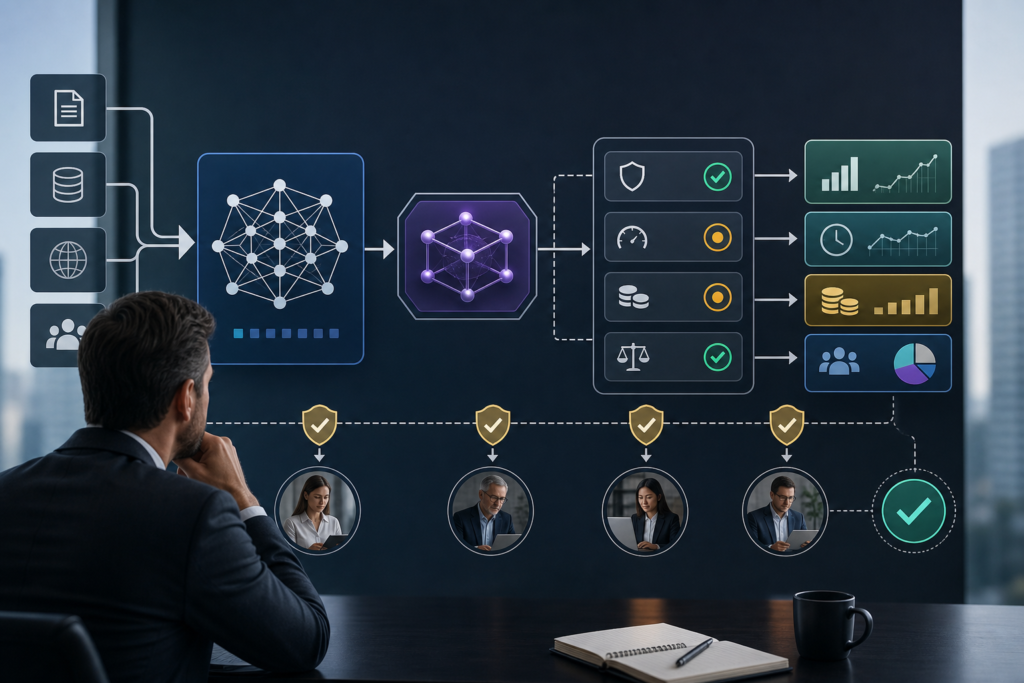
Quantum-enhanced LLMs are worth watching because they show the AI compute conversation moving beyond "add more GPUs," but they are not yet a business strategy. The IBM quantum hardware experiment is technically interesting, commercially premature, and useful mainly as a reminder that leaders need stronger evidence standards before turning research headlines into roadmaps.
A headline about an IBM quantum computer improving an AI model sounds like the start of a new infrastructure cycle. It is tempting to read it as proof that quantum AI has crossed from laboratory curiosity into enterprise planning.
That reading is too large for the evidence.
Researchers reported a hybrid quantum-classical approach that added a quantum-executed adapter to Llama 3.1 8B, while keeping the base model frozen. The reported improvement was a 1.4% reduction in perplexity with roughly 6,000 additional parameters, using a 156-qubit IBM Quantum System Two superconducting processor. Coverage of the work also highlighted examples where the enhanced model answered questions correctly that the base model missed.
That deserves attention. It does not justify a procurement strategy.
The business meaning is narrower and more useful: quantum-enhanced LLMs are a research signal about future compute architectures, parameter efficiency, and hybrid systems. They do not prove that companies should buy quantum AI infrastructure, abandon classical model tuning, or expect quantum hardware to fix production AI reliability.
The uncomfortable business test is simple: can the improvement beat cheaper classical methods inside real workflows after cost, latency, reliability, reproducibility, integration, and governance are counted?
Until that answer is yes, this is a signal to monitor, not a platform to fund.
What Are Quantum-Enhanced LLMs?
Quantum-enhanced LLMs are language models that remain mostly classical while adding a quantum or quantum-inspired component to part of the system.
That distinction matters. The recent experiment did not replace the full language model with a quantum computer. It did not train all of Llama 3.1 8B on quantum hardware. It used a hybrid architecture: a classical pretrained model, frozen base parameters, a small adapter, and quantum hardware execution for a specific component.
In plain business terms, imagine a large existing AI model with a specialized add-on module inserted into part of its internal processing. Most of the work still happens in the conventional model stack. The quantum component is a targeted supplement, not the whole engine.
The paper describes Cayley-parameterized unitary adapters, or CUAs, as quantum circuit blocks inserted into frozen projection layers of pretrained LLMs. The authors report that those adapters were executed on real quantum processing hardware and improved perplexity on Llama 3.1 8B.
That is meaningful because many AI teams already use adapter-style techniques in classical machine learning. The general idea is to modify or tune a small part of a model rather than retraining the entire model. The quantum twist is that a small trainable or executable component may eventually offer a different way to represent or transform information.
For business leaders, the important part is not the linear algebra. The important part is scope. The experiment concerns a narrow augmentation method. It does not mean quantum computing and AI have merged into a ready-made enterprise product category.
The IBM Quantum Computer AI Test In Plain Language
The experiment matters because it reached a production-scale pretrained LLM rather than staying only in toy-model territory. Llama 3.1 8B is an 8-billion-parameter model from Meta's Llama 3.1 family, released in July 2024, with a 128k context length listed in the model card. The researchers used the model as a serious test bed for a hybrid quantum-classical AI method.
The reported setup had several details worth separating:
| Headline Interpretation | Research Reality | Business Implication |
|---|---|---|
| A quantum computer trained an AI model | A classical LLM was augmented with a small quantum-executed adapter while the base model stayed frozen | Do not treat this as proof that full LLM training has moved to quantum hardware |
| The AI got smarter | Perplexity improved modestly and some example answers changed from incorrect to correct | Measure task performance in real workflows before assuming value |
| Quantum AI is enterprise-ready | The result is a proof of concept using specialized hardware and a narrow architecture | Treat vendor claims as research-adjacent until operational proof exists |
| Quantum advantage has arrived | The reported result shows quantum enhancement, not practical quantum advantage over all classical alternatives | Ask for classical baselines, cost, latency, and reproducibility |
| Bigger GPUs are obsolete | Classical AI infrastructure still does almost all practical production work today | Keep current AI strategy grounded in model selection, evaluation, routing, retrieval, and workflow design |
Perplexity also needs careful interpretation. In language modeling, lower perplexity generally means the model is better at predicting text sequences. It is a useful research metric, but it is not the same as business reliability.
A customer support team does not buy perplexity. It buys fewer escalations, better first replies, lower handling time, higher policy compliance, and less cleanup. A legal review team does not buy perplexity. It buys more accurate issue spotting, traceable evidence, better review prioritization, and fewer missed risks.
A 1.4% perplexity improvement may be scientifically interesting while still being commercially irrelevant in a given workflow. It depends on whether the improvement transfers to the task, survives operating conditions, and justifies its cost.
Why This Matters Now
The timing is why the story travels.
AI infrastructure strategy is already under pressure. Large models are expensive to train and run. Latency matters in user-facing products. Power and data center constraints are now boardroom topics. Product teams are trying to decide when to use frontier models, smaller models, retrieval, fine-tuning, routing, caching, or domain-specific workflows.
Against that backdrop, a quantum-enhanced LLM headline lands with unusual force. It suggests another path: maybe AI progress will not come only from larger dense models and larger GPU clusters. Maybe the next set of improvements will come from hybrid architectures, specialized accelerators, adapters, compression, model routing, and new compute substrates.
That is the useful strategic signal.
The weak strategic move is jumping from that signal to a budget line. Most companies have more immediate AI infrastructure problems than access to quantum hardware. They are still trying to create reliable evaluation sets, reduce token waste, govern data access, control latency, build approval paths, connect AI to existing systems, and decide which use cases deserve automation.
For those companies, quantum AI is not the missing implementation layer. The missing layer is usually workflow clarity.
A business that cannot measure whether a classical AI assistant reduced rework in support, finance, sales, engineering, or operations will not become more disciplined because the adapter is quantum-enhanced. It will simply have a more expensive uncertainty problem.
The Technical Reality Behind The Business Caution
Quantum hardware is not another GPU SKU. It has different operating constraints, different failure modes, and different maturity assumptions.
IBM's own quantum hardware materials describe Heron as a 156-qubit processor and the core of its System Two architecture. IBM also describes fault tolerance as necessary for larger, deeper quantum circuits because errors grow with qubit counts unless the system has a plan to address them. NIST's quantum computing explainer makes the same broader point in practical language: some tasks may require millions of qubits that can operate error-free for long periods, and that class of quantum computer remains much further away.
That does not make near-term quantum research useless. It does mean production AI leaders should separate "ran on real quantum hardware" from "ready for enterprise operations."
A production AI system has to answer operational questions that a research paper does not need to fully resolve:
- How long does inference take when the quantum component is included?
- How available is the hardware?
- What is the cost per successful task?
- How reproducible is the improvement across seeds, datasets, model versions, prompts, and workloads?
- How does the method compare with classical adapters, fine-tuning, retrieval, routing, distillation, prompt optimization, and better evaluation?
- What happens when the quantum hardware is unavailable, noisy, queued, or changed?
- Who owns monitoring, fallback behavior, and incident response?
For engineers, the phrase "hybrid quantum-classical AI" should trigger architecture questions, not awe. Where is the quantum component called? What data is encoded? What happens on classical infrastructure before and after that call? What is cached? What is retried? What is measured? What is the failure path?
For executives, the translation is simpler: if the improvement cannot be delivered predictably at acceptable cost inside a business workflow, it is not yet a business capability.
Classical Alternatives Still Set The Bar
The best way to evaluate quantum-enhanced LLMs is not to ask whether the result is interesting. It is. The better evaluation is whether the same business result could be achieved more cheaply with methods already available.
Classical AI teams have many levers before they need quantum hardware:
| Approach | What It Improves | Why It May Beat Quantum Enhancement For Now |
|---|---|---|
| Better retrieval | Access to current, governed business knowledge | Often solves grounding failures without changing the base model |
| Classical adapters or fine-tuning | Task-specific behavior | Easier to run, evaluate, deploy, and monitor on current infrastructure |
| Model routing | Cost and quality tradeoffs | Sends easy work to cheaper models and hard work to stronger models |
| Prompt and schema design | Output consistency | Often reduces operational failures faster than model changes |
| Evaluation sets | Decision quality | Reveals whether any model change improves the workflow |
| Human review and escalation | Risk control | Makes imperfect systems useful before full automation is justified |
| Caching and batching | Cost and latency | Improves unit economics without new compute paradigms |
This is the core business discipline: novelty should compete against the best ordinary alternative, not against a weak baseline.
If a vendor claims that quantum-enhanced LLMs can improve your enterprise AI system, the first response should not be fascination. It should be comparison.
Could a smaller model with retrieval solve the same task? Could a stronger classical model handle the edge cases? Could a better data pipeline remove the error source? Could structured outputs and validation make the workflow safer? Could routing cut cost while preserving quality? Could a human approval gate handle the rare risky cases?
A quantum component earns a place only after it beats these options on the metrics that matter.
Common Failure Patterns Leaders Should Avoid
The first failure pattern is treating a research improvement as a roadmap mandate. A narrow measured gain becomes a slide in an AI strategy deck. The deck becomes a budget request. The budget request becomes exploratory vendor meetings. Six months later, the team has learned less about its actual workflows than it could have learned from a careful classical pilot.
The second failure pattern is confusing model metrics with operating metrics. Perplexity, benchmark examples, and correct-answer anecdotes can all be useful. They do not replace workflow evaluation. A model that performs better on a research metric may still fail at the points where business risk appears: ambiguous requests, missing context, conflicting policies, low-quality documents, regulated topics, permission boundaries, or downstream system writes.
The third failure pattern is ignoring latency and access. If a system depends on specialized quantum hardware, the architecture has to account for availability, queueing, runtime behavior, error handling, and fallback paths. These are not secondary details. They determine whether the system can support real users.
The fourth failure pattern is letting the word "quantum" lower the evidence bar. It should raise it. The more exotic the claim, the more ordinary the proof should be: representative tests, strong baselines, reproducible results, cost modeling, governance review, and a clear integration path.
The fifth failure pattern is dismissing the research because it is not production-ready. That is also a mistake. Many useful technologies begin as awkward, narrow, expensive experiments. The right stance is neither hype nor dismissal. It is disciplined monitoring.
A Better Mental Model: Research Signal, Evidence Gate, Workflow Test
The cleanest way to think about quantum-enhanced LLMs is a three-layer model.
First, treat the research as a signal. The signal says AI progress may increasingly come from architecture, compression, adapters, specialized hardware, and hybrid compute. It also says the familiar story of "bigger model, bigger cluster, better result" is incomplete.
Second, apply an evidence gate. Before a claim affects spending, the team should demand proof against classical alternatives. That includes task-specific evaluation, reproducibility, latency, cost, failure behavior, and governance. The evidence gate protects the business from buying vocabulary instead of capability.
Third, run a workflow test. Even if the model metric improves, the business still has to prove that the workflow improves. Did the support agent accept more drafts? Did finance reduce correction time? Did legal review catch more issues? Did engineering reduce review bottlenecks? Did the system reduce total cost per successful outcome?
This model keeps the organization curious without becoming gullible.
It also helps different stakeholders stay aligned. Business leaders can monitor the strategic signal. Product leaders can define workflow outcomes. Engineering teams can evaluate architecture and baselines. Procurement can insist on evidence. Governance teams can decide where human review and auditability remain required.
Quantum-enhanced LLMs may become important. Today, the practical work is deciding what would prove importance.
What To Ask If A Vendor Claims Quantum-Enhanced AI
A vendor may be doing serious research. A vendor may also be borrowing the authority of quantum computing to make an ordinary product sound harder to question. Buyers need a way to tell the difference.
Use this checklist before letting a quantum AI claim influence procurement:
| Evidence Area | What To Ask | Why It Matters |
|---|---|---|
| Architecture | Which part of the system is quantum, and which part is classical? | Prevents confusion between full quantum AI and a narrow hybrid component |
| Baselines | What classical methods did you compare against? | Novelty has to beat practical alternatives |
| Metrics | Which metrics improved, and by how much? | Avoids treating a vague "better AI" claim as evidence |
| Workflow relevance | Did the improvement transfer to our task? | Research gains may not affect business outcomes |
| Latency | How long does the quantum-enhanced path take at expected volume? | Slow systems can fail even when quality improves |
| Cost | What is the cost per successful task after retries and review? | Infrastructure value depends on unit economics |
| Reproducibility | Can the result be repeated across datasets and model versions? | One-off gains are weak procurement evidence |
| Reliability | What happens when the quantum component fails or is unavailable? | Production systems need fallback paths |
| Governance | What is logged, reviewed, and auditable? | High-risk AI needs operational accountability |
For most organizations, the likely decision will be: monitor the space, do not buy infrastructure, and keep current AI investments focused on measurable workflow improvement.
That is not conservative in a lazy sense. It is how serious technology adoption works.
What Leaders And Builders Should Do Now
Executives should fund evidence capacity before experimental compute. That means evaluation sets, workflow instrumentation, cost tracking, governance controls, and technical pilots with decision rules. Those investments will help whether the next improvement comes from a better LLM, a smaller model, retrieval, routing, custom fine-tuning, or quantum-enhanced components.
Product leaders should identify the workflows where a small quality lift could actually matter. Some workflows are highly sensitive to marginal improvements because errors are costly or review time is expensive. Others are limited by integration, policy, data quality, or change management. Quantum enhancement would not fix those bottlenecks.
Engineering leaders should keep quantum AI on the research radar, especially if they work in industries already tracking quantum computing, high-performance computing, optimization, cryptography, materials, or specialized AI infrastructure. They should also keep their baseline discipline sharp. Any future quantum-enhanced method will still need to beat classical alternatives under operational constraints.
Procurement teams should avoid buying claims that collapse under basic questions. "Quantum-enhanced" should never be enough. Ask where the quantum component sits, what it improves, how it was evaluated, what it costs, how it fails, and why it beats current methods.
Governance teams should resist the idea that advanced compute makes AI safer by default. A more capable model can still produce ungrounded, noncompliant, or poorly routed outputs. Controls remain necessary: permissions, review paths, logging, escalation, human oversight, and rollback plans.
AI enthusiasts should enjoy the research without turning it into prophecy. The field is more interesting when technical curiosity and operational discipline coexist.
The Signal Is Real. The Strategy Is Still Work.
The IBM quantum-enhanced LLM experiment is a legitimate research moment. It suggests that future AI systems may use stranger, more specialized, and more hybrid compute architectures than today's production stacks. It also gives builders another reason to look beyond the simple scaling story.
But business strategy does not begin with the strangest component in the architecture. It begins with the work to be improved.
A quantum adapter that improves a model metric is interesting. A system that improves cost per successful business outcome is valuable. The distance between those two statements is where leadership judgment lives.
The companies that handle quantum-enhanced LLMs well will not be the first to put quantum AI on a roadmap slide. They will be the ones that preserve curiosity while demanding proof.
The future of AI compute may be wider than GPUs. Today's AI strategy still has to survive the workflow.
Key Takeaways
- Quantum-enhanced LLMs are hybrid systems that augment a mostly classical language model with a quantum or quantum-inspired component.
- The recent IBM quantum hardware experiment is research-significant, but it is not proof of enterprise readiness.
- A 1.4% perplexity improvement is interesting, but business value depends on workflow outcomes such as accuracy, latency, cost, review effort, and reliability.
- The experiment used a frozen Llama 3.1 8B base model and a small adapter, not a fully quantum-trained LLM.
- Quantum AI claims should be judged against strong classical baselines such as retrieval, routing, fine-tuning, adapters, and evaluation improvements.
- Leaders should monitor quantum-enhanced LLMs as a strategic signal while funding evidence, governance, and workflow measurement now.
- The right adoption standard is practical proof, not novelty.
Practical Decision Framework
Use this framework when deciding whether quantum-enhanced LLMs deserve attention, research time, vendor evaluation, or budget.
| Decision Level | When It Fits | What To Do |
|---|---|---|
| Monitor only | Your company is not already working on quantum computing or specialized AI infrastructure | Track credible research, but keep investment focused on current AI workflow reliability |
| Research review | Your technical team evaluates AI architecture trends | Assign someone to review papers, compare classical baselines, and report practical implications |
| Vendor scrutiny | A vendor claims quantum-enhanced AI capability | Demand architecture details, benchmarks, workflow tests, cost models, latency data, and reproducibility evidence |
| Limited R&D | Your industry has long-range quantum exposure or high-value compute research needs | Run a scoped research evaluation with clear decision rules and no production dependency |
| Avoid infrastructure spend | The claim is based on a headline, demo, or vague performance promise | Do not fund quantum AI infrastructure until there is workflow-specific proof and a defensible operating model |
A useful rule: quantum-enhanced AI should not enter production planning until it beats ordinary alternatives on the business task, not only on the research metric.
FAQ
What are quantum-enhanced LLMs?
Quantum-enhanced LLMs are language models that keep most of the model classical while adding a quantum or quantum-inspired component, such as an adapter or circuit block. Current examples should not be confused with fully quantum language models.
Did scientists train an AI model on an IBM quantum computer?
The recent experiment did not train an entire LLM on quantum hardware. It used a pretrained Llama 3.1 8B model with frozen base parameters and added a small quantum-executed adapter component.
Did the IBM quantum AI experiment prove quantum advantage?
No. The reported result showed a quantum-enhanced approach with a modest perplexity improvement and real QPU execution, but that is not the same as proving practical quantum advantage over all relevant classical alternatives.
Should businesses care about quantum-enhanced LLMs now?
Yes, as a research and infrastructure signal. Most businesses should not treat them as a near-term procurement item. The practical priority remains evaluation, workflow design, cost control, governance, and comparison against classical AI methods.
What makes the result technically meaningful?
The result is meaningful because it applied a quantum-executed adapter to a production-scale pretrained LLM, reported a 1.4% perplexity improvement, and validated end-to-end inference on real quantum hardware. The limits are equally important: the adapter was small, the base model remained classical, and production economics remain unproven.
What should a company ask before buying quantum-enhanced AI?
Ask what part of the system is quantum, what metrics improved, what classical baselines were tested, whether the result transfers to your workflow, what latency and cost look like, how reproducible the gain is, and how the system fails safely.
Sources
- Quantum-enhanced Large Language Models on Quantum Hardware via Cayley Unitary Adapters: https://arxiv.org/abs/2605.05914
- Live Science, Scientists trained an AI model using an IBM quantum computer: https://www.livescience.com/technology/quantum/scientists-trained-an-ai-model-using-an-ibm-quantum-computer-and-it-answered-questions-correctly-that-the-base-model-couldnt
- IBM Quantum Computing Hardware and Roadmap: https://www.ibm.com/quantum/hardware
- Meta Llama 3.1 8B Model Card on Hugging Face: https://huggingface.co/meta-llama/Llama-3.1-8B
- NIST Quantum Computing Explained: https://www.nist.gov/quantum-information-science/quantum-computing-explained
- IBM, How IBM will build the world's first large-scale fault-tolerant quantum computer: https://www.ibm.com/quantum/blog/large-scale-ftqc
- IBM, What is fault-tolerant quantum computing?: https://www.ibm.com/quantum/blog/what-is-ftqc
Related articles from Kyle Beyke
- AI Procurement Is Broken: Demand Real Evidence: https://beykeworkflows.com/ai-procurement-buy-evidence-not-demos/
- LLM Scaling: Why Bigger AI Models Improve: https://beykeworkflows.com/llm-scaling-superposition-bigger-ai-models/
- Should Your Business Self-Host AI? A Practical Framework: https://beykeworkflows.com/should-your-business-self-host-ai/
- AI Model Selection: 7 Practical Business Rules: https://beykeworkflows.com/ai-model-selection-business-ai-guide/
- 7 LLM Scaling Lessons for Business AI: https://beykeworkflows.com/llm-scaling-lessons-business-ai/