
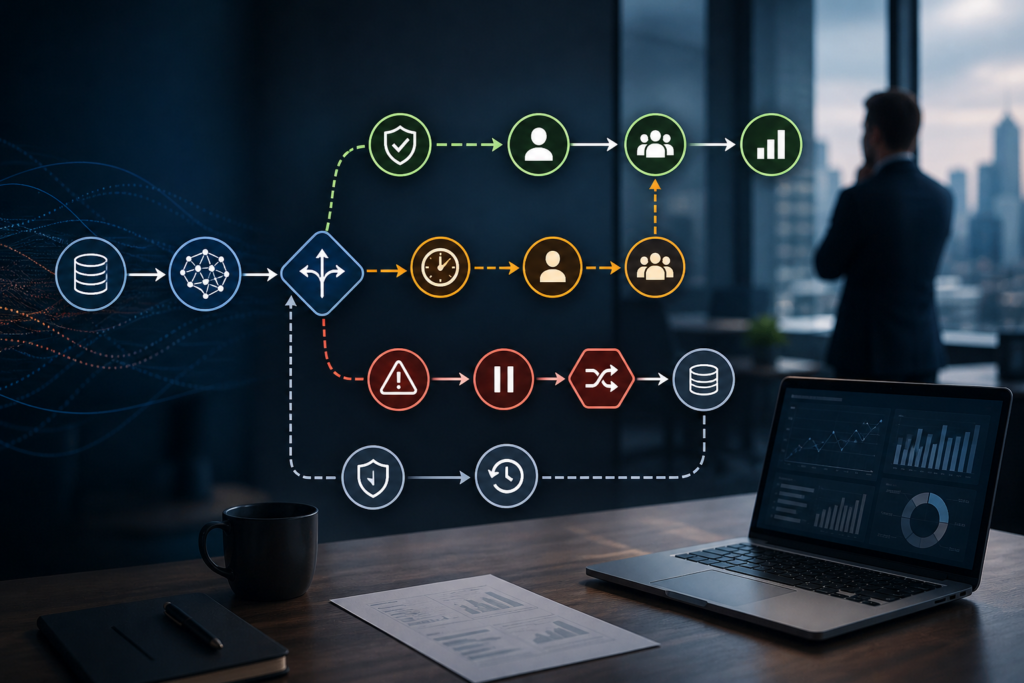
Thesis: A production AI system is not ready for the business until the organization knows how to reduce, pause, reroute, or reverse it without improvising during failure.
An AI rollback plan is the missing control layer in many production AI workflows. It is a documented operating plan for pausing, degrading, reverting, rerouting, or compensating for an AI workflow when its behavior becomes unreliable, unsafe, unavailable, or misaligned with business requirements.
That definition matters because rollback is often discussed too narrowly. In ordinary software, rollback may mean redeploying a previous application version. In machine learning operations, it may mean restoring a previous model version. In production AI workflows, that is not enough.
An AI workflow can fail because a model changed behavior, a prompt drifted, a retrieval index returned stale context, a connector timed out, a tool wrote the wrong record, a human reviewer missed evidence, or a vendor retired a model that the business depended on. If the workflow already sent messages, updated CRM fields, approved invoices, routed support cases, or changed customer state, reverting one model may leave the business problem untouched.
AI rollback planning is not a pessimistic exercise. It is the operating discipline that allows AI experimentation to become dependable business infrastructure.
What an AI rollback plan actually means
An AI rollback plan defines what happens when confidence drops below the level required for normal operation.
It answers practical questions before pressure rises:
- What gets paused?
- What keeps running in degraded mode?
- What moves to human review?
- What returns to a prior configuration?
- What downstream records must be corrected?
- Who has authority to trigger the change?
- What evidence must be preserved?
- What proves the workflow can resume?
This is where rollback differs from adjacent disciplines.
AI incident response handles the broader operating loop: detect, classify, contain, investigate, remediate, communicate, and learn. AI Incident Response Is the Missing Discipline covers that broader response problem. An AI rollback plan is a specific control within that loop. It defines how the workflow changes state when normal operation is no longer acceptable.
Observability records what happened. Evals test whether the system performs acceptably. Disaster recovery restores infrastructure after outages. Software rollback restores code. An AI rollback plan connects those pieces to business continuity.
NIST’s AI Risk Management Framework organizes AI risk work around govern, map, measure, and manage functions. Its Generative AI Profile adds guidance specific to generative AI risks. Those frameworks are useful because they push teams to treat AI risk as lifecycle work rather than a one-time approval. Rollback planning is one way to translate that lifecycle idea into an operational control.
The plan should be short enough to use during an incident and concrete enough to be tested before launch.
Why ordinary rollback is too small for production AI
Traditional rollback assumes the system state can return to a known good version. Production AI often breaks that assumption.
A support AI may retrieve the wrong refund policy and draft customer responses for two hours before anyone notices. A CRM enrichment workflow may write inaccurate firmographic data into hundreds of records. An invoice extraction system may misread line items after a prompt update. An internal knowledge assistant may cite an outdated procedure because a retrieval source was indexed incorrectly.
In each case, the failure involves more than the model.
| Control Type | What It Does | Where It Falls Short |
|---|---|---|
| Software rollback | Restores a previous code or deployment version | Does not correct AI-generated outputs already used by the business |
| Model rollback | Routes traffic to a prior model or model version | Does not fix prompts, retrieval, permissions, tool calls, or data side effects |
| Workflow rollback | Returns the process to a prior safe operating mode | Requires state tracking, fallback paths, ownership, and restart criteria |
| AI kill switch | Stops or disables part of the AI workflow quickly | Protects against further harm but may interrupt business continuity |
| Fallback path | Moves work to a simpler route, such as rules or human review | Requires capacity, training, and clear routing rules |
| Graceful degradation AI | Keeps lower-risk functions running while high-risk functions pause | Needs careful boundary design so reduced mode is still safe |
| Compensation | Corrects downstream actions already taken | Requires audit trails, affected-record detection, and business authority |
The uncomfortable truth is that many AI workflows are approved before the exit path exists.
That is not an engineering footnote. It is a business continuity problem.
The business stakes are bigger than uptime
AI can be available and still be wrong in ways that matter.
A dashboard may show healthy infrastructure. The API responds quickly. The queue drains. The model returns outputs. Yet the business process may be degrading because the AI is retrieving stale policy, calling a tool with the wrong argument, or generating answers that reviewers trust too easily.
For leaders, the business risk is not limited to a bad response. The risks include customer confusion, corrupted records, delayed operations, compliance exposure, rework, employee distrust, and unclear accountability.
Microsoft’s model lifecycle documentation is a useful reminder that vendor-hosted models can move through lifecycle stages, deprecation, replacement, and retirement. The exact dates and replacement paths vary by model and platform, but the operating lesson is stable: production teams should not treat vendor model availability as a permanent constant.
OWASP’s Top 10 for Large Language Model Applications highlights risks such as prompt injection, sensitive information disclosure, improper output handling, excessive agency, and unbounded consumption. Its agentic AI guidance pushes similar concerns into systems that can use tools, memory, and external integrations. Those risks are not solved by a rollback plan, but rollback planning reduces blast radius when a control fails.
A practical business metric is simple: how long can the workflow continue safely after the AI path becomes unreliable?
If the answer is “we would figure it out,” the system is not production-ready.
The technical reality behind an AI rollback plan
An AI rollback plan requires architecture that can change modes under stress.
For technical teams, that usually means versioning and control points across several layers:
- Model provider, model name, deployment version, and routing rules
- System prompts, prompt templates, examples, and policy instructions
- Retrieval indexes, document versions, chunking rules, filters, and freshness metadata
- Tool schemas, permissions, rate limits, arguments, retries, and idempotency rules
- Workflow state, queue state, approval state, and downstream write history
- Logs, traces, spans, timestamps, user identifiers, and affected-record identifiers
- Human review queues, escalation paths, and operational capacity
OpenTelemetry’s generative AI semantic conventions show where the ecosystem is heading: teams need consistent ways to observe model calls and related AI operations. Anthropic’s agent evaluation guidance also emphasizes transcripts, trajectories, tool calls, intermediate results, and environment outcomes when evaluating agent behavior. That same evidence is useful during rollback because it helps teams understand what changed, what was affected, and what can safely resume.
The deeper design issue is state.
If the workflow does not know where work is, what has already happened, which actions are reversible, and which records were touched, rollback becomes guesswork. That is why AI workflow rollback connects closely to AI Workflow State Machines: Implementation Guide. State machines make rollback more practical because they define valid states, transitions, retries, exceptions, and manual review paths.
The model should not be the workflow controller. The workflow should be able to reduce the model’s role when confidence drops.
A practical example: CRM enrichment gone wrong
Consider a sales operations workflow that uses AI to enrich CRM accounts.
The normal path looks simple. A new lead enters the CRM. The workflow retrieves company data, summarizes business fit, suggests industry and size fields, drafts a rep note, and writes low-risk enrichment fields automatically. Higher-risk updates route to review.
A model or prompt change improves some summaries but starts misclassifying subsidiaries as parent companies. The issue is subtle. No outage occurs. The workflow continues writing plausible but wrong account data.
A weak rollback plan says, “Go back to the previous model.”
That may help future outputs, but it does not answer the business problem:
- Which CRM records were changed?
- Which fields were touched by the AI workflow?
- Which prompt and retrieval sources were used?
- Did reps already act on the bad data?
- Should all enrichment now move to review?
- Can low-risk note drafting continue?
- Who approves bulk correction?
- What evidence proves the prior configuration is safe?
A stronger AI rollback plan has four moves ready.
First, disable automatic CRM writes while keeping drafting and summarization available for internal review.
Second, route new enrichment recommendations to a human queue with the affected fields highlighted.
Third, identify and quarantine records changed during the suspected window.
Fourth, restore the previous prompt and retrieval configuration only after replaying representative cases through evals.
That is workflow rollback. It protects continuity without pretending the only problem was the model.
Common mistakes that make rollback fail
The first mistake is treating an AI kill switch as the whole plan.
A kill switch is useful. It may be necessary when an AI system can take harmful actions, expose sensitive information, or create uncontrolled cost. But a kill switch is a stop control, not a continuity plan. If the business process depends on the AI workflow, someone must define what happens next.
The second mistake is assuming manual fallback capacity exists.
Many AI workflows are justified by labor savings. If the system is paused, the work does not vanish. It moves to employees, contractors, support queues, finance processors, or managers. A fallback path that requires 20 reviewers when only three are trained is a fiction.
The third mistake is rolling back the visible layer while leaving hidden state untouched.
A model rollback does not correct a poisoned retrieval index. A prompt rollback does not reverse records already written. A tool permission rollback does not explain which tool calls were harmful. A UI rollback does not fix reviewer overload.
The fourth mistake is restarting too quickly.
Google’s SRE material on canarying and release engineering is useful here because it reinforces gradual rollout, verification, and rollback when changes demonstrate problems. AI systems need the same release discipline, plus workflow-specific evidence. Restart criteria should include representative evals, affected-record review, monitoring checks, and business owner signoff.
The fifth mistake is failing to preserve evidence.
If logs are missing, privacy rules are unclear, or traces are incomplete, rollback becomes slower and riskier. AI Observability Is Automation’s Critical Control Layer is directly connected to this problem. You cannot roll back intelligently if you cannot reconstruct what the AI saw, retrieved, generated, called, approved, and changed.
The better mental model: operational gears, not one big switch
Leaders need a better mental model than “AI on” and “AI off.”
Think of production AI as a set of operational gears.
Normal mode is the highest-confidence gear. The AI performs its approved role under normal monitoring, eval coverage, permission boundaries, and human review rules.
Reduced mode narrows scope. The system may still summarize, classify, or draft, but it stops sending, approving, purchasing, deleting, or writing to systems of record.
Review mode routes outputs to humans before action. This protects customers and records while preserving some productivity.
Fallback mode moves work to rules, templates, deterministic automation, or manual handling.
Stopped mode disables the AI path entirely for the affected workflow, tool, segment, customer population, or data source.
Compensation mode corrects downstream side effects that already occurred.
This model lets the organization choose the smallest safe reduction rather than jumping between blind trust and full shutdown.
| Operating Gear | Business Meaning | Typical Trigger |
|---|---|---|
| Normal | AI performs approved tasks within defined controls | Metrics, evals, and review outcomes remain within limits |
| Reduced | AI handles lower-risk assistance only | Quality drift, latency, uncertainty, vendor change, or limited incident signal |
| Review | AI output requires human approval before action | Customer exposure, sensitive data, financial effect, or unclear confidence |
| Fallback | Work moves to rules, templates, or manual process | AI path unavailable or no longer trustworthy |
| Stopped | AI workflow is paused for the affected scope | High-severity incident, uncontrolled tool use, data exposure, or broad uncertainty |
| Compensation | Team repairs actions already taken | Incorrect writes, messages, approvals, routing, or financial actions |
This is how rollback becomes a management system rather than an emergency button.
What leaders should require before production approval
An AI rollback plan should be a launch gate for production AI workflows that affect customers, money, records, compliance, operations, or external communications.
Leaders do not need to review every technical detail. They do need proof that the workflow can be operated when behavior changes.
A practical pre-launch checklist should include:
- Named business owner for rollback decisions
- Named technical owner for execution
- Clear rollback triggers tied to business impact
- Safe previous configurations for model, prompt, retrieval, and permissions
- Ability to disable specific tools without taking down unrelated functions
- Human review capacity for reduced or review mode
- Evidence capture for prompts, retrieval, model calls, tool calls, approvals, and writes
- Affected-record detection for downstream actions
- Vendor dependency plan for outage, retirement, migration, or degraded latency
- Communication path for support, operations, legal, security, and executives
- Restart criteria based on evals, monitoring, incident review, and owner approval
This is not bureaucracy. It is the cost of connecting probabilistic systems to real business processes.
What builders should verify before scaling
Engineering and product teams should treat rollback as an architectural requirement.
Before expanding an AI workflow, builders should verify whether they can answer these questions without heroic investigation:
- Can we route traffic between model versions or providers if needed?
- Can we restore a previous prompt and know which outputs used each prompt?
- Can we identify the retrieval documents and chunks used for a specific output?
- Can we disable a tool, connector, action, or permission independently?
- Are downstream writes idempotent where possible?
- Can we detect duplicate, partial, failed, or excessive tool calls?
- Can we replay known failures in a test or evaluation environment?
- Can we move work to a human queue with enough context for review?
- Can we identify all records touched by the AI workflow during a time window?
- Can we restart gradually rather than all at once?
This is where AI Workflow Exception Handling: Reliable Recovery Patterns becomes important. Retries, dead-letter queues, idempotency, escalation, and compensation are not separate from rollback. They are the mechanics that let rollback work.
OpenAI’s evaluation guidance emphasizes testing with production-like inputs and growing eval sets over time. That matters because rollback criteria should be tested against cases that resemble real operations, not only clean examples.
The decision leaders should make now
The best time to design an AI rollback plan is before the AI workflow becomes invisible.
Once employees depend on it, customers experience it, and downstream systems trust it, rollback becomes harder. People forget the old process. Manual capacity disappears. Exceptions pile up. The AI path becomes the only path.
That is how an experiment becomes operational debt.
AI rollback plans do not make production AI risk-free. They do something more practical. They make risk governable. They give the business a way to reduce autonomy without losing the whole process, preserve evidence without freezing every team, and restart based on proof rather than optimism.
The organizations that scale AI well will not be the ones that assume failure disappears. They will be the ones that know exactly how the business keeps moving when the AI path has to step back.
Key Takeaways
- An AI rollback plan is a business continuity control for production AI workflows, not merely a model-version revert.
- Production AI rollback must account for prompts, retrieval, tool permissions, workflow state, human review, downstream writes, and vendor dependencies.
- A kill switch is useful, but it does not replace fallback paths, compensation steps, review capacity, or restart criteria.
- Leaders should require rollback planning before approving AI workflows that affect customers, records, money, compliance, or operations.
- Technical teams need versioning, observability, state tracking, tool boundaries, idempotency, and affected-record detection.
- The better operating model is a set of gears: normal, reduced, review, fallback, stopped, and compensation.
- Restarting after rollback should require evidence from evals, monitoring, incident review, and business owner approval.
Practical Decision Framework
Use this framework when deciding whether a production AI workflow needs a formal AI rollback plan and how strong that plan should be.
| Decision Area | Low-Risk Signal | Higher-Risk Signal | Required Rollback Capability |
|---|---|---|---|
| Customer exposure | Internal draft only | Customer-facing response, recommendation, or action | Review mode, pause authority, communication path |
| Data sensitivity | Public or low-sensitivity data | Customer, employee, financial, legal, regulated, or confidential data | Evidence controls, redaction rules, access limits |
| Autonomy | AI recommends only | AI sends, writes, approves, deletes, purchases, or triggers tools | Tool kill switch, permission rollback, affected-record detection |
| Reversibility | Easy to correct | Costly, slow, or impossible to reverse | Human approval, compensation plan, executive escalation |
| Business dependency | Optional productivity aid | Workflow employees or customers depend on | Manual fallback capacity, queue design, service-level expectations |
| Vendor dependency | Stable internal component | Hosted model, external API, connector, or model lifecycle risk | Provider contingency, model routing, migration plan |
| Evidence quality | Full trace available | Limited logs or missing identifiers | Observability work before scale |
| Restart confidence | Fix can be tested clearly | Cause uncertain or hard to reproduce | Gradual restart, eval replay, monitoring threshold, owner signoff |
A simple rule is useful: if an AI workflow can change records, influence customers, route money, expose sensitive information, or interrupt operations, it deserves a tested rollback plan before scale.
FAQ
What is an AI rollback plan?
An AI rollback plan is a documented operating plan for pausing, degrading, reverting, rerouting, or compensating for a production AI workflow when its behavior becomes unreliable, unsafe, unavailable, or misaligned with business requirements. It covers more than model rollback because production AI depends on prompts, retrieval, tools, permissions, state, approvals, and downstream actions.
How is an AI rollback plan different from AI incident response?
AI incident response is the broader process for detecting, classifying, containing, investigating, remediating, communicating, and learning from AI failures. An AI rollback plan is a specific control within that process. It defines how the workflow changes operating mode when normal operation is no longer safe or reliable.
Does every AI workflow need a rollback plan?
No. A low-risk personal productivity assistant may not need a formal plan. A production AI workflow that touches customers, systems of record, sensitive data, money, compliance, external communications, or operational decisions should have one. The more autonomy and irreversibility the workflow has, the stronger the rollback plan should be.
What should trigger an AI rollback?
Useful triggers include quality drift, repeated human overrides, customer-impacting errors, data exposure, prompt injection, stale retrieval, tool misuse, vendor outage, unexpected cost spikes, latency that breaks operations, failed evals, or uncertainty about the affected scope. Triggers should be tied to business impact rather than technical metrics alone.
Who should own AI rollback decisions?
Ownership should be shared and explicit. A business owner should have authority over customer, operational, and continuity tradeoffs. A technical owner should execute the rollback safely. Security, legal, compliance, support, and operations should be included when the workflow affects their risk areas.
How do teams roll back irreversible AI-assisted actions?
They usually cannot truly roll them back. They compensate. That may mean identifying affected records, correcting data, notifying customers, reversing financial entries, reopening cases, changing workflow state, or documenting the remediation. Irreversible actions should require stricter approval, better evidence capture, and narrower AI authority before launch.
Sources
- NIST AI Risk Management Framework 1.0: https://nvlpubs.nist.gov/nistpubs/AI/NIST.AI.100-1.pdf
- NIST Generative AI Profile: https://nvlpubs.nist.gov/nistpubs/ai/NIST.AI.600-1.pdf
- OWASP Top 10 for Large Language Model Applications: https://owasp.org/projects/top-10-for-large-language-model-applications
- OWASP Agentic AI Threats and Mitigations: https://genai.owasp.org/resource/agentic-ai-threats-and-mitigations/
- Google SRE Workbook on Canarying Releases: https://sre.google/workbook/canarying-releases/
- Google SRE Book on Release Engineering: https://sre.google/sre-book/release-engineering/
- OpenTelemetry GenAI Semantic Conventions: https://github.com/open-telemetry/semantic-conventions-genai
- Microsoft Foundry Models Lifecycle and Support Policy: https://learn.microsoft.com/en-us/azure/foundry/openai/concepts/model-retirements
- Microsoft Foundry Model Retirement Schedule: https://learn.microsoft.com/azure/foundry/openai/concepts/model-retirement-schedule
- Anthropic Demystifying Evals for AI Agents: https://www.anthropic.com/research/demystifying-evals-for-ai-agents
- OpenAI Evaluation Best Practices: https://developers.openai.com/api/docs/guides/evaluation-best-practices
Related articles from Kyle Beyke
- AI Incident Response Is the Missing Discipline: https://beykeworkflows.com/ai-incident-response-governance-operations/
- AI Observability Is Automation’s Critical Control Layer: https://beykeworkflows.com/ai-observability-business-automation-control-layer/
- AI Workflow Exception Handling: Reliable Recovery Patterns: https://beykeworkflows.com/ai-workflow-exception-handling-patterns/
- AI Workflow State Machines: Implementation Guide: https://beykeworkflows.com/ai-workflow-state-machines-practical-guide/